skip to main |
skip to sidebar
I wrote down 'xacuti biryani' as my X dish while listing recipes for this marathon without putting much thought into it even if there was no such traditional recipe. I have done enough A - Z marathons based on Indian cooking to know that the only authentic 'X' dish one can find in the cuisine would be a xacuti unless if someone uses prefixes like 'X-mas' or throw in some adjectives before the name of the dish. Xacuti or shagoti is a curry from the Goan cuisine that is said to be originated in the present day Arambol, a traditional fisherman village. The fisherman in the past used to get a fresh catch of fish or local chicken and prepare a gravy made with a paste of local spices and coconut that has now become popular through out the state. The dish of course can easily be converted into a vegetarian version and the spicy xacuti masala can brighten up the vegetarian dishes as shown in my xacuti vegetable curry and the xacuti masala rice.
My husband was away for the week when I made this pulao. I started making a biryani and halfway went through pulao route as I did not think it was worth the effort when cooking for one and it covered my next three meals. There is a unique spice powder involved in the xacuti preparation and I borrowed Sanjeev Kapoor's recipe this time which I have provided below. Another version of xacuti masala can be found at the link I provided above. I replaced the garam masala with the xacuti spice masala here and the strong flavor of the ground spices and coconut is unmistakably prominent. Start with adding half of the spice powder, taste and then add extra if preferred. The whole amount of spice powder for this pulao would make it very potently spicy though not in terms of heat. I replace the meat part in non veg biryani / pulaos with soy chunks blindly as they win over paneer hands down any time in my home. One can use paneer, tofu, mushroom or go with some extra vegetables instead of soychunks in the recipe.
 Ingredients for spice powder:
1/4 cup coconut
1 tsp. coriander seeds
1/4 tsp. cumin seeds
1/4 tsp. fennel seeds
1/4 tsp. carom seeds
1/2 tbsp. poppy seeds
1/2 inch piece cinnamon
2 black pepper corns
1 star anise
1 dried red chili
1 clove
Ingredients for spice powder:
1/4 cup coconut
1 tsp. coriander seeds
1/4 tsp. cumin seeds
1/4 tsp. fennel seeds
1/4 tsp. carom seeds
1/2 tbsp. poppy seeds
1/2 inch piece cinnamon
2 black pepper corns
1 star anise
1 dried red chili
1 clove
Ingredients for pulao: (Yield 3 servings)
1 tbsp. ghee
1 tsp. cumin / caraway seeds
2 cloves
1 black cardamom
1 inch piece of cinnamon
1 bay leaf
1 onion, finely minced
1/2 tsp. ginger paste
1 cup soy chunks (Substitute extra vegetables or paneer.)
1 potato, peeled and cubed
1 carrot, peeled and diced
12 beans, cut into 1 inch pieces
Xacuti spice powder as needed
1/8 tsp. turmeric powder
1.5 tsp. salt or as needed
1/2 cup basmati rice
3/4 cup water
Minced cilantro to garnish
 Directions for spice powder:
* Toast coconut on low flame until golden brown. Transfer it onto a plate.
* To the same pan, add coriander seeds, cumin seeds, fennel seeds and carom seeds. Continue to toast on medium flame and when coriander seeds start to brown, add poppy seeds, cinnamon, peppercorns, star anise, red chili and clove. Toast until coriander browns and turn off the stove.
* Transfer the contents to the coconut plate and let them cool.
* Grind them together to a fine powder.
* Store it in an airtight container and use as needed.
Directions for spice powder:
* Toast coconut on low flame until golden brown. Transfer it onto a plate.
* To the same pan, add coriander seeds, cumin seeds, fennel seeds and carom seeds. Continue to toast on medium flame and when coriander seeds start to brown, add poppy seeds, cinnamon, peppercorns, star anise, red chili and clove. Toast until coriander browns and turn off the stove.
* Transfer the contents to the coconut plate and let them cool.
* Grind them together to a fine powder.
* Store it in an airtight container and use as needed.
 Directions:
* Soak soy chunks in water if using.
* Heat ghee directly in a small sized pressure cooker. Add cumin / caraway seeds, cloves, cardamom, cinnamon and a bay leaf. When the cumin seeds start to brown, add onion and saute until golden brown.
* Add ginger and saute until the raw smell leaves.
* Wash and drain the rice. Add rice, chopped vegetables, xacuti spice powder as needed (don't add the whole amount), turmeric and salt. Saute for a minute.
* Squeeze the water from the soy chunks and add them to the cooker. Finally add water and stir gently.
* Pressure cook the rice mixture for 3 whistles. Wait for few minutes until the valve pressure is gone.
* Fluff the rice gently and garnish with cilantro. I sprinkled some fried onions as well.
* Serve it with plain yogurt / raita.
Directions:
* Soak soy chunks in water if using.
* Heat ghee directly in a small sized pressure cooker. Add cumin / caraway seeds, cloves, cardamom, cinnamon and a bay leaf. When the cumin seeds start to brown, add onion and saute until golden brown.
* Add ginger and saute until the raw smell leaves.
* Wash and drain the rice. Add rice, chopped vegetables, xacuti spice powder as needed (don't add the whole amount), turmeric and salt. Saute for a minute.
* Squeeze the water from the soy chunks and add them to the cooker. Finally add water and stir gently.
* Pressure cook the rice mixture for 3 whistles. Wait for few minutes until the valve pressure is gone.
* Fluff the rice gently and garnish with cilantro. I sprinkled some fried onions as well.
* Serve it with plain yogurt / raita.
 So far in my Biryani / Pulao / Khichdi series,
A - Ambur Biryani
B - Basanti Pulao / Misthi Pulao
C - Corn - Fenugreek Greens Pulao
D - Donne Biryani
E - Ek Toap na Dal Bhaat
F - Fada ni Khichdi
G - Gutti Vankaya Biryani
H - Hyderabadi Vegetable Dum Biryani
I - Iyengar Puliyogare
J - Jaipuri Mewa Pulao
K - Kashmiri Pulao
L - Lucknowi Biryani
M - Motiwale Pulao
N - Nei choru
O - Oodhala Pulao
So far in my Biryani / Pulao / Khichdi series,
A - Ambur Biryani
B - Basanti Pulao / Misthi Pulao
C - Corn - Fenugreek Greens Pulao
D - Donne Biryani
E - Ek Toap na Dal Bhaat
F - Fada ni Khichdi
G - Gutti Vankaya Biryani
H - Hyderabadi Vegetable Dum Biryani
I - Iyengar Puliyogare
J - Jaipuri Mewa Pulao
K - Kashmiri Pulao
L - Lucknowi Biryani
M - Motiwale Pulao
N - Nei choru
O - Oodhala Pulao
 Check out the Blogging Marathon page for the other Blogging Marathoners doing BM#99.
I initially thought of including some international recipes in my list to pull off the difficult alphabets in the series and checked with Srivalli, the BM coordinator to see whether I can do so. There was a choice of going with a series of completely either Indian or International biryani / pulao / khichdis for this marathon but not a mix and match kind stuff from both, she confirmed. I chose to go with Indian rice dishes and so was in two minds about trying this biryani as my 'S' dish. Sindhi biryani has become a part of Pakistani cuisine since it is said to have originated in the Sindh province there. However this dish with the Mughalai touch obviously must have originated in India centuries ago and is not a recent creation.
This meat and potato based biryani seems to be a quite popular one in Pakistan in general and in the Sindhi community in particular which resides on both sides of the border. In fact it is so popular in Pakistan that it is served in most of the flights of 'Pakistan International Airlines'. What sets this biryani apart from the other regional versions is it being on a spicier and zesty side and also the proportion of masala to the rice used being slightly more. The usage of khatta dahi / sour tasting yogurt, generous amount of chilies and spices, mint, and tangy aloo bukhara (dried plums / prunes) are the prominent features of this biryani. The biryani is layered and cooked in dum style. I substituted soy chunks for meat and pressure cooked it for a quicker version.
Ingredients to marinate:
1/2 cup soy chunks
1/4 cup yogurt
2 tsp. mustard oil
Salt to taste
1/4 tsp. red chili powder
1/2 tsp. ginger - garlic paste
Ingredients to fry:
Oil as needed
1/2 cup thinly sliced onions
1 big potato, peeled and cubed
Other ingredients:
1 tbsp. warm milk + a pinch of saffron strands
1/2 cup basmati rice
4 dried plums / prunes
1 tbsp. ghee / oil
1 tsp. cumin seeds / caraway seeds
2 pepper corns (optional)
1 or 2 red chilies
2 cloves
2 cardamom
1 inch piece cinnamon
1 bay leaf
1/2 cup chopped onion
1 inch piece grated ginger / ginger paste
1/2 tsp. garlic paste (I didn't use any.)
1 tomato, chopped
1 green chili (or use as needed)\
1/8 tsp. turmeric powder
Chili powder if needed (I didn't use any)
2 tbsp. mint - cilantro leaves
1 and 1/4 tsp. salt or to taste
3/4 cup water
 Prep work:
1. Combine all the ingredients mentioned under 'to marinate' in a bowl while doing the frying part or until they are needed.
2. I advise against soaking dried prunes since they turn mushy when cooked. I instead chopped each into 3 or 4 pieces since they are big and added them at the end.
3. Mix warm milk and saffron in a small bowl and keep aside.
Prep work:
1. Combine all the ingredients mentioned under 'to marinate' in a bowl while doing the frying part or until they are needed.
2. I advise against soaking dried prunes since they turn mushy when cooked. I instead chopped each into 3 or 4 pieces since they are big and added them at the end.
3. Mix warm milk and saffron in a small bowl and keep aside.
Directions:
* Heat about 1/4 cup oil in a small pan, add onion slices and fry them until golden brown. Take care not to burn them, by stirring continuously. (I did the shallow frying but they can be deep fried.) Remove the fried onions with a slotted spoon and place them on a paper towel lined plate. Potatoes can be fried for a couple of minutes or fully at this point.
* Heat 1 or 2 tbsp. oil directly in a small pressure cooker or a pan. Add cumin seeds, pepper corns, red chilies, cloves, cardamom, cinnamon and bay leaf. Saute for few seconds and add 1/2 cup chopped onion. Fry until they turn pink.
* Next add ginger - garlic paste, green chilies and saute for few seconds. Add tomatoes, turmeric, mint and cilantro leaves, chili powder if using to the pan and cook until tomatoes soften. Next add prunes, soy chunks along with the marinade, salt and rice (that is washed and drained). Saute for about a minute and add 3/4 cup water and the saffron milk. Close the lid and pressure cook for three whistles.
* If using a pan and not using a pressure cooker, then bring the mixture to a boil and close the lid. Cook on low flame until rice is cooked, for about 15 - 20 minutes and turn off the stove.
So far in my Biryani / Pulao / Khichdi series,
A - Ambur Biryani
B - Basanti Pulao / Misthi Pulao
C - Corn - Fenugreek Greens Pulao
D - Donne Biryani
E - Ek Toap na Dal Bhaat
F - Fada ni Khichdi
G - Gutti Vankaya Biryani
H - Hyderabadi Vegetable Dum Biryani
I - Iyengar Puliyogare
J - Jaipuri Mewa Pulao
K - Kashmiri Pulao
L - Lucknowi Biryani
Check out the Blogging Marathon page for the other Blogging Marathoners doing BM#99.
I already have a Hyderabadi version qabooli on my blog and so it was going to be a Jodhpuri version this time, I thought when planning for my 'Q' recipe this month. I cooked this week's dishes well ahead except for the qabooli for the lack of good pomegranates here locally. I waited all through the end of fall, then winter and now through these early days of spring which by the way looks more like winter considering that I had a full day blast of snow early this week. The poor husband kept bringing whatever pomegranates he could lay his hands on during these months. The sorry looking fruits had arils looking like someone sat leisurely and leeched off the color without missing even a single one. Kashmiri pulao was done without them but not qabooli, I decided.
 Biryani and pulao names kept piling up when I started listing the dishes for this marathon. Khichdis were almost like last minute addition to justify the title of this marathon's theme. I came across a version of 'Panchkuti dal khichdi' after I cooked 'Pariba khechudi' and it got bookmarked to try later. When the qabooli didn't happen, I cooked it using quinoa. I am not sure if this khichdi belongs to a particular region. There was a Sanjeev Kapoor recipe with rice version which suggested that it may be from the western regions of India. Another recipe floating around the web is a millet based one, seemingly one from Himachali cuisine. I am sure both taste yummy and are wholesome. I have been eating quinoa for years and love it in khichdi consistency dishes. And so this combo was a 'match made in heaven' to me.
 This khichdi uses five different varieties of lentils as the Rajasthani panchmel dal
.
Toor dal, Moong dal in both yellow and green colors, masoor dal and chana dal feature in this recipe. One can keep the grain and lentil ratio equal or go with a slightly higher lentil ratio to rice. Soaking some of the lentils for an hour or two before cooking will ensure that all lentils and rice are cooked at the same time, qualifying it to be a quick one pot meal. Use whatever grain that is preferred in your home to prepare this khichdi - millet, oats, quinoa, rice and also any combo of lentils you have on hand. The final result would be a khichdi that is still delicious, nutritious and filling. One can soak the lentils the previous night or use any pre- soaked ones to make it a quicker meal option to cook during morning rush. This version doesn't even involve any vegetables and so can be a cooked as a quick lunch box item or a meal that needs no side dishes and can be served on it's own. I didn't feel the lack of veggies in the khichdi but one can always add them to make it wholesome. Serve it warm with some spicy pickle / achaar and yogurt to make it a wholesome meal.
Ingredients: (yield 2 servings)
1/4 cup quinoa / rice / millets
1 tbsp. split yellow peas / chana dal
1 tbsp. green gram / sabut moong dal
1 tbsp. pigeon peas / toor dal
1 tbsp. yellow moong dal
1 tbsp. red lentils / masoor dal
1.5 cups water (divided)
1/8 tsp. turmeric powder
1 tsp. salt
Ingredients for tempering:
2 tbsp. ghee and /or oil
1 tsp. mustard seeds
1 tsp. cumin seeds
2 cloves
1/4 tsp. crushed black pepper (Use whole pepper corns if you prefer them that way.)
1 inch piece cinnamon stick
2 green or dried red chillies
Directions:
* Wash and soak yellow split peas, pigeon peas and green gram in water for about 1 to 2 hours. Drain the water and keep aside.
* Rinse quinoa with water thoroughly and drain. Rinse moong dal and red lentils in two changes of water and drain.
* Pressure cook together quinoa, lentils, and turmeric adding a cup of water, for 3 whistles. (I usually avoid adding salt since pigeon peas are not cooked well.)
* Heat ghee in a small pan for tadka / tempering. When it melts, add all the other ingredients mentioned under 'tempering'. Turn off the stove when mustard seeds start to splutter.
* Remove the cooker lid when the valve pressure is gone. Add salt and 1//2 cup water to the cooked quinoa mixture. Stir well and check the consistency of the khichdi. Add extra water if a thinner consitency khichdi is prefeered. Add the tempering and mix well.
* Turn on the stove and let the mixture simmer for few minutes.
* Turn off the stove and serve the khichdi warm with achaar, papad and yogurt to make it a wholesome meal.
Note:
The tempering can be done initially, directly in the pressure cooker before adding quinoa and lentils and cooked together.
So far in my Biryani / Pulao / Khichdi series,
A - Ambur Biryani
B - Basanti Pulao / Misthi Pulao
C - Corn - Fenugreek Greens Pulao
D - Donne Biryani
E - Ek Toap na Dal Bhaat
F - Fada ni Khichdi
G - Gutti Vankaya Biryani
H - Hyderabadi Vegetable Dum Biryani
I - Iyengar Puliyogare
J - Jaipuri Mewa Pulao
K - Kashmiri Pulao
L - Lucknowi Biryani
Check out the Blogging Marathon page for the other Blogging Marathoners doing BM#99.
Nei choru is a mildly spiced, richly flavored ghee rice version from Kerala / Malabar regions. Nei choru literally means ghee rice and the dish is cooked in a base of ghee, making it an aromatic and flavor loaded one. Ghee rice is a savory rice preparation which is popular in southern parts of India albeit with minor regional variations. Khuska or kuska rice is a similar dish that includes mint and cilantro as well in the preparation. Ghee rice is even reserved for celebratory occasions and it has been a popular choice in the region for years, especially for vegetarians, when picking a simple yet rich tasting dish for parties, small or big.
 I started cooking for this marathon with nei choru since it was a simple dish to start with before plunging into the world of layered biryanis. I remember enjoying it very much in spite of it's simplicity. If not a fan of elaborate, time and energy consuming biryani preparations which have a laundry list of ingredients and steps, then this would be the basic version to try without getting intimidated. Ghee rice provides a very delicious base for spicy curries, kormas or even dals. A short variety, aromatic rice called jeerakasala / jeerakasamba / kaima that needs no prior soaking is the preferred choice of rice in the Malabar regions to prepare ghee rice. Basmati rice would be a great substitute if not able to find the mentioned rice. Keralites seem to pair ghee rice with non veg versions but this parippu curry was one of the suggested side dishes for the vegetarian folks. The pairing sounded so unusual initially but after tasting it, I have to admit that this combo go real well.
 Ingredients:
1 cup rice*
4 to 6 tsp. ghee (One can use more.)
1/4 cup cashews and raisins
1 cup peeled and sliced onions (divided)
2 cardamom pods
2 cloves
1 inch cinnamon piece
1 bay leaf
1 and 3/4 cup water
salt to taste
* A short grained rice called jeerakasala is used locally but basmati rice can be substituted in it's place.
Ingredients:
1 cup rice*
4 to 6 tsp. ghee (One can use more.)
1/4 cup cashews and raisins
1 cup peeled and sliced onions (divided)
2 cardamom pods
2 cloves
1 inch cinnamon piece
1 bay leaf
1 and 3/4 cup water
salt to taste
* A short grained rice called jeerakasala is used locally but basmati rice can be substituted in it's place.
Directions:
1. Wash and soak rice in water for about 10 minutes. Drain and keep aside.(This step is optional. No need to worry if you forgot.)
2. Heat 2 tsp. ghee in a pan and or directly in a small pressure cooker. Add cashews and toast on medium flame until golden brown. Don't burn them. Remove them with a slotted spoon onto a small plate. Add raisins next and toast them (by shaking the pan so that they are evenly toasted) until they turn plump. Remove them with a slotted spoon onto the cashew plate. Next add half of the onions and 2 tsp. ghee (I added oil here.) and saute on medium flame until they turn golden brown, stirring continuously. This is the only step in the recipe that calls for some attention. We want the onions turn golden brown with sweet flavor. Don't saute on high flame or don't leave the onions unattended since they can burn easily and would turn bitter and not suitable to use in the dish. Transfer the onions to another bowl.
3. Add the remaining ghee to the pan / cooker and add cardamom, cloves, cinnamon and bay leaf. Saute them for few seconds and add the remaining onion slices and. Saute until translucent.
Next add rice, water and salt. Mix well and taste the water. It should be a little on the salty side. If using pressure cooker, close the lid and cook for 3 whistles. If using a pan, add 1/4 cup more water than the quantity mentioned in the ingredients' list. Cover and cook on low flame, without keeping peeking into the dish until done, about 20 minutes.
4. Steps 2 and 3 can be done simultaneously using two different pans, to cut down the cooking time.
5. Garnish with raisins, cashews and fried onions. Serve warm with any Kerala style coconut based curry / parippu curry. (Recipe here.)
 So far in my Biryani / Pulao / Khichdi series,
A for Ambur Biryani
B for Basanti Pulao / Misthi Pulao
C for Corn - Fenugreek Greens Pulao
D for Donne Biryani
E for Ek Toap na Dal Bhaat
F for Fada ni Khichdi
G for Gutti Vankaya Biryani
H for Hyderabadi Vegetable Dum Biryani
I for Iyengar Puliyogare
J for Jaipuri Mewa Pulao
K for Kashmiri Pulao
L for Lucknowi Biryani
So far in my Biryani / Pulao / Khichdi series,
A for Ambur Biryani
B for Basanti Pulao / Misthi Pulao
C for Corn - Fenugreek Greens Pulao
D for Donne Biryani
E for Ek Toap na Dal Bhaat
F for Fada ni Khichdi
G for Gutti Vankaya Biryani
H for Hyderabadi Vegetable Dum Biryani
I for Iyengar Puliyogare
J for Jaipuri Mewa Pulao
K for Kashmiri Pulao
L for Lucknowi Biryani
Check out the Blogging Marathon page for the other Blogging Marathoners doing BM#99.
Here is a quick and tasty pulao made with juicy, succulent corn and my personal favorite, fenugreek greens aka methi. This pulao can be made with corn alone if preferred or replace the greens in the recipe with other vegetables like potato / capsicum / peas or even soy chunks or paneer. I like the combo of corn and fenugreek where the strong flavor of the latter is balanced by the hint of sweetness from corn kernels.
The recipe again is made to serve two adults. My son is away at college while my daughter won't touch these rice dishes with a barge pole. There was no point in making large servings though the recipe below can be doubled or tripled easily. I used fresh corn to make this pulao. This can be a quick lunch box recipe and if one has cooked basmati rice or leftover rice, this can be prepared in a short time. I cooked rice separately since I did want my corn to retain some bite. I have given both methods of cooking below. This is a kid - friendly recipe and one can add green chillies as needed. The chillies I used here were hot. This can be served with a spicy raita if the pulao is mildly hot. Or it can be made more spicier by adding more chillies and can be served with plain yogurt.
Ingredients: (Yield - 2 servings)
1/2 cup Basmati rice
1 cup or more roughly chopped fenugreek greens / methi
1 cup corn kernels (I used one ear of corn.)
2 tbsp. oil
1 tsp. cumin or caraway seeds (jeera / shahjeera)
2 cardamom pods
2 cloves
2 one inch piece cinnamon
1 bay leaf
1 star anise
2 or more spicy green chillies
1 big onion
1 tsp. ginger - garlic paste or grated ginger - chopped garlic
1.5 tsp. salt
3/4 cup water
Prep work:
1. If using fresh corn, peel off the husks and the silky threads. Use a sharp knife to cut down along the cob, to remove kernels.
2. Thinly slice the onions and green chillies.
3. Wash and roughly chop the fenugreek greens.
This is what I did:
1. Rinse the rice in two or three changes of water and pressure cook for 3 whistles adding 3/4 cup water. (I didn't soak the rice in water before cooking.) Let it sit for few minutes after the valve pressure is gone.
2. Heat oil directly in a pressure cooker or a pan. Add cumin / caraway seeds. When they brown, add cloves, cardamom, cinnamon, bay leaf, star anise and saute for 30 seconds. Add green chillie, onion and salt. Saute until onion is cooked to golden brown. Then add garlic - ginger paste and saute until raw smell disappears.
3. Next add chopped fenugreek greens and corn. Saute the vegetables until the fenugreek greens is cooked well, about 5 to 7 minutes. By the time corn would be done as well with very slight bite to it.
4. Next add the cooked rice and if it is still warm, leave it for few minutes. Gently fluff it with a fork or spoon and mix gently to combine. Let it sit for few minutes for the flavors to mingle.
This is how it is usually done:
1. Rinse and soak the rice in water and keep it aside.
2. Heat oil directly in a pressure cooker or a pan. Add cumin / caraway seeds. When they brown, add cloves, cardamom, cinnamon, bay leaf, star anise and saute for 30 seconds. Add green chillie, onion and salt. Saute until onion is cooked to golden brown. Then add garlic - ginger paste and saute until raw smell disappears.
3. Next add chopped fenugreek greens and corn. Saute the vegetables for a couple of minutes.
4. Drain the rice and add it along with 3/4 cup of water.
5. a) If using pressure cooker, cook for 3 whistles and turn off the stove. When the valve pressure is gone, fluff and serve.
b) If the pulao is being cooked in a pan instead of a cooker, add 1/4 cup more water. Cover and cook on low flame until rice is done, about 18 - 20 minutes. Taste and see whether rice is cooked. If the rice is not cooked yet, sprinkle some water and let it cook for some more time.
c) If you don't want to brown the bottom of the pressure cooker by directly cooking in it, a pan can be used to cook until step 4 and the contents can be transferred to a pressure cooker or a electric rice cooker and finish cooking.
So far in my Biryani / Pulao / Khichdi series,
A for Ambur Biryani
B for Basanti Pulao / Misthi Pulao
Check out the Blogging Marathon page for the other Blogging Marathoners doing BM#99
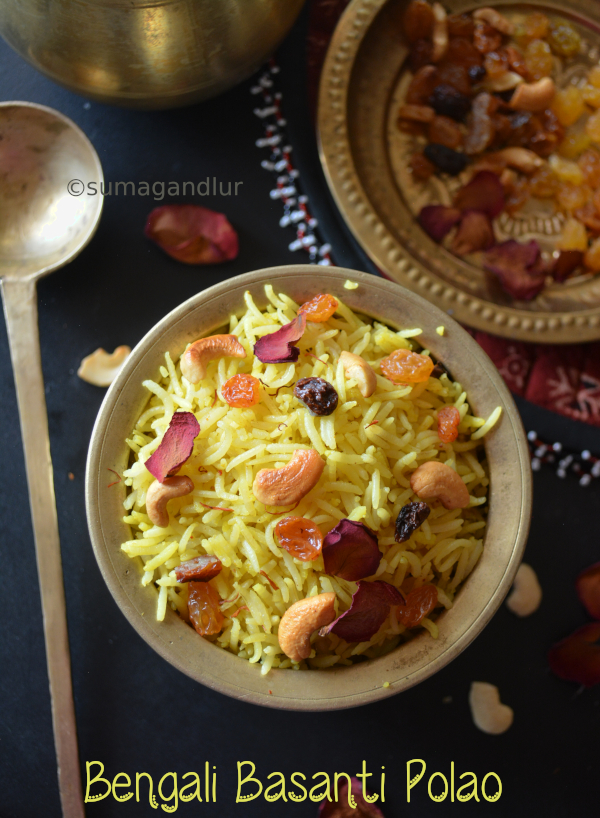
Many basic versions of pulao exist in Indian regional cuisine that pair well with a spicy curry or gravy. Most of them sound similar and vary very minutely and today's basanti polao is one such dish. Yes, it's not a typo. It's called polao instead of pulao. It is a specialty from the Bengal region and is usually reserved there for auspicious occasions like Durga pooja, new year celebration and so on. The word 'basanti' has nothing to do with basant, the spring season but stands for the polao's bright yellow color. The rice is also called holud polao for the same reason. This rice delicacy is called misthi polao as well since it is on the sweeter side unlike the regular pulao dishes.
It is usually served with a spicier side dish to balance out the sweetness from the polao. The use of saffron lends a yellow tinge to the dish and food color is added as well for the yellow color of the pulao but not turmeric, according to some Bengali food bloggers. (I am not a fan of food colors to be honest and turmeric is of course an healthier choice. The bloggers were mentioning that one should not feel the whiff of turmeric from the dish.)
 It is distinctly yellow in color, subtly rose flavored and unmistakably sweeter. Not enough sweeter that it can be served as a dessert on it's own but sweet enough to put it apart from the savory versions. If one is counting calories then feel free to decrease the quantity or totally skip the sugar even if purists may scoff at the suggestion since it may no longer be called a misthi polao.
Bengalis use a locally cultivated rice called Gobindobhog rice which is a short grain, sticky and aromatic rice. The rice supposedly imparts an inviting aroma and flavor to this rice delicacy. I used aged Basmati rice instead. The addition of rose water lifts the flavor of the dish. The dish is subtly spicy and serves as a base for spicy curries. The most popular Bengali accompaniment to this polao seems to be a mutton curry called kosha mangsho. Vegetarian side dishes like aloor dum and aloo phulkopir dalna would go well with this polao. I preferred a gravy curry instead.
Ingredients:
1 cup rice *
2 tbsp. ghee
2 tbsp. cashew nuts
2 tbsp. raisins
2 - 3 cardamom
2 - 3 cloves
1 inch cinnamon
1 bay leaf
1 and 1/2 cups water
3 tbsp. sugar
Salt to taste
1/2 tsp. garam masala
A pinch of saffron strands soaked in a tbsp. milk
A few drops yellow food color
Few drops of rose water
* Use Gobindobhog rice if available and if not, Basmati rice would be a great substitute.
Directions:
* Rinse and soak rice for about 30 minutes. Drain and keep aside.
* Heat ghee directly in a small pressure cooker and add cashews and raisins. Toast until cashews are golden and raisins turn plump. Remove them with a slotted spoon onto a plate and keep them aside.
* To the same ghee, add cardamom, clove, cinnamon and bay leaf. Toast them for 30 seconds and then add drained rice. Saute them for few seconds.
* Add water and the remaining ingredients. Stir them once and pressure cook for 3 whistles. Wait until the valve pressure is gone. Add the toasted cashews and raisins to the polao, fluff and serve with a spicy side dish.
So far in my Biryani / Pulao / Khichdi series,
A for Ambur Biryani
Check out the Blogging Marathon page for the other Blogging Marathoners doing BM#99.