HOME        |        ABOUT        |        COPYRIGHT        |        CONTACT        |         RECIPE INDEX        |         INDIAN THAALIS        |         MILLET RECIPES        |        EVENTS' ROUNDUP        

Showing posts with label Fruits. Show all posts

Wednesday, October 27, 2021

Usirikaya Pachadi / Andhra Style Indian Gooseberry Pickle


(This was originally published on 8/4/2010.)

Today's post is about a pickle prepared using the Indian gooseberry which is called amla in Hindi and usirikayi in Telugu. Indian gooseberries which are rich in vitamin c, come in two sizes. One is tiny variety which are called nellikayi in Kannada. These are shaped like pumpkins, are pale green colored and are about or little smaller than a grape in size. These are mouth puckeringly sour and I have fond memories of greedily snacking on them while growing up. The bigger variety which is called bettada nellikayi in Kannada is used to make dishes like spicy pickle, murabba, spicy rice and other dishes in India. The big berries are also used to light the lamps during Tulsi festival in south India where cotton wicks greased with ghee would be placed on them and lighted. 

My mother mostly uses the berries to prepare usiri avakaya, a popular pickle from Andhra Pradesh, made with gooseberries and ground mustard. I don't prepare that as I don't find fresh gooseberries locally. I however find frozen berries at Indian stores and I use them to prepare this style pickle, following my sister-in-law's recipe. 
The process of making pickle using frozen berries needs a little improvisation. I wash and thaw them for half a day and then squeeze them to get rid of excess of water. People who are familiar with Indian pickle making know that even a trace of moisture would ruin the fate of pickle. This pickle, if prepared with frozen berries needs refrigeration since water keeps oozing out of them as you squeeze them even after thawing. The pickle prepared with frozen gooseberries stays fresh for 2 tp 3 weeks, refrigerated. And the one made with fresh gooseberries stays fresh longer.

Ingredients: 
Indian gooseberries / amla / usirikaya - About a dozen (I had 14 berries in the frozen pack)
1/2 tsp. turmeric powder 
1/2 cup (or more) oil 
Salt to taste
Chili powder to taste (I had used 6 tbsp.)
Lemon juice as needed (optional)
Ingredients for tadka:
1 tbsp. oil
1 tsp. mustard seeds
2 pinches of ground asafoetida 

Method:
1. Wash and wipe dry the usirikaya if using fresh ones. If using frozen ones, wash and thaw them for a few hours. Wipe them dry using a towel or paper towels.
2. Keep your hands and the utensils dry. Chop the berries into small pieces and discard the seeds. Chop away the skin if you notice any blemishes. Transfer the berries to a bowl. 
3. Add turmeric powder, salt and oil to the chopped gooseberries. 

4. Mix it well, cover and let it sit overnight.
5. Next day, stir the mixture well.
6. Transfer the mixture to a dry blender and grind the mixture coarsely without adding any water. 
7. Heat a tbsp. of oil in a pan and add mustard seeds. When they start to splutter, add asafoetida and turn off the stove. Let it cool. 
8. Transfer the ground gooseberry mixture to the bowl back, Add chili powder to the mixture and mix well. Taste and adjust the quantities of chili powder and salt if needed. Add the lemon juice as needed (1 tsp. or so) and mix one more time. Add the tempering from step 7 and mix well.

9. Refrigerate the pickle to store longer, especially if preparing with frozen berries and use a dry spoon whenever using.

Note:
Use salt, chili powder and lemon juice to taste.

Comment

Friday, June 11, 2021

Kumbalakayi Idli / Sihi Kumbalakayi Idli / Savory Pumpkin Idli

Kumbalakayi idli is a traditional breakfast dish from the south Indian state of Karnataka. The pumpkin is called kumbalakayi in Kannada. As the title suggests, kumbalakayi / pumpkin is the star ingredient of the dish and hence use Indian variety pumpkin if available, for an authentic flavor. I have used the American one since that is what I get even in my local Indian store. 

Pumpkin idlis come in both savory and sweet versions and today I am sticking to the former though I made both. One can make both for breakfast to balance the flavors or can go with one version. Yes, the sweet version is also made for breakfast and not served as a dessert. These savory idlis I am posting today are an interesting and delicious option for those who are bored eating the regular idlis. Besides, it is an instant version for an added bonus. 
These are gluten-free, vegan and as I mentioned earlier, instant variety idlis. One can skip the usual rigmarole of idli making here which puts off many to try the idlis in the first place. One doesn't need to soak the ingredients, grind them or ferment them in this case. Rice rava is mixed with grated pumpkin, coconut and spices and rested for about an hour or less. The batter is then used to make idlis. There is no need to add any leavening agents here. Rice rava, though a traditional choice can be easily replaced with idli rava. 

These delicious idlis don't need any elaborate side dishes. A simple coconut chutney will be a perfect accompaniment. The leftovers can be refrigerated. They freeze well as well and when needed, just remove them from the freezer and microwave them covered in a glass bowl for few minutes and you will have hot piping idlis to serve.

Ingredients: (Yield 6 idlis)
1 to 2 tbsp. split chickpeas / chanadal / Bengal gram
1/2 cup rice rava / idli rava (I used idli rava.)
1/2 cup grated pumpkin (1/2 cup more can be added.)
1/2 grated fresh coconut (I added 2 fistfuls of coconut.)
1/2 inch piece of ginger
1 spicy green chili 
2 tbsp. minced cilantro
3/4 tsp. salt or to taste
Water as needed (I added about 1/4 cup.)
1/4 tsp. ground pepper (I didn't use any.)
Oil to grease idli plates
Directions:
* Soak Bengal gram in water for a couple of hours or until dal can be broken when pressed between thumb and forefinger. Drain the water used to soak the Bengal gram. (One can soak the dal the previous night and refrigerate to use it in the morning.)
* Rinse the idli rava and squeeze out all the water completely. Add it to a bowl. 
* Pulse the coconut, ginger and green chili to a coarse paste. (This is optional. (Instead one can add shredded coconut, finely minced chili and grated ginger directly to the rava bowl.)
* Add the soaked Bengal gram, ground coconut mixture, grated pumpkin, salt, minced cilantro and 2 tbsp. water to the idli rava bowl and stir well to combine.
* Cover and let the mixture sit for about an hour. If in an hurry, it can be soaked for 30 - 40 minutes.
 
* Check the consistency of the batter after the resting period. Add 1 - 2 tbsp. of water if needed. The mixture should look thick but if you squeeze it, some water should come out of it.
* Heat water in a idli cooker / pressure cooker / steamer base on medium heat.
* Grease the idli plates and fill the moulds with the batter and press them with fingers to shape them. 
* Place the idli stand in the steamer and close the lid. Don't use the pressure valve if using pressure cooker.
* On low medium flame, steam for about 20 minutes or until when the surface of the idlis don't stick when touched with moist fingers. 
* Turn off the stove and let it sit for about 10 minutes.

* Run a sharp spoon around the edges of idlis and remove the idlis.
* Serve them warm with ghee if desired and coconut chutney.

Tuesday, May 4, 2021

A - Z Idli Series ~ H for Halasina Hannina Idli / Halasina Hannina Kadubu (Jackfruit Idlis)

The inspiration for my idli series came from Karnataka cuisine which has a wide range of traditional idli recipes. These jackfruit  idlis are one among the bunch which are commonly prepared in the South Canara region. These idli indeed are unique compared to the other versions tastewise and in terms of preparation. They are usually steamed in envelopes of teak leaves which lend their aroma and color to the dish. In lieu of it, banana leaves are used and of course in absence of both, idli moulds or small cups can be used to make these idlis.

Jackfruit is extensively used in cooking in the coastal areas of Karnataka. It is called halasina hannu in Kannada, pelakayi in Tulu and ponosu in Konkani and so the dish goes by different names. Gujje gatti is a local name. Jackfruit idlis are called halasina hannina kadubu / gatti / idli in Kannada. The names pelata gatti or pelakayi gidde in Tulu allude to teak leaves that are used to steam them. They go by ponsa muddo in Konkani if they are steamed in leaves or else ponsa idli. 
These idlis are a common preparation during the jackfruit season in Mangalore / Udupi areas and the same batter can be used to prepare fritters by adding some extra rice flour. The idlis are usually on a sweet side, redolent with the fruit flavor. Jackfruit is the star ingredient of the dish and one cannot miss either the flavor or the  fragrant aroma of the bulbs in the dish. 

These idlis are made with a batter prepared using rice/rice rava, jackfruit, coconut and jaggery. The amount of jaggery used in the recipe depends upon the sweetness of the jackfruit bulbs used. If jack fruit bulbs are sweeter then less jaggery is used and vice versa but it should be noted that these idlis are on a sweeter side. I used tinned jack frit bulbs which were sweet. The jackfruit idlis can be prepared using either rice or rice rava / idli rava or even toasted semolina. I have used rice rava here. If using rice, it needs to be soaked for a couple of hours and then ground into a slightly coarse paste.
These idlis are served for breakfast along with coffee with no side dishes or served with just some ghee / honey. I enjoyed them on their own. The extras can be refrigerated and should be finished with in a day or two. They can be frozen as well as I have done. Just nuke them in a microwave when needed in a microwave safe dish, covered and they come out soft and piping hot.

Ingredients: (Yield - about 10 idli)
2 cups jackfruit pieces
1/2 cup shredded fresh coconut 
1 cup jaggery, powdered (or adjust as needed)
2 cardamom pods
A pinch of salt
3/4 cup rice rava / idli rava (Fine cracked rice)
2 - 3 tbsp. water 
Ghee to grease the idli plates

Directions:
* Add jackfruit pieces, coconut, jaggery, cardamom and salt together to a blender / food processor.
* Blend the ingredients together to a paste.
 * Add rice rava to the bowl and just pulse to combine. (If using soaked rice instead of rava, drain the water completely from the rice and add it to the jackfruit puree. Blend it into slightly coarse paste without adding water.)
* Transfer the rice rava - jackfruit mixture to a bowl. Cover and keep it aside for about 20 - 30 minutes.
* The mixture should be thicker than the regular idli batter. However if the mixture appears too thick after the resting period, add a few tbsp. of water to the bowl and mix well. (I added about 2 tbsp. of water.)
* Heat water in a idli cooker / pressure cooker / steamer base on medium heat.
* Grease the idli plates and fill them with the jackfruit batter. Place the idli stand in the steamer and close the lid. Don't use the pressure valve if using pressure cooker.

* On low medium flame. steam for about 20 minutes or until when the surface of the idlis don't stick when touched with moist fingers. Turn off the stove and let sit for about 10 minutes.
* Run a sharp spoon around the edges of idlis and remove the idlis. 
* They can be served plain or with ghee or honey. Serve them warm for breakfast along with coffee.
This post is an entry for Blogging Marathon #122 and check the link to find out what other marathoners are cooking.

Friday, December 18, 2020

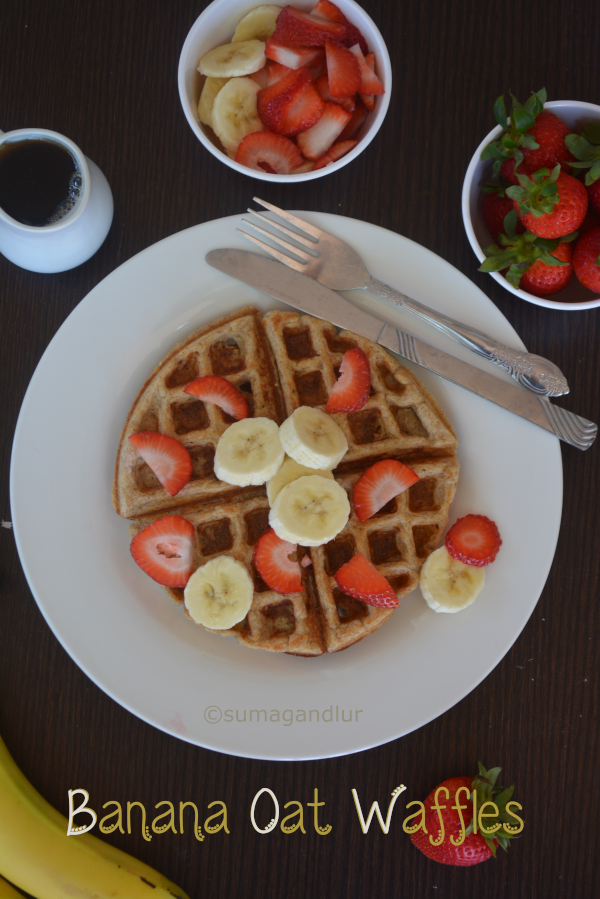
Vegan Banana Oat Waffles

I was cleaning up our pantry a few months ago and finding ways to use up those odds and bits from the bins. This recipe was an interesting find to finish off that last portion of the oats that were lying untouched in the can for months. Of course I could make only a small portion which my daughter thoroughly enjoyed for her lunch that day. 

These light and fluffy pancakes are gluten-free and vegan. These are made with oats, banana, almond milk and flax eggs. They make an easy and fuss-free breakfast. In fact, all you need to do is blend the ingredients and make waffles. They can be made in a big batch and extras can be refrigerated or frozen, stored in plastic wraps. They can be reheated in a toaster oven when needed.
Recipe source: Here
Ingredients: (Yield - about 4)
2 flax eggs
2 cups old fashioned oats
1 cup unsweetened almond milk or milk of choice
1 medium sized ripe banana
1.5 tsp vanilla extract
1 tsp. cinnamon
1 tsp. baking powder
1 packet stevia / preferred sweetener

Directions:
* For flax eggs, combine 2 tbsp. flax meal and 6 tbsp. water in  a small bowl.
* Blend all ingredients until smooth in a blender and let it sit for about 10 minutes.
* Meanwhile preheat the waffle iron. 
* Cook waffles in the waffle iron as per the manufacturer's instructions. Leave the waffles a little longer after the waffle iron goes off to make the waffles a little crisper.
* Enjoy them warm with any preferred toppings like maple syrup, fruits, honey / others.

Friday, April 12, 2019

A - Z Indian Biryani / Pulao / Khichdi Series ~ K for Kashmiri Pulao

I ended up with more rice options for the alphabet 'K' than any other ones. There were popular regional biryanis from Kashmir, Kerala and Kolkata. There were kushka, kathal aka jackfruit biryani, and the one made with kidney beans. There were beans with regional names that started with 'K' that could be used to cook rice dishes. And of course, 'K' stands for the popular khichdi as well. Among the lot, Kasmiri pulao won the round because it looked so attractive with fresh fruit garnishing.

For today's post, I am travelling to the northern most part of India, Jammu and Kashmir. Kashmir, dubbed the 'Heaven on earth' by emperor Jahangir is a land of beautiful valleys and rivers, located in the majestic Himalayan mountains. The Muslim invasions have greatly influenced the Kashmir region in all walks of life including it's cuisine. The cooking style of the local Hindu pandits, which has been the first major influence on the regional cuisine and that of the Muslim community are the two predominant cooking styles of the region. These have evolved over centuries of culinary craftsmanship, a result of the blend of cultures greatly influenced by central Asian, Persian and Afghani cuisines. 

This Kashmiri pulao is a special one in the sense it doesn't use any vegetables but loaded with nuts and fruits, both in fresh and dried forms. Diced apple, seedless grapes, pomegranate seeds, and diced pineapple seem to be the popular choices to add to the pulao. I kept postponing the cooking part until the end in the search of pomegranates with pink, juicy arils, which proved elusive in my Midwest neighborhood in the middle of winter. I am not sure whether pomegranate and pineapple were locally grown in the past centuries and whether they were an authentic addition to this pulao in a traditional sense. The addition of apple makes more sense to me. However the garnish of fresh fruits makes it very colorful, inviting and super delicious. I was initially skeptical about their addition but after tasting it, I would say the more the merrier. I kept enjoying the bursts of sweetness in every bite I took. My tongue couldn't handle even a tiny bit of spice the day I made this and so I ate it as it is to my utter satisfaction. A raita along with the pulao makes a satisfying meal.

Ingredients: (Yield 2 servings)
1/2 cup basmati rice
1 tbsp. ghee / oil
1 tsp. caraway seeds / cumin seeds
2 cloves
2 cardamom
1 one inch cinnamon piece
1 bay leaf
1/2 tsp. ground fennel (saunf powder)
1/4 tsp. ground ginger
A pinch of saffron
Salt to taste (about 1 and 1/2 tsp.)
3/4 cup water
Ingredients for garnish:
2 tbsp. ghee / oil
1 big onion, thinly sliced (about 1 cup)
10 to 12 each - Almonds, cashews and walnuts (I added pistachios as well.)
1/2 to 1 cup fresh fruit pieces (Cut them just before garnishing.)

Directions:
* Wash the rice in two changes of water, soak in water for about 30 minutes and drain.
* Heat ghee in a small pressure cooker and add caraway seeds, cloves, cardamom, cinnamon, and bay leaf. When the seeds start to brown, add ground fennel and ground ginger and stir.

* Next add the soaked rice and stir gently for about a minute so that grains are coated well with ghee /oil. Add a pinch of saffron, salt and water and stir well.

* Close the lid and put the valve on. Pressure cook for 3 whistles and turn off the stove. Let the valve pressure be gone. Allow it to sit for few minutes and then open the lid.

* While the rice is being cooked, heat ghee / oil in a small pan for toasting the onions and nuts. Add nuts one by one and toast until golden brown on low flame, Remove them with a slotted spoon and drain on paper towels. Each variety takes few seconds to toast. Do not burn them.

* Add onion slices to the same oil and a pinch of salt and fry on medium flame until golden brown. Drain on paper towels.
* Gently fluff the rice and garnish with toasted nuts, toasted onion and fruits.

So far in my Biryani / Pulao / Khichdi series,
A for Ambur Biryani
B for Basanti Pulao / Misthi Pulao
C for Corn - Fenugreek Greens Pulao
D for Donne Biryani
E for Ek Toap na Dal Bhaat
F for Fada ni Khichdi
G for Gutti Vankaya Biryani
H for Hyderabadi Vegetable Dum Biryani
I for Iyengar Puliyogare
J for Jaipuri Mewa Pulao

BMLogo 

Thursday, January 10, 2019

Brazilian Fried Bananas

Here is a simple and easy fruit based dessert from Brazil. Bananas are toasted in butter until golden brown and flavored with cinnamon sugar and all it takes is less than 10 minutes. I usually associate apple in this kind of dessert but definitely not bananas. And I was not expecting it to taste so good that I ended up making two batches of fried bananas on the same day. My daughter, whom I was not even counting to do the taste testing decided to try it as soon as she entered home and smelled something cinnamon. The girl who acts like she is food-phobic decided that she was going to have them again at dinner. They were that good. 

This is a recipe one can try when they have bananas in surplus. However bananas that are going to be used should be ripe yet firm, not the overly ripe and mushy kind. I think these fried bananas would taste extra good if prepared with sweeter variety bananas. The regular bananas would have a tinge of tanginess after the roasting. They can be served as it is warm or with ice cream if preferred. 

Ingredients:
1 tbsp. unsalted butter
2 big sized bananas or 4 - 5 small bananas
2 to 3 tsp. sugar
1/2 tsp. ground cinnamon

Directions:
* Heat a griddle pan and melt butter over it. 
* Peel the two bananas and cut each banana lengthwise. Now again cut each banana piece into two. (There are totally 8 banana pieces now.)
* Place the banana slices over the griddle, cut sides down. Fit as many banana slices as the griddle can fit without overlapping.
* Meanwhile, mix cinnamon and sugar in a small bowl and keep aside.
* Toast the bananas until the bottom side turns golden brown, about 3 minutes or so. Tilt the pan once or twice if you notice the butter moving towards the edges so that bananas are browned nice and even. Sprinkle cinnamon sugar generously over the banana slices and flip them with a spatula, taking care not to break them. (Actually I noticed that using two plastic knives was more convenient to flip the bananas.)
* Toast the bananas for another 2 - 3 minutes, until the flip side turns golden brown as well. Sprinkle the bananas with cinnamon sugar again.
* Serve the fried bananas warm as it is or with ice cream.

This goes to Blogging Marathon under 'Recipes from Southern Hemisphere' Theme.

bmlogo

Comments

Monday, December 24, 2018

Brown Betty / Apple Brown Betty

Brown betty is one of those 'apple' based desserts dating back to colonial times in America. Apple betty was originally created to use up the stale bread and it is a rustic bread pudding. Sweetened and spiced apple slices were arranged in layers with bread crumbs or stale bread, mixed with butter and then baked. The recipe probably used brown sugar / molasses as processed, refined sugar at that time was an expensive commodity. The recipes uses white bread though I have substituted it with wheat one here. Berries or pears can be substituted for apples in the recipe. Apple betty is usually served warm with lemon sauce, whipped cream or ice cream.

The dish was first mentioned in print in 1864 in the Yale Literary Magazine, with 'brown' in lower case thus making 'Betty' the proper name. It is widely believed that it was perhaps alluding to the race of the cook rather than the browning of buttered breadcrumbs during baking. A recipe from 1877 used apple sauce and cracker crumbs to prepare apple betty. There is one more version from 'Better Homes and Gardens' published in 1970s. Whatever the method used, apple betty is quite an easy one to prepare.

Apple betty is said to be one of Reagans' favorite dessert in White house. Not surprising considering how good this betty tastes. I halved the recipe since I was expecting to serve only two and regretted it as soon as I tasted it. Everyone loved it, fresh out of the oven served with vanilla ice cream.

Source: Here
Ingredients:
4 cups Granny Smith or any baking apples * (I used honeycrisp.)
4 cups white sandwich bread slices (I used brown.)
3/4 cup brown sugar, packed (divided)
1 tsp. ground cinnamon
1/4 tsp. ground ginger
1/2 tsp. nutmeg
3 tbsp. butter + extra for greasing the pan

Directions:
* Preheat the oven to 375 deg F. Grease a 7x11 inch baking dish with butter. 
* Peel, core and slice the apples thinly.
* Slice breads into dices or tear into small pieces.

* Sprinkle 1/4 cup brown sugar in the prepared pan and arrange half of the apple slices evenly. 

* Add half of the bread crumbs. 

* Then sprinkle cinnamon, ginger and nutmeg.

* Repeat the layers of sugar, apple, bread crumbs and spices again.
* Slice the butter and lay them over the bread crumbs. Sprinkle the remaining 1/4 cup brown sugar.

* Cover the baking dish with aluminium foil and bake until done, about 30 - 40 minutes.
* Remove the foil carefully during the last few minutes of baking to brown the top. 

* Increase the sugar level by 1/4 cup if using Granny Smith apples.

This cake goes to Bakeathon and Blogging Marathon #95 under the theme 'Bookmarked recipes' events.
Bakeathonbmlogo

Comments

Saturday, April 28, 2018

A - Z Indian Street Foods ~ X For 'X'tremely Easy Fruit Chaat / Fruit Salad

Vendors selling fruits in the neighborhoods or street corners is a common feature in Indian cities and towns. Fruits sold with a sprinkle of salt or salt and red chili powder / black pepper powder is a common sight in southern regions. One can see cucumber slices sold with a sprinkling of salt and red chili powder near bus stations where as I used to eat pineapple slices sold with salt and pepper in Bangalore during my college days though now they have another version, pineapple masala. 

There are also versions where a melange of spice powders are used to flavor the fruit pieces in other regions called a fruit chaat / fruit salad. A fruit chaat happens to be the easiest of the chaats that one could assemble if one is not talking about the Delhi version. Delhi fruit chaat uses tubers as well. We are talking about the other version today where only fruits are used and are sprinkled with spice powders to make it more flavorful. 

It is quite an easy recipe and I chose to go with an adjective for my alphabet 'X' today. The variety of fruits used in this chaat are obviously the local ones that are available abundantly. They are the typical tropical fruits like pineapple, papaya, mango, banana, orange, pomegranate, grapes, apple and others. However one can feel free to go with any seasonal and available fruits. Also I have given the list of spices below that are commonly used for a fruit chaat. However one can use only the spice powders they prefer or can with the combo they prefer. I prefer only chili powder while my husband prefers chili powder and black salt.  

Use refrigerated fruit or chill them for few minutes if using fruits at room temperature. This colorful and refreshing chaat is a welcome treat on a sunny day or serve it as a healthy snack in between meals.

Ingredients: (3 servings)
3 cups of mixed fruits (I used banana, grapes, green and red apple, orange, pear, pineapple and strawberries.)
Salt to taste (optional)
1 tsp. lemon juice (optional)
(And use all or any of the spices below you prefer. The quantities can be increased or decreased as per taste.)
1/2 tsp. black salt 
1/2 tsp. chili powder
1/2 tsp. chaat masala
1/2 tsp. roasted cumin powder

Method:
* Peel the banana and slice them into discs. Grapes can be halved or used as whole. Strawberries are hulled and sliced. Pineapple, apple, pears, mango are cubed. Orange slices are halved.
* Combine mixed fruits in a bowl. Add salt, black pepper powder
* If using lemon juice, add that as well. Toss the fruits a few times to coat them with the spices used.
* Divide them into 3 serving bowls and serve.

BMLogo
Check out the Blogging Marathon page for the other Blogging Marathoners doing BM# 87