HOME        |        ABOUT        |        COPYRIGHT        |        CONTACT        |         RECIPE INDEX        |         INDIAN THAALIS        |         MILLET RECIPES        |        EVENTS' ROUNDUP        

Showing posts with label Sweet Potato. Show all posts

Monday, July 5, 2021

Sweet Potato Kheer

This post was originally published in 2009 and needed some revamping both in terms of content and images. I had posted a microwave version but I am updating with the stove-top method too. 

Kheer / payasam is a popular and quick to cook dessert from Indian cuisine. It is equivalent to the pudding recipe from the western world sans eggs. Rice, vermicelli, sago/tapioca pearls, and split chickpeas versions are the most common and traditional kheers prepared across India. There are though several other delicious versions and kheers are mostly easy to prepare. The basic preparation of a kheer remains the same. A grain / lentil / vegetable / other ingredient is cooked in milk and sweetened with sugar or jaggery. Dairy milk is most commonly used though other milks like coconut milk, almond milk can be easily substituted in the recipe. Whole milk adds richness to a kheer but replacing it with half and half or a splash of condensed milk makes it festive. Cardamom is the most common flavor used in south India while saffron, kewra essence and rose water are other flavoring agents that go in north Indian style kheers. A garnish of ghee toasted dry fruits and nuts finishes the dish.

I love simple kheers like carrot / chayote / dates that sound special and unusual. I sometimes combine half & half to my kheers for the extra richness. These are some of the kheers that I have already posted on my blog. The first time I prepared this sweet potato kheer was for my guests who had hard time guessing the contents of the kheer and were bowled over by it's taste. I had never heard about sweet potato kheer before that and it was an experiment done on a whim. I use the pink fleshed sweet potato that is common in USA to make this kheer. The color of this chilled kheer is just because of the yam and no saffron was added. It can be cooked with the Indian variety sweet potato too but the sugar quantity in the recipe needs adjustment as it is a more sweeter variety. This is so delicious that it can be served to guests or can be included in festive meals. It can also be cooked during vrat / fasting since sweet potato is allowed during the period.
Ingredients:
2 tbsp. ghee
1/2 cup peeled & shredded sweet potato 
1.5 cups whole milk or as needed (or substitute with half & half for more richer version.) 
3 - 4 tbsp. sugar or to taste
Seeds ground from 2 cardamom pods / 2 pinches of ground cardamom
1 tbsp. cashews and raisins for garnishing (optional)
(For the original microwave version, I had used a tbsp. of ghee and 1.5 tbsp. sugar.)

Stove-top method:
* Heat ghee in a pan and add cashews and raisins. Toast them until raisins turn plump and cashews turn golden brown. Remove them with a slotted spoon and transfer them to a small bowl.
* Add grated sweet potato to the same ghee and sauté for 5 - 6 minutes, stirring continuously. 
* Next add milk to the pan and cook until sweet potato softens. (It doesn't tale much time.)
* Next add sugar and ground cardamom and cook until the sugar melts. Turn off the stove.
* Garnish with toasted cashews and raisins. 
* I usually serve it chilled but it can be served both warm or chilled.

Microwave version:
* Mix the ghee and the shredded sweet potato in a microwave safe bowl and cook it for a couple of minutes in the microwave. Remove and stir the contents once in between. 
* Add 3/4 cup of milk to the bowl and mix well. Put the bowl back in the microwave and cook until the sweet potato is almost done. Check once in between and if the milk has been absorbed by the sweet potato, add some more. (It may take about 3 - 4 minutes.) 
* Add sugar, remaining milk, and cardamom to the bowl. Mix well and put it back in the microwave and cook for a couple of minutes or until the sweet potato is cooked. Garnish with nuts/raisins if using. Stir well before serving. This kheer can be served warm or cold.
 
Note:
1. For diabetic-friendly version, omit the sugar and add a little sweetener to the bowl just before serving.
2. The time to cook the kheer in a microwave may vary depending upon the strength of the microwave. Use your discretion and cook accordingly.

Saturday, January 19, 2019

Sweet Potato Fry (Air Fryer Version)

Here is a quick and guilt free sweet potato fry, Indian style. My recipe uses air fryer though sweet potato cubes can be fried even in a convection oven though it takes a little longer to roast. The fry is done traditionally in a kadai / saute pan and consumes extra oil than the quantity I used here. I don't go roasting the vegetable until it resembles sweet potato fries or until it is browned but just enough to be served as a curry, slightly crispy from outside and tender inside. Serve it warm as a part of Indian meal.

Ingredients:
1 big sized sweet potato (About 2 cups cubes)
Salt to taste
Red chili powder to taste (I used about 1 tsp. of less spicy powder.)
1.5 tsp. oil
Directions:
* Peel and cut sweet potato into cubes or small pieces.
* Add sweet potato cubes, salt and chili powder to  a bowl and toss well to coat. Add oil next and toss again so that the cubes are coated well with oil.
* Add them to the cooking pan of the fryer and cook according to the manual instructions. 
I set it at 400 deg F and toasted for 13 to 14 minutes, tossing the sweet potato cubes occasionally. (My Gourmia air fryer setting includes 3 minutes of preheating in the above mentioned cooking time. I am not sure but if there are air fryer models which require preheating before the addition of vegetables to the fryer, then the cooking time should be around 10 minutes.)

This goes to Blogging Marathon under 'Easy Dinner Recipes' Theme.

bmlogo

Comments

Thursday, October 4, 2018

Vegetarian West African Peanut Stew / Soup

This comforting bowl of creamy and spicy soup comes from the western region of Africa and is said to have originated in Mali. Though the traditional version is chicken based, there are a lot of  versions online omitting chicken making it a great choice for vegetarians. Though unexpected, the unconventional medley of peanut butter, chard and yam somehow surprisingly work well together here. The spices lend an additional flavor layer on top of this, making this an enjoyable soup.

Usually my husband ends up adding a bit of this sauce and that to soups whenever I make them. However he wasn't complaining this time and ended up having it as his lunch and dinner. The consistency of this soup is more like a thicker stew version and is usually served over white rice. I added more liquid and made it thinner since I was planning to serve it as a soup. However it had reached a very thicker consistency while cooling.

Ingredients: (Yield 3 generous servings)
1 tbsp. oil
1 small onion, peeled & finely chopped
1 tsp. grated ginger + 1 finely minced garlic clove or 1 tbsp. ginger - garlic paste
2 tomatoes, chopped or 1 small can of tomatoes
1 sweet potato, peeled and cubed
1 cup of chard / kale /spinach leaves, chopped
3 cups of vegetable stock / water
1 tbsp. tomato paste
1/4 cup peanut butter 
Salt to taste
Freshly ground black pepper 
Cayenne to taste
Toasted peanuts to garnish

Directions:
* Roughly chop the peanuts with a knife or pulse them in a food processor.
* Heat oil in a soup pan and add onion, ginger, garlic and sweet potatoes. Saute the vegetables over medium heat until they slightly soften.
* Next add the broth, tomatoes, tomato paste, cayenne, salt and black pepper. Stir to combine and bring the mixture to a simmering boil.
* Keep cooking on medium heat until sweet potatoes are almost done. Add peanut butter and the greens being used. Add more liquid if needed to reach the desired consistency. Please note that the mixture thickens while cooling. Continue to simmer for another 8 to 10 minutes.
* Taste and adjust the seasonings if needed.
* Serve over white rice, topped with toasted peanuts.

bmlogo

This goes to blogging marathon #93 with the theme of recipes from countries that start with the same alphabet, "Pick one alphabet - 3 countries". My choice of alphabet this week is 'M' and today's post is from Mali. Check out the page here to read what other marathoners are cooking.

Comments

Saturday, May 28, 2011

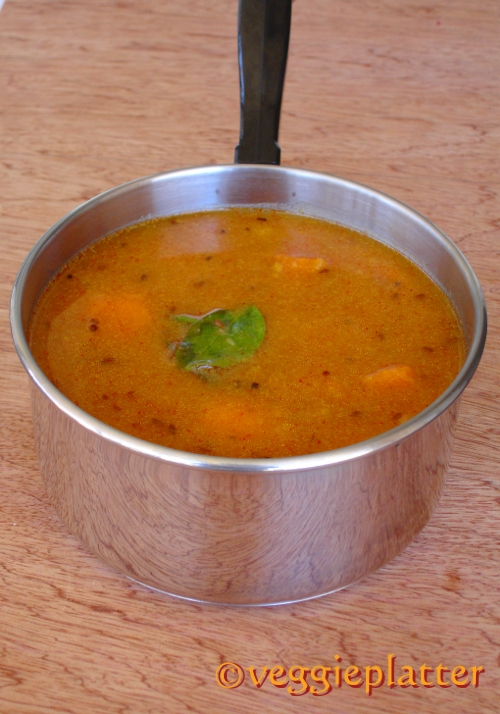
Genasugadda Pulusu

Genasugadda Theeyati Pulusu ~ A Sweet & Spicy Sweet Potato - Lentil Stew

I was surprised to notice that this one is going to be my first pulusu post here considering the fact that I grew up eating pulusu / pappus on a daily basis. To this day, my mother and her siblings prepare either a sweet - tangy pulusu / pappu in their kitchens but never a sambhar. This may be surprising to many South Indians but there are many Brahmin families (especially in the coastal Andhra regions) where sambhar never makes an appearance at their dining tables. Naturally, I was (and still am) not fond of sambhar and did not start to prepare it until M (who is used to sambhar from childhood) kept insisting for it.
Like a sambhar, Andhra pulusu is prepared using toor dal and a vegetable / a mixture of vegetables. Depending upon one's preference, the consistency of a pulusu can be anywhere between a sambhar and a rasam. The main difference between these two stews is that sambhar uses sambhar powder, the signature spice mix while the pulusu doesn't need anything of that sort. The sweet, tangy flavors should balance and sometimes for the uninitiated palates, pulusus can come across as sweeter.
For today's post, I have used the sweet potato to prepare a tangy - sweet pulusu.

Ingredients: (4 servings)
1/2 cup toordal
1 cup sweet potato cubes (chopped and cubed)
1/4 tsp turmeric powder
1 tsp chili powder
Salt to taste
1 small lime sized tamarind (soaked in water and juice squeezed)
1 Tbsp powdered jaggery (less or more quantity depends upon preference)
For tadka: 2 tsp oil, 1 tsp mustard seeds, 1 tsp cumin seeds, asafoetida, curry leaves

Method:
* Wash the toor dal. Cook the dal along with the vegetable and turmeric powder adding about a cup of water in a pressure cooker, until softly done. If your pressure cooker takes longer to cook the dal, then the sweet potato may be cooked separately until tender either on stovetop or in a microwave. 
* When the valve pressure is gone, remove the dal container; gently mash the dal with the backside of the ladle and keep aside.
* Heat the oil in a kadai / deep pan and add the tadka ingredients. When the mustard seeds start to splutter, add the cooked dal, sweet potato, tamarind juice, jaggery, salt and chili powder. Add water to reach the desired consistency and check the taste and adjust the quantities of ingredients if needed. All the flavors should shine in this recipe unlike sambhar. Bring to a rolling boil and lower the heat. Let it simmer for a couple of minutes more and turn off the stove.
Serve with hot rice and koora, a vegetable side dish.


Check out the other marathoners participating in BM#5
Curry in a hurry under 30 min: Aarthi, Divya, Jayashree , Kaveri, Pavani,
Seven Days of Indian Sweets: Gayathri, Priya Suresh,
Seven Days of Microwave Meals: Monika,
Seven Days of Regional Specials: Harini, Me , PJ and Vaishali
Seven Days of Colorful Dishes Kid's Special: Kalyani
Summer Coolers: Jayasree, Kamalika, Srivalli

Today's post is going to be a part of the event I am guest hosting this month, Cooking with Wholefoods - Toordal / Pigeon Peas, originally started by Kiran.


Comments

Tuesday, February 15, 2011

Blogging Marathon Day 7 ~ Papdi Chaat / Papri Chaat


I have never continuously posted for a week in my four years of blogging. I go by my own slow pace and usually post around 1-3 dishes per week depending upon my moods and what I cook. There were times when I didn't post for months either because of a valid reason or due to sheer lethargy. This was indeed a mini marathon for me. Apart from a couple of recipes that were in my drafts, I cooked the rest this week during the marathon. I prefer, prepare and post simple and quick food most of the time and this marathon was no exception.
I started this blog to record our family recipes four years ago and mostly know the Indian food bloggers who had been already blogging (and sadly some who no longer are blogging) by then and those who started around the same time as me. Now there are a myriad number of talented bloggers out there that it is hard to keep track of everyone. The "Blogs I follow" list on the sidebar of my blog needs an update real badly. Thanks to Srivalli, this marathon gave me a small opportunity to connect with a few such bloggers and hopefully our relation continues in the future. :)
Now moving on to the last post of this blogging marathon, I am left with the street food theme and I am going with papdi chaat. Chaats are a family favorite and even the little finicky one at home loves it because she gets to choose the toppings of her liking. She enjoyed it with a sense of pride yesterday for being able to create her own chaat and of course, it was a onion-green chutney free version.
Like the rest of the chaat family, papdi chat is also full of flavorful layers and as the name suggests, papdi / papri is the main ingredient.
Most of the chaats have a common theme when it comes to the ingredients. The green chutney, the sweet date chutney, sev, cooked garbanzo beans, chopped onion, tomato & cilantro, yogurt are the very basic and common ingredients found in most of the chaats. If you have them ready, assume that the significant part of the job is done. The chutneys can be done ahead and refrigerated. Garbanzo beans can be cooked in a large quantity and stored in a freezer in small portions for later use. Similarly sevs, papdis can be prepared in advance and stored in airtight containers. And if you don't find time to do everything from scratch, there is always the option to buy at stores. Chutneys, sev, papdis are available at Indian grocers and canned chickpeas/yogurt box serve the purpose.
If you go by the store option, then all you have to do in this particular recipe is boiling potato cubes in a microwave, chopping the veggies, assembling the ingredients and enjoying a bowlful of flavorful chat.

What you need for this chat:
Papris / Papdis (See the recipe below.)
Sev (Recipe found here.)
Green chutney
Sweet chutney
Boiled potato cubes
Cooked garbanzo beans
Sweetened / Plain yogurt
Finely minced onion, tomato and cilantro
Chat masala for garnish (optional)


Note: I had not noted down the quantities for the chutneys and so will post the recipes next time.

Papdi / Papri Recipe:
Ingredients: (Makes about 3 dozen)
2 cups all purpose flour / maida
Salt to taste
4 tsp hot oil
Oil to fry the papdis


1. Combine the first three ingredients in a mixing bowl. Add enough water to form firm dough. If not using immediately, cover the dough.
2. Pinch off a lime sized portion and shape it into a ball. Roll it out thinly like you do for rotis, dusting with flour if necessary. Prick the rolled out dough with a fork randomly to avoid papris puffing up while frying. I rolled out a big roti and cut out small circles of about 1&1/2 inches diameter.
3. Heat enough oil for deep frying in a kadai / deep pan. When the oil is hot enough, let the stove setting be at low. Drop the dough circles into oil and fry them till they turn light golden brown on both sides. Drain them on absorbent paper towels.
4. Cool and store them in an air tight container.


Assembling the papdi chaat:
Though the chaat is conveniently eaten in a bowl, I have arranged them on a tray just to have a better look at the various layers of flavors that go into this. Also I have added the toppings in smaller quantities for photographic purposes. Be generous while serving. :))
Take a wide and deep serving bowl / plate. Place 4-5 papdis, layer each papdi with boiled potato cubes and boiled chickpeas. Next go the chutneys. Sprinkle chopped onion and tomato. Spoon sweetened yogurt. Finally finish off with sev and coriander leaves. Garnish with some chat masala if you prefer. Repeat the layers if you wish. :)


The recipes I posted in this blogging marathon under "Special Choice" theme are
1. Sweet recipe - Oats - Coconut Laddu
2. Book marked recipe - Kalkandu Sadam
3. Rice recipe - Menthya Rice
4. Kid friendly dish - The all American Mac n Cheese
5. Starters - Guilt FreeTomato Soup
6. Regional Special: Dosavakaaya 

I am sending this over to Srivalli's Kid's Delight - Street Food event.

Sunday, October 31, 2010

Kayi Holige / Coconut Poli

Holige = Obbattu = Holiga = Poli = Bobbattlu => A sweet delicacy from India


Yes, I have saved the best for the last part of my CFK.
I grew up and have spent two thirds of my life in a state where every celebration, bigger or smaller is impossible with out holige / obbattu on the menu. It would have been a shame if I had not posted a holige recipe when I am hosting an event that is dedicated to festive foods. I see all Kannadigas nodding their heads. :)  Holige plays a major role in Karnataka cuisine and this delicacy enjoys a 'royal' status there. 'Holige oota' - The food including these sweet flatbreads is considered to be the ultimate feast one can serve to their guests. Festivals, engagements / marriages, graduations, welcoming home a new son-in-law or a baby, a new home / job (for that matter, any reason under the sun that one can think of that has brought joy to life) has to be celebrated with these holiges, of course lovingly prepared by dear mothers or chefs if prepared on a big scale!
Holige making is considered an art and usually the job is reserved to the experienced matron figure of the family. As I mentioned above they are flat breads with a sweet stuffing. The usual traditional stuffing can be pureed toordal / chanadal or coconut ones sweetened with jaggery and flavored with aromatic cardamom. Usually when moongdal filling is used, sugar is the preferred sweetener. I have noticed that even a traditional poli could become versatile depending upon one's creativity and experiments. Now coming back to the traditional ones, kayi holige or kayobbattu is said to be one of the tougher ones to nail down. They are supposed to be wafer thin and some experience helps in perfecting them. My mom usually prepares and prefers coconut stuffed ones since they can be stored longer, about a month or so with out any refrigeration. Some stores in Bangalore sell them in plastic packets because of their long shelf life.
The outer layer uses the chiroti rave along with maida. Chiroti rave happens to be finer semolina than the regular version that is used to prepare upmas. As the name suggests, it is used in preparation of another delicacy from the state, chirotis. Chirotis happen to be one more sweet delicacy from Karnataka and usually appear on wedding menus. Their preparation is left to seasoned chefs since the preparation process happens to be an elaborate one.

The following ingredients make around 22 obbattus. My mother though added the ingredients for the stuffing and the dough with out any measuring tools, they were perfect. We were not left with any of the stuffing or the dough.
Since I don't do pictorial explanations, I didn't take pictures for each step. I will try to update the post with new images for a better understanding of the recipe.

Ingredients for the stuffing:
4 cups finely shredded fresh coconut*
3 cups powdered jaggery (or less if you find the mixture sweeter)
1 tsp powdered cardamom

* It is important to note that the coconut needs to be very finely shredded. I had used the frozen, shredded coconut and since the gratings were larger, I just ran it through food processor for a minute so that it was finely shredded.

Preparing the stuffing:
Add everything to a thick bottomed or a non-stick pan and start cooking on medium low flame till it thickens. It took me around 25 minutes to cook it. To know whether it is done, do this test. Take a tsp of the stuffing, make it into a ball and try to pat it on a plastic sheet with your fingers. You must be able to spread it with out any difficulty. It should not curl back.
Let it cool. At this stage, either you can use it to prepare holiges or can refrigerate it to use later. It can be stored refrigerated for at least a couple of weeks. This step can hence be done very well in advance.

Ingredients for the outer layer:
Chiroti Rava / Very fine semolina - 1 & 1/4 cups
Maida / All Purpose flour - Half the quantity of rava
Oil - 6 to 7 Tbsp

Photobucket

Preparing the dough for the outer layer:
Combine the flour and rava in a bowl. Add sufficient water (I added about 1 cup minus 1 Tbsp) and make a thick dough as roti / poori dough. Then add the oil gradually and keep kneading so that the oil gets incorporated well into the dough. According to my mother's instructions I kept kneading it for at least 15 minutes.  My mother swears that this much of kneading (and the addition of that much of oil too) is really important and one shouldn't skip this step. 
Let the dough rest for about 30 minutes.

Making obbattus:
* Pinch about a small lime sized dough and place it on a greased banana leaf or a thick plastic sheet that is greased.
* Now using your fingers, pat and flatten it into a thin circle of about 3 inch diameter.
* Place about a lime sized ball of stuffing at the center of the dough circle. Bring the edges of the dough from all sides to cover the stuffing completely. Now the stuffing should be well inside the dough casing.
* Again flatten it with your fingers and go on patting it carefully so that it results in a thin, flat circle with stuffing not spilled out. Take care that the edges have stuffing too so that you don't end up eating hard edges.
The below one was stuffed by me on my first trial and hence looks like that.:)

Photobucket

* Meanwhile heat a griddle / tava / or a shallow pan. Now place the disc on it and fry it both sides till it is done by flipping it once or twice and adding a half spoon of oil / ghee around the edges while doing so.

Photobucket

* Repeat the procedure with the remaining dough and the stuffing. You can prepare the discs and do the frying part simultaneously. 
Enjoy them with a spoon of melted ghee.
Cool the rest and store them in an airtight container. They remain good atleast for a month, unrefrigerated.

I am really glad to send them over to my CFK - Festive Foods, an event originally started by Sharmi.


Post a comment

Tuesday, October 2, 2007

Genasugadda Pachchadi / Sweet Potato Chutney

When ever I hear about 'Cooking with pedatta' book on other blogs, it always reminds me, my own paternal aunt. The only paternal aunt I had, whom we fondly called atthaiyya. Whenever we had annual family gatherings at my father's place, she was the one whom we kids would cling to. Besides her other amazing skills in various fields which I slowly learnt through my 'grown up' eyes, we were basically drawn towards her for her story telling abilities. She was a master in that. She never was in need of a story book to amuse us. She would then and there create a story based on listeners' demand. Yes, listener demand :) . We kids would ask her to tell a story about 'something' and she would then and there spun an amazing story which sustained our attention through out.
Kids' dinner and story time were meant to be together for us. We kids would be sitting on the cots spread in the court yard on moon lit nights and she would bring the food in a plate. After deciding what story we are going to listen to, she would start the story and at the same time each kid would go on eating 'muddas' (Small portion of food made into a ball) from her hand. By the time the story finished, every kid would have eaten enough pachchadi annam (rice and pickle), Koora annam (rice and vegetable) pappu annam (rice and dal) and perugu annam (rice and yogurt). Now when I think of those precious moments, I yearn for more.
This recipe is a little tribute to my aunt, who lost her battle to cancer a couple of years ago. Her name was Annapoorna and she was literally one, when it came to culinary skills. This chutney was her creation at one of the family gatherings. She prepared this chutney and asked us to guess what it was. Till then, no one in the family had ever heard of sweet potato chutney. The best answer everyone could come up with was coconut chutney. That's how this chutney tastes. Subtly sweet and spicy at the same time. It can be prepared in a jiffy as the recipe demands no roasting / frying of the vegetable.


Ingredients:
One cup peeled, grated sweet potato
One Tbsp Uraddal
One tsp mustard seeds

1/4 tsp fenugreek seeds
Little asafoetida
6 Dry red chillies
2 Tsp oil
3/4 tsp salt

Preparation:
Heat oil in a small pan and add mustard seeds and uraddal. When uraddal starts to turn red, add fenugreek seeds, red chillies, asafoetida. When urad and fenugreek seeds have turned red, turn off the stove. Let it cool.
Grind this mixure with grated sweet potato and salt coarsely using a little water if required.
It stays fresh for a couple of days, refrigerated.