HOME        |        ABOUT        |        COPYRIGHT        |        CONTACT        |         RECIPE INDEX        |         INDIAN THAALIS        |         MILLET RECIPES        |        EVENTS' ROUNDUP        

Showing posts with label Green Gram / Mung Beans. Show all posts

Thursday, June 25, 2020

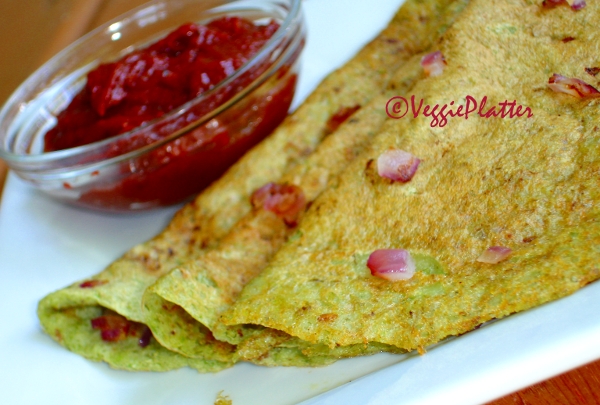
'Millet' Pesarattu / Proso Millet - Green Gram Dosa / Varigula Pesarattu


Green gram / mung beans are called pesalu / pesarapappu and dosa is attu in Telugu language. Basically pesarattu are green gram dosas which need soaking and grinding but no fermentation. If ingredients are soaked overnight then the batter can be ground in a mixer / bender in about 5 minutes for the morning breakfast. Or the batter can be ground ahead and refrigerated for a convenient meal anytime of the day. These are quite healthier since they are legume based and are protein rich. These dosas from Andhra are made with mostly green gram alone with out adding split black gram (urad dal) or rice, the common ingredients of a dosa preparation. At most a spoonful of rice is added to the green gram in a standard traditional recipe.
 I haven't seen anyone in either side of our families getting enthusiastic over a stack of pesarattu though pesarattu seems to top when searching for Andhra cuisine online. However the combo of pesarattu, upma and allam pachadi / ginger chutney really tastes good and an ideal one if looking for a healthy, nutritious and filling breakfast or a meal.  My husband is not a great fan of pesarattu prepared with green gram alone and I tend to add some rice / millet as well to the batter and serve it along with some spicy - sweet ginger chutney which is a classic combo. 

I added proso millet in today's recipe but any other kind like barnyard, foxtail, little millet or kodo millet works too. Or rice can be substituted in place of millet. One way to enjoy these pesarattu is to make them thinner and cook longer to make them crispier. 

Ingredients: (Yield 10 dosas)
1/2 cup proso millet
1/2 cup green gram
1 inch piece of ginger
2 green chillies
1 tsp. cumin seeds
Salt to taste
1/8 tsp. turmeric powder (optional)
Oil to make dosas

Directions:
* Soak millet and green gram in water overnight or for at least 3 hours.

* Drain the water and rinse them once with fresh water. Grind the drained millet, green gram, ginger, green chillies and cumin to a smooth batter, adding about a cup of water.

* Transfer the ground batter to a bowl and add salt and turmeric to it. Mix well to combine using a ladle.
* Heat a tawa / skillet. To check whether the skillet is hot, sprinkle some water over the hot pan. If it sizzles and evaporates, then the skillet is ready to make dosas. If not, heat the skillet a little more but don't bring it to a smoking point.
* Pour a ladleful of batter at the center and spread it into a thin circle. Add 1/2 tsp. of oil around the edges. Flip it when the surface appears dry. Let it cook the other side as well, about a minute or so and then remove.

* Repeat the steps with remaining batter.
* Serve the dosas piping hot with ginger chutney or any spicy chutney. They taste good when they are hot.

Comments

Monday, October 24, 2016

Greengram Idli / Moong Idli


The idea for this healthy breakfast option came from Kalyani's post from last blogging marathon though I overlooked the details at the time of preparation, ending up altogether with a different variety of idlis if I am not wrong. My husband loves his idlis as my daughter does her macaroni and cheese. The man wouldn't be complaining if idlis are the only thing that get served at breakfast table all his life while I am the opposite. I would eat them only as my last option though I make good quality idlis, thanks to my south Indian upbringing. The healthy infusion of moong beans in the idli captivated my attention though I wasn't sure how my husband would receive the idea. My husband considered me crazy to try to mess up with the perfected, traditional version of fluffy idlis though he wasn't that vehement about the idea after tasting them. They were a little heavy when compared to the standard version idlis and a few will fill you up good for a longer time. I used idli rice, forgot the seasoning part before filling the idli moulds and so, my idlis ended up looking different than Kalyani's. I am sure that the seasoning would make them more flavorful and there is always a next time to try them. :) These idlis make a healthier meal option and a great variation if looking out to try a different variety idli. 
Ingredients: (Yield 18 to 20 idlis)
1/2 to 3/4 cup whole green gram / sabut mung
3/4 cup split, skinned black gram / urad dal
3/4 cup idli rice
Salt to taste

Method:
* Rinse green gram, black gram and idli rice twice and soak in water (submerging them well) for 3 to 4 hours. Drain the water used to soak before grinding.
* Finely grind the soaked ingredients adding salt and enough water into thick batter. Transfer the batter into a container that can hold more than the ground batter since it is going to raise during the fermentation period.
* Cover the container and keep it in a warm place to ferment overnight. (I usually grind the batter in the evening and leave it in the oven with the light on. I do not turn on the oven. I live in a cold place and this method works for me resulting in a good fermented batter in around 12 to 14 hours.)
* Grease the idli plates and fill the moulds with the batter and steam them on low flame, about 20 minutes.
* Serve them with chutney / sambhar of your choice. 
 
This goes to Blogging marathon #69, under the theme 'Bookmarked Recipes'. Check here to find out what the other marathoners are cooking as part of the BM.

Comments

Friday, July 3, 2015

Mung Beans - Carrot Soup


This has become a recent favorite of mine though normally I abhor the soup kinds. I came across this spicy and yummy on an Indian food channel and tried it instantly as somehow I loved the idea. This is one of those hearty and healthy soups that can fill you up and so the soup alone would take care of a meal.

Ingredients:
1 tbsp. oil
1/2 tsp. garlic paste (optional)
1 tsp. peppercorns
1 onion, peeled and finely chopped
1 tomato, chopped
1 big carrot, peeled and chopped
1/2 cup cooked mung beans / green gram (whole, green ones)
Salt to taste
1 cup fat-free milk
 
Method:
* Heat oil in a small sauté pan and add garlic if using. Sauté for few seconds and then add peppercorns, onion, tomato and carrot.
* Cover and cook until the vegetables are tender.
* Transfer the cooked mixture, salt, cooked mung beans and milk to a blender. Puree the mixture and if the mixture appears too thick for your liking, add extra milk or water until the desired consistency is reached.
* Add the puree back to the pan and heat it.
* Serve warm.

This goes to BM #54 under the theme "Cooking lentils in 3 ways". Check here to see what other marathoners have come up with, for today.

Comments

Tuesday, December 17, 2013

Khattu Mag


The name sounded so exotic and I had no idea what to expect when I came across this dish. I saw the recipe in a Sanjeev Kapoor's cookbook and my guess was leaning towards northeast Indian cooking. Surprisingly, it turns out to be a dish that is prepared commonly in Gujarati kitchens. A thick kadhi with a twist, if you can call it so. I found out from online that it is pronounced as "khaa-too-mug", khattu being sour and mag meaning mung beans.
It is relatively a quick and simple dish to put together, if you had soaked mung beans beforehand and if you own a pressure cooker. The soaking period is also less, just a couple of hours and not too long. It's like a typical Jain dish involving no onion-garlic and it is quite an easy preparation sans vegetables. The chickpea flour and the mung make this a protein rich side dish. In spite of it's simplicity, it was a lip-smacking dish for me considering that I am a sucker for kadhi kind of dishes. Even my picky daughter asked for a second serving and so this recipe is a keeper for me.

Ingredients: (4 servings)
1/2 cup green gram / mung beans
1.5 cups low fat sour yogurt
2 tbsp. besan / chickpea flour
Salt to taste
1/4 tsp turmeric powder
1 tsp ginger paste
1 tsp green chile paste
1 tsp sugar
Ingredients for tadka:
2 tsp oil, 1 tsp mustard seeds, 1 tsp cumin seeds, 1/4 tsp fenugreek seeds / methi seeds, 3 whole cloves, 1 inch piece of cinnamon, few curry leaves, and a pinch of asafoetida

Method:
1. Wash moong beans in two exchanges of water and drain. Soak them in 2 cups of fresh water for an hour or two. Drain the beans in a colander after the soaking period.
2. Cook the beans in a pressure cooker adding 1 to 1.5 cups of water. If you don't own a pressure cooker, add moong and about 2 cups of water in a sauce pan and cook on medium flame until moong is softly cooked. Add extra water if needed while cooking.
3. Add yogurt, besan, salt, ginger paste, chile paste, turmeric and sugar to a bowl. Whisk well to combine. Sometimes if besan is not whisked properly, then it forms lumps while cooking. To avoid that, you can add everything to a blender while grinding ginger and green chile. You will get a lump free, homogeneous mixture this way and it is lot easier than whisking besan. Add one more cup of water and whisk again.
4. Heat another nonstick pan and add oil. Add mustard seeds, cumin, fenugreek seeds, cloves and cinnamon. When mustard seeds start to pop, add curry leaves and asfoetida.
5. Then add the yogurt mixture from the step 2 and cook until the besan is cooked and the raw smell leaves, about 5 minutes.
6. Next add the cooked moong and cook for about 3 - 4 minutes. Turn off the stove
7. Serve hot with rotis.

 This is going to be a part of BM #35 under the theme of "Regional Cooking - Specific Course". Check what other marathoners are cooking here.

Comments

Monday, November 7, 2011

Moong Bean / Greengram Rotti


Greengram rottis ~ Adding a protein punch to the delicious akki rottis, the famous breakfast dish from Karnataka.
I have been making these hearty rottis for several years now and we certainly enjoy them. They taste fabulous as the regular rottis besides being nutritious.
Other rotti recipes that have been published here earlier.
Southekayi Rotti
Oats Rotti

Ingredients for about 8 - 10 rottis:
1.5 cups greengram flour (Grind the moongbeans into a slightly coarse powder.)
1.5 cups rice flour
Salt to taste
1/2 cup shredded, fresh coconut
4 - 5 green chillies
1 cup finely minced onion
Oil


Preparing the rotti dough:
Combine the greengram flour, rice flour, salt in a mixing bowl. Finely minced chillies can be directly added to the mixture. However if serving kids or do not like to bite on green chillies, grind the coconut and chillies adding a little water. Add this coconut - chillie mixture and onion to the flour mixture. Form a firm dough adding water as needed.

Making rottis:
Pinch about a big orange sized portion from the prepared dough and shape into a ball. Pour about a tsp of oil at the center of a griddle and place the dough ball on it. Pat it into a thin, flat circle and pour a tsp of oil around the edges and cover with a lid.  


Now turn on the stove and let it cook on a low - medium flame, about 3 - 4 minutes. When it appears cooked on the bottom side and brown spots appear, flip it. Again add a tsp of oil around the edges if needed. Cover it again and cook till the other side is done too. Repeat the procedure with the remaining dough.
Be sure to turn off the stove and cool the griddle slightly so that it is safe to pat the next dough ball on it. You can use 2 griddles to quicken the process but still have to let the tawa / griddle to cool after making a rotti. Actually I give the cast iron pan a quick wash with coldwater after preparing a rotti so that I can go ahead immediately just after wiping it dry with a paper napkin.


These are going to
Priya Suresh's Cooking with Seeds - Moong beans event and
Susan's MLLA, guesthosted this month by Simona.
Comments

Monday, June 27, 2011

Pesarattu


My BM theme this week is Regional Specials - Andhra Pradesh. Check what the other marathoners in BM#6 have come up with, for today.

Today I am posting a recipe that is more popular among Indian bloggers than in the Andhra households itself. Jam just kidding but I have noticed that "pesarattu" and "gongura" are two popular items when bloggers not native to the region are posting about Andhra vegetarian recipes. I therefore initially thought to stay away from "oh, so predictable pesarattus" during this Andhra themed marathon. This weekend I however had second thoughts since this is one of those commonly prepared items in my household that has not yet got the opportunity to shine on my blog (even after four years). What a shame. L

And so here I am with one of those Andhra classic dishes, pesarattlu. Pesara (refers to the pesarapappu / pesalu) means green gram / moong dal and attu means dosa in Telugu. A pesarattu would therefore be a moong dal (whole green gram) dosa and the plural is pesaratlu. It is a power packed, traditional dish to start your day on a healthy note. And one better thing about these delicious dosas is that the batter need not be fermented after grinding. Just soak the dal and rice, grind and you are ready to enjoy protein rich, nutritious atlu for any meal.

Ingredients: (for about 15 dosas)
1 cup moong dal (green gram)
A handful of rice
4 -5 green chillies or to taste (I used Serrano peppers)
One inch piece of ginger
1 Tbsp cumin seeds
Salt to taste
Oil to make dosas
2 onions, finely minced (Entirely optional.)


Preparation of batter:
Soak moongdal and rice overnight or for a minimum of 3 - 4 hours. Discard the water used to soak dal and wash the dal again in one or two exchanges of water. Add the other ingredients (excepting the oil and onion) to the drained dal and grind into a coarse, thick batter adding only as much water needed. The batter should be not runny.


Method:
Heat a griddle / shallow pan. Sprinkle some water on the griddle. If the water sizzles and evaporates, then the griddle is ready to prepare dosas. Pour a ladleful of batter (about 1/2 cup) at the center of the griddle and spread it into a circle. Sprinkle some minced onion over it. Pour 1/2 tsp of oil around the circumference of the spread batter (and also onion if preferred). Flip the dosa after the bottom side is done and spread a few drops of oil again along the edges. Fry the other side too and remove the dosas. Repeat the process with the remaining batter.


Traditionally the dosas are served with allam pachadi / ginger chutney while we went ahead with mango ginger chutney.

This moong dal dish goes to Cook it Healthy - Proteinicious event.
Comments

Friday, April 22, 2011

BM#4 ~ Panchmel Dal / Panchratan Dal

Panchmel / Panchratan dal comes from Rajasthan, the colorful Western state of India known for its legacy of warrior kings and gorgeous forts. Panch mel dal literally means a (cooked) mélange of five dried beans while panch ratan means five jewels. The both names are interchangeably used for the nutritious dal (bean stew) prepared using five different dried lentils that can be commonly found in any Indian kitchen. While the green gram (sabut moong) and the red lentils (sabut masoor) are used in their whole forms, the urad dal (black gram), toordal (pigeon peas) and chana dal (Bengal gram) are used in their skinned, split forms. The infusion of spices in the form of tempering adds new layers of flavors making the dal medley more delectable. This protein packed, healthy dal makes a perfect accompaniment to rotis / rice. And an apt one for my diabetic theme during this marathon.


Recipe courtesy: Sanjeev Kapoor

This dal is a typical example of simple, delightful Rajasthani cuisine. The Rajasthani cooking could not always use fresh ingredients because of the arid weather and hence the absence of onion - garlic in most of the traditional dishes. Asafoetida is usually used as a substitute for garlic. However onion and garlic can be freely incorporated in the following recipe. Don't get exasperated by the long list of ingredients presented here. Most of them go in tempering.

Ingredients for 4 - 6 servings:
1/4 cup chana dal (Split Bengal gram)
1/4 cup moong dal (whole, green mung beans)
1/4 cup urad dal (skinned black gram)

1/4 cup masoor dal (whole ones but I used the skinned, split ones)
1/4 cup toor dal
1/2 tsp turmeric powder

1 tsp cumin seeds
Asafoetida (a pinch)
1 tsp ginger - green chili paste (I used grated ginger and green chillies)
2 tomatoes
1/2 tsp cumin powder
1/2 tsp coriander powder
Chili powder (to taste)
Salt to taste
1/2 tsp garam masala
Minced cilantro for garnish

Method:

* Soak dals in hot water for about an hour. Drain and pressure cook them adding water as needed and turmeric powder till done. Alternatively, they can be cooked on stovetop until soft.
* Heat oil in a pan and add ginger. When it starts to brown, add the cumin seeds, asafoetida and green chillies. Sauté for few seconds. Add cumin powder, coriander powder and red chilli powder.
* Then add the tomatoes and cook until mushy.
* Now add the cooked dals and salt. Add water if required to reach the desired consistency. Stir well and simmer for a few minutes for all the flavors to mingle.
* Add garam masala powder at the end and mix well.
* Garnish with minced cilantro and serve hot.


Check what the other bloggers are cooking on Day 5 during
this BM#4.
Diabetes Diet/Management: Kamalika, Smitha
Kid Friendly Recipes: Anusha, Cool Lassi(e)
Seven Days of Soup: Priya Suresh
Seven Days of Indian Bread: Jayasree, Pavani
Seven Days of Cakes:  Priya Vasu
Seven Days of Preserves: Gayathri Kumar, Vaishali
30 Minutes Meals: Priya Mahadevan, Srivalli

Comments

Tuesday, December 28, 2010

Pesara Sunnundalu / Green Gram Laddus


Warning! This recipe is not for the faint hearted or the modern era 'smarties' who count their calorie intake on a day to day basis. The recipe has fat and calories written all over it and yet happens to be one of the popularly loved desserts in my home state, Andhra. This is an old world dessert / snack born when people didn't yet rely on machines to do their jobs and believed that people need to eat good food to keep them fit.
Probably there is no granny in Andhra who would say sunnundalu are not good for you in spite of the amount of ghee and the jaggery / sugar that goes into it. My mom would feed us sunnundalu as an evening snack saying that they are very nutritious because of the protein and iron content in them. Then we did not know ABCs about calories. Anyway even I knew, it would not have mattered since those sunnundalu tasted so yummy and besides I was thin as a stick during my teenage years.
Though 'sunnundalu' refer to the ones prepared with uraddal, they can be made using green gram as well. I love the dal with husk (either urad or moong) - jaggery combination when making sunnundalu and so have used green gram (moong with the husk) and jaggery in this recipe. They are equally delicious as the minapa sunnundalu (urad dal laddus) and can be made in a jiffy. Roasted and powdered green gram can be made ahead and stored in an airtight jar. Just mix jaggery powder and ghee when you love to have sunnundalu.

Ingredients:
1 cup green gram / pesalu
1 cup powdered jaggery (sugar can be substituted)
Ghee to shape the balls (We can't get stingy here. Shaping the mixture into balls becomes difficult when enough ghee is not added.)

Making sunnundalu:
* Dry roast the green gram on medium flame until they slightly brown.
* Cool and grind the green gram into a coarse powder. Then add the jaggery powder to the green gram powder and pulse it in the processor / blender so that they blend well.
* Melt the ghee. Add as much ghee as needed to shape the green gram - jaggery mixture into balls.

These yummy laddus are on their way to 
Susan's MLLA30th edition hosted by Priya Mitharwal.

Post a comment

Wednesday, August 5, 2009

Loving Legumes ~~ Moong Beans With Veggies


In our family, Pushpa (M's SIL) prepares a lot of delicious moong dishes, which I have always enjoyed. I already posted her Moong bean khichdi. She prepares a couple of subzis with it, which I have devoured enjoying till the last bit. One version is drier while this one has equal amount of vegetables with moong. The moong is almost creamier and attains a melt in your mouth texture by the end in this dish. Serve this with a stack of rotis and some cooling yogurt / buttermilk for a hearty, healthy meal.

Ingredients required to serve generously at least six people:
1/2 cup green gram (moong beans/పెసలు)
Vegetables -1 carrot, 1 potato, 2 medium sized tomatoes, 2 medium sized onions, 10 - 15 green beans
4 -5 Serrano peppers - stems removed (or any other variety chillies can be used as needed)
A piece of ginger - 1inch by 1inch sized
1 tsp cumin and coriander powder
1.5 tsp salt
1/4 tsp turmeric powder
1 tsp cumin seeds and mustard seeds each
About 2 Tbsp canola oil

The work:
Rinse the moong beans well and throw away the water used. Soak moong beans in plenty of water overnight or at least for 4 hours. later, throw away the water used to soak.
Peel carrot and potato and chop into cubes. Trim the ends of the green beans and cut into 1&1/2 inch lengths.
Place the moong beans, carrot, potato and green beans in a pressure cooker and add water as needed. Cook till you hear three whistles. In the absence of a pressure cooker, add all the ingredients with water to a pot and cook till the moong bean is cooked well enough while still holding it's shape.
In the mean while, peel the skins of the onion and ginger. Place the onions, tomatoes, ginger and chillies in a blender and grind into a fine paste. Use 1/4 c of water if needed.
Heat oil in a saute pan (non stick is the best) and add cumin and mustard seeds. When the mustard seeds start to pop and cumin seeds turn brownish, add the ground paste and turmeric powder to it. Cover the pan and keep frying the paste on low to medium flame for about 10 - 15 minutes till all the raw smell of onion - chillie disappears.
The valve pressure of the cooker would have subsided by this time. Add the cooked moong - veggies to the saute pan. Reserve the liquid used to cook them.
Stir in the cumin-coriander powder and salt. If the mixture appears thick, a little quantity of reserved water can be added.
Mix well and cook on slow flame for a couple of minutes till all the flavors are mingled.
Squeeze half a lemon, if preferred.

Any Comments?

Friday, January 23, 2009

Moong Bean Khichadi


Our last India trip was to celebrate the Kanakabhishekam of M's parents. Though the trip was a short one, there was no dearth for the family gatherings and home cooked, good food. When ever I came across something I liked, I would ask for a pencil and paper and note down the recipe, with out feeling any embarassment. Of course, that happened many times as M comes from a big family filled with amazing cooks. By the time I came home, my purse was full of loose sheets with recipes scribbled all over.
Among those scribblings was this fabulous khichadi from Pushpa, who is M's SIL. She comes from a Kannadiga family and naturally her recipes are influenced by Kannada Cuisine which is less hotter compared to Andhra cuisine. She uses moong beans (green) and moongdal (yellow) a lot in her cooking with lot of variations. This khichadi is an example of it.
This Moong khichadi is meant for people who love quick, one pot meals. It hardly takes 15 - 20 minutes to prepare this dish if you have a cooker. Pair with some chutney / gojju and some yogurt, you will have a complete meal.

Ingredients to serve 4:
Rice - 1 cup (I have used sona masuri)

Moong beans (green gram) - 1/4 cup, heaped
Chopped vegetables - 1 cup
(I used carrot, potato, tomato, green beans and green peas).
Water - 2 cups
Salt 1.5 tsp
Sambhar powder 1Tbsp
For tadka /seasoning: 1 Tbs ghee, 1 tsp grated ginger, 1 tsp mustard seeds and few curry leaves


Pressure cooker cooked moong khichadi

The cooking part:
Wash and soak moong beans for about an hour. In the mean time, do the prep work. Peel the carrot and potato and wash the remaining veggies. Chop them finely.
Heat ghee in a small saute pan and add ginger and fry for a few seconds and then add mustard seeds and curry leaves. When mustard seeds start to pop, turn off the stove. You can do tadka directly in the pressure pan or cooker in which the khichadi is going to be cooked.
Wash the rice and throw away the water used. Add rice, soaked moong beans (with out the water used to soak), vegetables, salt, sambhar powder, the tadka and the 2 cups of water to a container and place it in a cooker and cook till you hear 3 whistles. Note that this khichadi should not be mushy.When the valve pressure is gone, remove and serve hot with dalia - coconut chutney.


This is going to
Susan's 'My Legume Love Affair' - The seventh helping hosted by Srivalli of 'Cooking 4 all seasons' this month.
and 'Harvest - The festival of rice' event hosted by Sudeshna of 'Here I cook'.

Note:
The quantity of moong can be increased to 1/2 cup. 1 cup rice + 1/2 cup lentils (toordal) + a handful of moong is another variation. Adjust the quantity of water accordingly.

Post a Comment

Wednesday, September 26, 2007

Greengram Sprouts Subzi

Here is a simple yet nutritious sprouts subzi which can be prepared in a jiffy. Just for a change, I added sambhar powder to the dish and ended up with a new, delightful flavor. Serve this healthy side dish with rotis / pooris / tortillas.

Ingredients:
Green gram sprouts - 1 cup
One big onion & one tomato, chopped
Sambhar powder - 1 tsp
Chili powder - 3/4 to 1 tsp
Salt
Oil - 1 or 2 tbsp
Mustard seeds & cumin seeds - 1/2 tsp each

Cooking:
Heat oil in a small wok / pan and add mustard and cumin seeds. When mustard seeds start to pop, add onions and fry it till turns translucent and then add tomatoes. Fry till the tomatoes turn into a mush.
Mean while, add a little water to the green gram sprouts and cook them in a MW for a minute or two. Add this cooked sprouts, salt, sambhar & chili powders and a little water to the above tomato - onion mixture. Simmer this mixture on a low to medium flame for a couple of minutes. Turn off the stove. (If you have not cooked sprouts in the MW earlier, cook for somemore time till the sprouts are well cooked).

Post a comment

Tuesday, August 7, 2007

Sprouting In The Dark


Sprouting is a way of increasing the nutrient value and digestability of beans, seeds and nuts. Sprouts are the most nutrient dense food on earth. They are rich in vitamins, minerals, amino acids, proteins and phytochemicals, as these are necessary for a germinating plant to grow. They are also rich in nutrients essential for human health. On wikipedia, there is a long list of seeds, beans and nuts, which can be sprouted. Kidney bean sprouts however are toxic and so, should be avoided.(source: wiki)

I have been following the method of sprouting in the dark, from the past few years and enjoy the crunchy sprouts all through the year. I usually sprout green gram (mung beans), garbanzo beans (chana), red chori beans, which are my favorites.

For 1/4 cup of green gram soaked, you will have about a cup of sprouts. Here is (an example of) how I do the sprouting.

  • Sunday night: Before you go to sleep, soak the mung beans in plenty of water in a bowl.
  • Monday morning: Throw away the water used to soak the beans. Sprouting would have already started. Wash the beans with fresh water twice or thrice without rubbing the beans much. Drain all the water and cover the bowl and keep it in a dark, warm place such as an oven (turned off).

Soaked green gram by morning. Sprouting already started.

  • Monday night: Take out the bowl from the oven and add water to the beans and drain it. Again cover the bowl and put it back in the dark place.
  • Tuesday morning: Your sprouts would be ready.

Sprouted green gram

Note: For red chori beans, follow the above process but it will take a few hours more. So on tuesday morning, add water, drain and again put them back in the oven (or a dark place). You will have your sprouts ready by evening. Also the broiler burner we have may be playing an active part in the sprouting process.

Refrigerate the sprouts and use as required.

Sprouted red chori beans

Recipes with sprouts will be posted soon.

Post a comment