HOME        |        ABOUT        |        COPYRIGHT        |        CONTACT        |         RECIPE INDEX        |         INDIAN THAALIS        |         MILLET RECIPES        |        EVENTS' ROUNDUP        

Showing posts with label Proso Millet. Show all posts

Monday, October 19, 2020

Proso Millet - Moong Kheer

 
Here is a millet based sweet recipe keeping the 'Navaratri' theme in mind. It is a delicious and easy kheer / payasam prepared with proso millet and moong. I  initially pressure cooked the millet and moong in water to save time and then further cooked it in milk and sugar. The millet and moong can also be cooked in a sauce pan on low heat until the mixture  reaches a soft and creamy consistency. It can be cooked in milk without the addition of water to make it more richer. Jaggery can be substituted instead of sugar in the kheer. This yummy kheer is fit to offer as a naivedyam on festive days or enjoy as a simple dessert.
Ingredients:
1/2 cup proso millet

1/4 cup yellow moong
1 & 1/2 cups of milk
3/4 cup sugar or to taste
1/8 tsp. cardamom powder
1 tbsp. ghee
1 tbsp. cashews
1 tbsp. raisins

Directions:
* Rinse proso millet and moong and pressure cook adding 1 and 1/2 cups water, for 3 whistles.
* Transfer the cooked moong - millet mixture to a pan, preferably a non-stick one. Add milk and cook until a desired consistency is reached or for about 10 - 15 minutes, frequently stirring. Add sugar and cardamom and cook further until the sugar is dissolved. Turn off the stove.
* Heat ghee in a small pan and add cashews and raisins. Toast until the cashews turn golden brown  and raisins turn plump. Remove from the heat and add them to the kheer.
* Serve the kheer warm or chilled.

Monday, September 28, 2020

Idli Platter ~ Proso Millet Idli

Idli is a popular breakfast dish from the southern parts of India, that is prepared by steaming a fermented batter of rice and black gram. They are steamed in special moulds called an idli stand which holds about two dozen idlis, the ones typically used in a household setting. Whereas the moulds used in restaurants are naturally bigger in size to hold more idlis, to cater their customers. The fact that they are steamed and use no fat in the preparation makes them an healthy breakfast choice for everyone including toddlers, the ailing or convalescing. The idlis are bland by themselves are usually served with a chutney and/or a soupy lentil gravy called sambhar.
The standard version idlis use rice and black gram that need soaking, grinding and fermenting before steaming which means that they need advance planning. There are versions with other grains substituted for rice which basically follow the same method. There are a second set of idlis where the ingredients are mixed and soaked for a short amount of time and steamed which make them instant versions. I have a few varieties of idlis in my platter today which fall under these two categories. I chose to go with about ten varieties though there are plenty of other variations. Most of the idlis in my idli platter are from Karnataka and the accompaniments I have are those side dishes popularly served in Bangalore restaurants - chutney, sambhar and saagu. Check my breakfasts page for more idli ideas.

I have the following in my idli platter.
Idli - Standard version prepared using idli rice and black gram.
Semolina idli / Rave idli (Recipe here)
Cucumber idli / Southekayi idli
Field beans Idli / Avarekayi Idli
Pumpkin idli / Kumbalakayi idli (Recipe here.)
Horse gram idli / Kulitha idli 
Flattened rice idli / Avalakki idli
Pearl millet idli / Bajra idli / Sajje idli
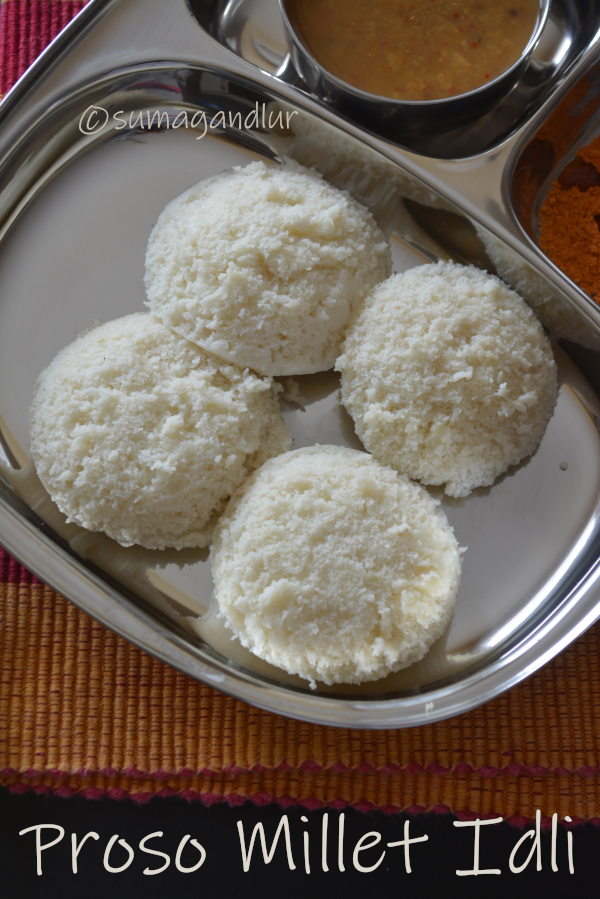
Proso millet idli / Baragina idli
Finger Millet idli / Ragi idli
I am posting the the proso millet idli recipe for today. I replace a portion of idli rice with either millets or millet flours in my regular idli recipe to make them healthier and nutritious. I haven't liked those idlis that much which are made adding no rice. We enjoy the version I am posting today and as far as I have noticed, the millets do not change the taste of idli at these proportions. They make a healthy and delicious breakfast or lunch along with some chutney and/or sambhar. My husband loves idli and so, I usually make a big batch of idlis and freeze them so that I don't need to make them every other day. The idlis can be refrigerated or frozen given that there are no power cuts in the area you live. If freezing, cool the idli immediately after they are demolded and put them in the freezer.  When ready to eat, heat them in the microwave, covered and you will have fresh, piping hot idlis.
Ingredients:
1/2 cup proso millet
1/2 cup idli rice
1/2 cup black gram / urad dal
Salt to taste

Directions:
* Rinse and soak the ingredients in water for about 3 to 4 hours.
* Grind them together to a thick batter adding as much as water needed. Add salt as well if living in a cold climate. 
* Transfer the batter to a container big enough (to allow the batter rise), cover and leave it aside to ferment. The fermentation may take anywhere between 8 to 14 hours depending upon the local climate. Make sure to place the batter in a warm place if living in cold climate.
* The fermented batter should look like the one below, light and frothy slightly smelling sour. Add salt if it was not added while grinding and gently mix to combine.
* Add water up to 2 inches in a steamer / idli cooker / pressure cooker base and heat it.
* Grease the idli plates and spoon the batter into moulds. Place the filled idli stand into the cooker and close the lid. Do not use the pressure valve on the lid if using a pressure cooker,.
* Steam the idlis on low heat until done, about 20 minutes or until the surface of the idli doesn't stick if touched with wet fingers. Turn off the stove.
* Let it sit for about 10 minutes and then remove the lid. Run a sharp spoon along the edges to demould the idlis.
* Serve them warm with chutney / sambhar. 
* These can be refrigerated or frozen as well.

Thursday, June 25, 2020

'Millet' Pesarattu / Proso Millet - Green Gram Dosa / Varigula Pesarattu


Green gram / mung beans are called pesalu / pesarapappu and dosa is attu in Telugu language. Basically pesarattu are green gram dosas which need soaking and grinding but no fermentation. If ingredients are soaked overnight then the batter can be ground in a mixer / bender in about 5 minutes for the morning breakfast. Or the batter can be ground ahead and refrigerated for a convenient meal anytime of the day. These are quite healthier since they are legume based and are protein rich. These dosas from Andhra are made with mostly green gram alone with out adding split black gram (urad dal) or rice, the common ingredients of a dosa preparation. At most a spoonful of rice is added to the green gram in a standard traditional recipe.
 I haven't seen anyone in either side of our families getting enthusiastic over a stack of pesarattu though pesarattu seems to top when searching for Andhra cuisine online. However the combo of pesarattu, upma and allam pachadi / ginger chutney really tastes good and an ideal one if looking for a healthy, nutritious and filling breakfast or a meal.  My husband is not a great fan of pesarattu prepared with green gram alone and I tend to add some rice / millet as well to the batter and serve it along with some spicy - sweet ginger chutney which is a classic combo. 

I added proso millet in today's recipe but any other kind like barnyard, foxtail, little millet or kodo millet works too. Or rice can be substituted in place of millet. One way to enjoy these pesarattu is to make them thinner and cook longer to make them crispier. 

Ingredients: (Yield 10 dosas)
1/2 cup proso millet
1/2 cup green gram
1 inch piece of ginger
2 green chillies
1 tsp. cumin seeds
Salt to taste
1/8 tsp. turmeric powder (optional)
Oil to make dosas

Directions:
* Soak millet and green gram in water overnight or for at least 3 hours.

* Drain the water and rinse them once with fresh water. Grind the drained millet, green gram, ginger, green chillies and cumin to a smooth batter, adding about a cup of water.

* Transfer the ground batter to a bowl and add salt and turmeric to it. Mix well to combine using a ladle.
* Heat a tawa / skillet. To check whether the skillet is hot, sprinkle some water over the hot pan. If it sizzles and evaporates, then the skillet is ready to make dosas. If not, heat the skillet a little more but don't bring it to a smoking point.
* Pour a ladleful of batter at the center and spread it into a thin circle. Add 1/2 tsp. of oil around the edges. Flip it when the surface appears dry. Let it cook the other side as well, about a minute or so and then remove.

* Repeat the steps with remaining batter.
* Serve the dosas piping hot with ginger chutney or any spicy chutney. They taste good when they are hot.

Comments

Tuesday, September 24, 2019

Baked Millet Handvo

Handvo, the second dish of the week comes from Gujarat. It is a traditional, savory snack that is made from a fermented rice and lentil batter. It is healthy, nutritional and quite filling. Traditionally the handvo was baked on coal. It can be prepared using a special handvo pan, baked in an oven or cooked in a wide, deep nonstick pan on stove-top as well. Like Andhra dibba rotte, it can be prepared in both thin and thick versions if using a pan. 
The preparation is simple if local stores carry the handvo mixture. All one need to do is add yogurt and water mixture and let it ferment before adding the vegetables and seasonings. If one cannot source handvo mixture, then either the dry ingredients can be ground and soaked or the ingredients can be ground coarsely after soaking the ingredients. I follow the latter method and I have already posted a baked version of rice - lentil handvo recipe. I usually follow the bake method since it is fuss free and needs no supervision. I made a baked handvo this time using mixed millets and lentils to make it more healthier. Serve this delicious handvo along with tea or even as a meal since it is quite filling on it's own.
It is hard to mess a handvo recipe especially if you make idli or dosa batters. After grinding, ferment the batter overnight or about 7 to 8 hours in hot weather. Handvo batter doesn't rise like idli and dosa batters and it gets sour if kept longer than that. The resulting handvo would end up being sour. Eno's fruit salt is added to the batter anyway.
Ingredients:
1 cup mixed millets (See note below.)
1 cup mixed legumes / dals (See note below.)
3/4 cup sour yogurt / dahi
1.5 tsp. salt
2 - 3 tbsp. oil (divided)
1.5 cup grated vegetables (See note below,)
1 tsp. grated ginger
1 tsp. finely chopped green chillies / green chillie paste
1/8 tsp. turmeric powder
1 tsp. Eno fruit salt / 1/2 tsp. baking soda
1 tsp. mustard seeds
1 tbsp. white sesame seeds
2 sprigs of curry leaves
2 pinches of asafoetida powder

Note:
1.  I used kodo, fox tail and proso millets. Instead, a single variety of millet or rice can be substituted.
2. I used urad dal (split black gram), chana dal (Bengal gram), toor dal (yellow lentils / pigeon peas), yellow and green moong dal (mung beans).
3. Grated bottle gourd is the commonly used vegetable. I used finely chopped methi / fenugreek greens, grated carrot and cabbage.)

Directions:

* Rinse millets and legumes twice and soak them in water for about 3 to 4 hours, taking care that they are well immersed in water. Drain the water completely after the soaking period and grind the mixture adding yogurt and salt to a slightly coarse batter. Add a tbsp. of oil to the batter. 


* The batter is on a thicker side and so there is no need to add any extra water to grind. 

* Leave the mixture to ferment for about 7 to 8 hours or overnight if the weather is cold. 
* When ready to make handvo, grease a round / square baking pan and preheat the oven to 350 deg F. (I used my 8 by 8 inch square pan.)
* Add grated vegetables. ginger, chillie paste, turmeric and mix well with a spoon.

* Heat a tbsp. oil and add mustard and sesame seeds. When the mustard starts to splutter and sesame seeds start to turn golden brown, add curry leaves and asafoetida. Turn off the stove.
* Add Eno's fruit salt to the prepared batter and give a quick stir to mix well. 

* Pour the ground batter mixture into the greased pan. 

* Pour the mustard and sesame seeds mixture over the top of the batter.

* Bake for about 30 to 40 minutes or until the surface turns light  brown or a toothpick inserted at the enter comes out clean. Broil on low for a minute or so, until the surface evenly turns golden brown.

* Turn off the oven and remove the pan. Let it sit for a few minutes.
* Slice the handvo using a plastic knife and serve with any chutney or yogurt.

First week - Sweets
Malaadu / Hurigadale Unde
Dry Gulab Jamun
Coconut Burfi / Kobbari Mithai
Almond Halwa / Badam Halwa
Elaneer Payasam
Godhuma Sojjappalu

Second week - Snacks from Gujarat
Damni Dhokla
Doodhi Muthia / Lauki Muthia
Dal Pandoli
Methi Khakhra
Pressure Cooker Khandvi

Jhal Muri


Check out the Blogging Marathon page for the other Blogging Marathoners doing BM#104.
You are invited to the Inlinkz link party!
Click here to enter
Comments