HOME        |        ABOUT        |        COPYRIGHT        |        CONTACT        |         RECIPE INDEX        |         INDIAN THAALIS        |         MILLET RECIPES        |        EVENTS' ROUNDUP        

Showing posts with label Millets. Show all posts

Wednesday, November 24, 2021

Edamame - Millet Khichdi

I picked 'easy dinner ideas' as my theme for this week's marathon which required the dish to be a meal by itself or can be served as a main course. This healthy and tasty khichadi happens to be a one pot meal, prepared with millet, spinach and edamame and one that can be cooked at the last minute. It is quite a simple and easy preparation as all you do is dump everything into a cooker / pot and cook them. I cooked the khichadi directly in a small sized pressure cooker but of course it can be cooked in any sturdy pot on stove top, under 30 minutes. 
Edamame pronounced 'eh-dah-maa-may' is the Japanese term for the young soybeans that are harvested before they get ripened. They are available both in pods / shelled forms, fresh or frozen. They are great to snack on or tossing them in a stir fry or salad. I have used frozen ones here and added them along with spinach and potato to boost the nutrition factor of this khichdi. I used the yellow colored millet commonly available in US stores and threw in a handful of Basmati rice as well. Substitute any long grain / Basmati rice or a combination of rice and millets or any other quick cooking grain in place of millets. This edamame and millet khichdi is a quick, wholesome and nutritious meal that can be prepared under 30 minutes.  

Ingredients:
2 tbsp. ghee and/or oil
1 tsp. cumin seeds
2 cloves
2 cardamom pods
1 inch piece cinnamon
1 bay leaf
2 green chilies or according to spiciness preferred
1/2 inch piece ginger, grated and crushed
1 big onion, sliced
1 big tomato
1 potato, chopped
1/2 cup edamame (I used about a cup of edamame and that quantity seemed more.)
2 cups chopped spinach
A pinch of asafoetida
1 tsp. garam masala (optional but recommended.)
1/8 tsp. ground turmeric
Salt to taste
1/2 cup millets
1/4 cup yellow moong dal
2 cups + extra water
Directions:
* Wash millets and moong dal, drain and keep aside.
* Heat ghee / oil directly in a pressure cooker and add cumin seeds, cloves, cardamom, cinnamon and bay leaf. Toast for few seconds until you start to smell fragrance of the spices.
* Add the chopped green chillies and ginger and saute for few seconds. Next add onion and saute until golden brown. After onions are done, add tomatoes and cook until they soften.
* Next add potatoes, spinach, edamame, turmeric, salt (I used about 2 tsp.), garam masala, millets, moong dal and about 2 cups of water.
* Close the lid, put the valve on and pressure cook for 3 whistles. 
* When the valve pressure is gone, remove the lid and check the consistency. Do the taste testing to check the seasonings. If needed, add salt / chili powder. If the khichdi appears too thick, add a cup of water (or as needed). Simmer for few minutes until it starts to bubble, stirring in between to avoid the khichdi sticking to the bottom of the cooker. 

Monday, October 19, 2020

Proso Millet - Moong Kheer

 
Here is a millet based sweet recipe keeping the 'Navaratri' theme in mind. It is a delicious and easy kheer / payasam prepared with proso millet and moong. I  initially pressure cooked the millet and moong in water to save time and then further cooked it in milk and sugar. The millet and moong can also be cooked in a sauce pan on low heat until the mixture  reaches a soft and creamy consistency. It can be cooked in milk without the addition of water to make it more richer. Jaggery can be substituted instead of sugar in the kheer. This yummy kheer is fit to offer as a naivedyam on festive days or enjoy as a simple dessert.
Ingredients:
1/2 cup proso millet

1/4 cup yellow moong
1 & 1/2 cups of milk
3/4 cup sugar or to taste
1/8 tsp. cardamom powder
1 tbsp. ghee
1 tbsp. cashews
1 tbsp. raisins

Directions:
* Rinse proso millet and moong and pressure cook adding 1 and 1/2 cups water, for 3 whistles.
* Transfer the cooked moong - millet mixture to a pan, preferably a non-stick one. Add milk and cook until a desired consistency is reached or for about 10 - 15 minutes, frequently stirring. Add sugar and cardamom and cook further until the sugar is dissolved. Turn off the stove.
* Heat ghee in a small pan and add cashews and raisins. Toast until the cashews turn golden brown  and raisins turn plump. Remove from the heat and add them to the kheer.
* Serve the kheer warm or chilled.

Monday, September 28, 2020

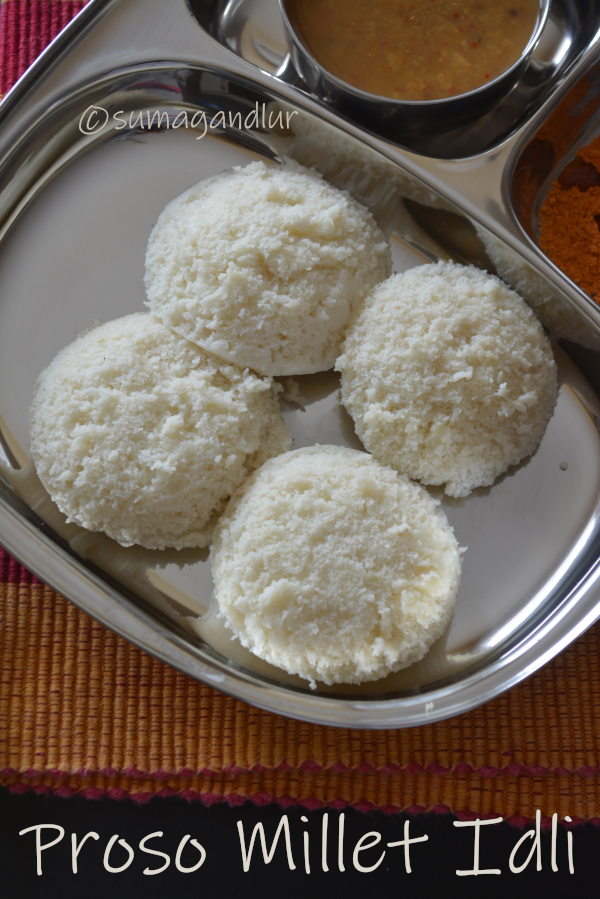
Idli Platter ~ Proso Millet Idli

Idli is a popular breakfast dish from the southern parts of India, that is prepared by steaming a fermented batter of rice and black gram. They are steamed in special moulds called an idli stand which holds about two dozen idlis, the ones typically used in a household setting. Whereas the moulds used in restaurants are naturally bigger in size to hold more idlis, to cater their customers. The fact that they are steamed and use no fat in the preparation makes them an healthy breakfast choice for everyone including toddlers, the ailing or convalescing. The idlis are bland by themselves are usually served with a chutney and/or a soupy lentil gravy called sambhar.
The standard version idlis use rice and black gram that need soaking, grinding and fermenting before steaming which means that they need advance planning. There are versions with other grains substituted for rice which basically follow the same method. There are a second set of idlis where the ingredients are mixed and soaked for a short amount of time and steamed which make them instant versions. I have a few varieties of idlis in my platter today which fall under these two categories. I chose to go with about ten varieties though there are plenty of other variations. Most of the idlis in my idli platter are from Karnataka and the accompaniments I have are those side dishes popularly served in Bangalore restaurants - chutney, sambhar and saagu. Check my breakfasts page for more idli ideas.

I have the following in my idli platter.
Idli - Standard version prepared using idli rice and black gram.
Semolina idli / Rave idli (Recipe here)
Cucumber idli / Southekayi idli
Field beans Idli / Avarekayi Idli
Pumpkin idli / Kumbalakayi idli (Recipe here.)
Horse gram idli / Kulitha idli 
Flattened rice idli / Avalakki idli
Pearl millet idli / Bajra idli / Sajje idli
Proso millet idli / Baragina idli
Finger Millet idli / Ragi idli
I am posting the the proso millet idli recipe for today. I replace a portion of idli rice with either millets or millet flours in my regular idli recipe to make them healthier and nutritious. I haven't liked those idlis that much which are made adding no rice. We enjoy the version I am posting today and as far as I have noticed, the millets do not change the taste of idli at these proportions. They make a healthy and delicious breakfast or lunch along with some chutney and/or sambhar. My husband loves idli and so, I usually make a big batch of idlis and freeze them so that I don't need to make them every other day. The idlis can be refrigerated or frozen given that there are no power cuts in the area you live. If freezing, cool the idli immediately after they are demolded and put them in the freezer.  When ready to eat, heat them in the microwave, covered and you will have fresh, piping hot idlis.
Ingredients:
1/2 cup proso millet
1/2 cup idli rice
1/2 cup black gram / urad dal
Salt to taste

Directions:
* Rinse and soak the ingredients in water for about 3 to 4 hours.
* Grind them together to a thick batter adding as much as water needed. Add salt as well if living in a cold climate. 
* Transfer the batter to a container big enough (to allow the batter rise), cover and leave it aside to ferment. The fermentation may take anywhere between 8 to 14 hours depending upon the local climate. Make sure to place the batter in a warm place if living in cold climate.
* The fermented batter should look like the one below, light and frothy slightly smelling sour. Add salt if it was not added while grinding and gently mix to combine.
* Add water up to 2 inches in a steamer / idli cooker / pressure cooker base and heat it.
* Grease the idli plates and spoon the batter into moulds. Place the filled idli stand into the cooker and close the lid. Do not use the pressure valve on the lid if using a pressure cooker,.
* Steam the idlis on low heat until done, about 20 minutes or until the surface of the idli doesn't stick if touched with wet fingers. Turn off the stove.
* Let it sit for about 10 minutes and then remove the lid. Run a sharp spoon along the edges to demould the idlis.
* Serve them warm with chutney / sambhar. 
* These can be refrigerated or frozen as well.

Thursday, September 24, 2020

Bajra Aloo Roti

Bajra aka pearl millet, a healthy and gluten free grain has been grown in India for centuries. The grain is packed with nutrients, rich in fiber thus aiding in digestion and has a low glycemic index making it ideal for diabetics. However over the time, the grain somehow had been relegated to the status of rustic and rural food excepting a few states in India. Fortunately the millets are again slowly gaining popularity among the urban communities as well for their health benefits. Bajra is widely consumed in the Indian states of Gujarat, Rajasthan, Haryana, and Maharashtra. I originally made these bajra aloo rotis for the state of Haryana but later realized that these are made in Rajasthan and Gujarat as well with variations.
These rotis are a variation to the regular bajra rotis aka pearl millet flatbreads made across the western parts of India, where bajra is widely consumed. Potato and spices are additional ingredients in this flatbread where the roti is made patting between palms and are slightly thicker than what I have made here. These are basically rustic and everyday kind breads where one doesn't need any fancy side dishes. Some butter, pickle or even plain yogurt would make an excellent accompaniment to these tasty rotis. I served them with pitla, a chickpea flour based side dish from Maharashtra which is called Bombayi chutney in Andhra.
I started slowly incorporating various millet flours into out diet a few years ago and now they have become pantry staples. I started my exploration by using them in thicker Karntaka style rottis. I make somewhat decent rotis now using bajra / pearl millet and jowar / sorghum flours though I need to yet master them. It took a lot of trial and errors since no one at back home use these flours though I learnt recently that my paternal grand mother used to cook millets regularly in place of rice when my father was a kid. One can easily incorporate various millet flours in everyday breakfast dishes like idli, dosa and rotis by starting with replacing a portion of rice / wheat flour by a millet. Similarly millets can replace rice in main dishes. One of the important things to remember regarding bajra flour is not to overstock it as the flour tends to get bitter if it sits for longer periods without getting used.
Experts and people with gluten issues can leave out the wheat flour from the recipe and make rotis, by patting them between palms or on a plastic sheet or a wet cloth and transferring them to the griddle.  However I prefer the version with an addition of wheat flour to it, which makes it comparatively easier to roll the rotis. 

Ingredients: (Yield - 10 rotis)
3/4 cup pearl millet / bajra flour
3/4 cup whole wheat flour + extra for dusting
1/2 tsp. dry mango / amchur powder
Salt to taste
3 to 4 spicy green chillies or to taste, grated 
1 inch piece of ginger, peeled and grated
1 potato, peeled and boiled (I had about 3/4 cup mashed.)
About 1/2 cup warm water to knead
Oil to make rotis

Directions:
*
Mash the potato well and keep aside. Don't throw away the water used to cook the potatoes and use instead in preparing the dough. Warm it if the water has come to room temperature.
* Combine flours, salt, dry mango powder in a mixing bowl. Next add the remaining ingredients except the water and oil. Mix the ingredients well using fingers. 
* Add warm water as needed to form a slightly firm dough and allow it to rest for 30 minutes to an hour. If the dough appears sticky, add some extra wheat flour and knead.

* Knead the dough once. Divide the dough into 10 portions and roll each one into a smooth ball and pat them into discs. Place them in the bowl and keep them covered while working on each ball at a time.
* Flour the disc generously and roll into a thin circle of about 5 to 6 inches in diameter. If rolling appears difficult, roll them between two sheets of plastic or parchment paper which makes it easier to roll.

* Heat a tawa / shallow pan / skillet. Pat away any excess dough from the rolled circle and place it at the center of the griddle.
* When small bubble start to form, flip and cook for about 20 to 30 seconds. 
* Add 1/4 to 1/2 tsp. oil around the edges and smear the back side of the spoon over the surface of the roti. Cook flipping once or twice in between, pressing the spatula all over the surface of the roti until brown spots appear on both sides.
* Repeat the steps of rolling and toasting the rotis with the remaining dough.

Wednesday, October 2, 2019

'Indian Sweets and Snacks' - A Recap


Readers who follow my blog might me aware that I am a part of blogging marathon group where we sign up to post recipes each month. April and September months are meant for month long marathons where we post recipes each day with set themes, barring Sundays. I have been part of these mega marathons since it started excepting a few owing to my India trips. I posted some traditional sweets and snacks from India this September. Before posting round up of those recipes, below are links for my previous mega marathons with the mentioned themes. If interested, click on those links and you will find about 26 to 30 dishes in each category.

Apr 2019 A - Z Indian Biryani / Pulao / Khichdi Series
Apr 2018 A - Z Indian Street Food
Sep 2016 A - Z Indian Rice Dishes
Apr 2016 A - Z Andhra Cuisine
Sep 2015 Buffet on the Table
Apr 2015 Fire up Your Oven (Baking Recipes)
Sep 2014 Around the World in 30 Days (International Recipes)
Apr 2014 Indian Food Odyssey - Recipes from 30 States
Sep 2013 A - Z Event with 4 Set Themes
Apr 2013 Event with 4 Different themes


This September's marathon was based on Indian sweets and snacks, divided between four themes. This marathon was a learning curve with some surprises thrown in, indeed. I would have never thought that I would even try making the tricky khandvi or the tedious khakras from Gujarat, at home. For a person who doesn't even make urad dal vadas to avoid deep frying, Uttar Pradesh's dahi gujiyas were a revelation. I had no idea such a recipe even existed where a batter would act as an outer covering for stuffing a gujiya instead of a flour based dough and more surprising was that I enjoyed it with full gusto. Neither I had an inkling that I get to try and enjoy a delicious treat sitting in my home, that was originally created for the officers of British Raj in Ooty, a hill station in the south Indian state of Tamil Nadu. There was this snack from Ratlam in Madhya Pradesh, a spicy sev that was created to satiate the Mughal emperors and now boasts a GI tag to it's name. What was new and extremely pleasing in the sweets category was a simple yet flavorful kheer made with coconut water, coconut milk and the tender coconut meat which has become now my 'favorite' kheer. The black eyed peas based dumpling, pandoli was an interesting addition to my idli repertoire. Apart from these, if you are interested to see what other delicious Indian snacks I got to try this marathon, check out the below links.


The first week was meant for sweets and I went ahead with simple yet festive treats keeping in mind Navratri and Diwali festivals. What conjures up in my mind when I think about an Indian sweet is a laddu / burfi / kheer / halwa, or a stuffed sweet rather than dairy based sweets. My mind automatically associates the latter category or the deep fried varieties like jalebis / jhangri kind to a sweet shop / bakery somehow. I included a recipe from each of the above categories along with the ever popular jamun recipe, a dry one this time. 


Dry Gulab Jamun (North India)


Elaneer Payasam (Tamil Nadu)

Godhuma Sojjappalu (Andhra Pradesh)

The second week's theme was to pick some traditional snacks from one particular state. I did not have to think much and blindly picked Gujarat, a state in the western part of India that happens to be the land of farsans aka snacks. The local cuisine not only has a wide range of deep fried snacks that have become popular among the Indian diaspora but also can boast about guilt free ones. I went ahead with the latter category picking the healthy, traditional snacks that can be enjoyed by everyone, including diabetics. Five of those dishes are steamed snacks and most of them can be enjoyed as a mini meal too. 

Damni Dhokla (Gujarat)


Dal Pandoli (Gujarat)

Sev Khamani (Gujarat)

Methi Khakhra (Gujarat)


The third week was a free choice and we could pick whatever we preferred. I went ahead with some more guilt free, regional snacks that were mostly quick fix ones as well. None were deep fried except the kalmi vada chaat, where I used the vadas that were fried as part of the final week theme.

Bafauri (Chattisgarh / Madhya Pradesh)


Jhal Muri (West Bengal)


The fourth week was meant for eight traditional Indian snacks that were agreed upon beforehand by the participating team. The snacks chosen were from four corners of the country and a few proved to be new and delectable surprises to me.

'Aakukoora' Pappu Chekkalu (Andhra Pradesh)


Ratlami Sev (Madhya Pradesh)

'Jowar' Kothimbir Vadi (Maharasthra)

Kalmi Vada (Rajasthan)

Ooty Varkey (Tamil Nadu)

Dahi Gujiya (Uttar Pradesh)


Check out the Blogging Marathon page for the other Blogging Marathoners doing BM#104.

Comments