HOME        |        ABOUT        |        COPYRIGHT        |        CONTACT        |         RECIPE INDEX        |         INDIAN THAALIS        |         MILLET RECIPES        |        EVENTS' ROUNDUP        

Showing posts with label Rajasthan. Show all posts

Thursday, September 24, 2020

Bajra Aloo Roti

Bajra aka pearl millet, a healthy and gluten free grain has been grown in India for centuries. The grain is packed with nutrients, rich in fiber thus aiding in digestion and has a low glycemic index making it ideal for diabetics. However over the time, the grain somehow had been relegated to the status of rustic and rural food excepting a few states in India. Fortunately the millets are again slowly gaining popularity among the urban communities as well for their health benefits. Bajra is widely consumed in the Indian states of Gujarat, Rajasthan, Haryana, and Maharashtra. I originally made these bajra aloo rotis for the state of Haryana but later realized that these are made in Rajasthan and Gujarat as well with variations.
These rotis are a variation to the regular bajra rotis aka pearl millet flatbreads made across the western parts of India, where bajra is widely consumed. Potato and spices are additional ingredients in this flatbread where the roti is made patting between palms and are slightly thicker than what I have made here. These are basically rustic and everyday kind breads where one doesn't need any fancy side dishes. Some butter, pickle or even plain yogurt would make an excellent accompaniment to these tasty rotis. I served them with pitla, a chickpea flour based side dish from Maharashtra which is called Bombayi chutney in Andhra.
I started slowly incorporating various millet flours into out diet a few years ago and now they have become pantry staples. I started my exploration by using them in thicker Karntaka style rottis. I make somewhat decent rotis now using bajra / pearl millet and jowar / sorghum flours though I need to yet master them. It took a lot of trial and errors since no one at back home use these flours though I learnt recently that my paternal grand mother used to cook millets regularly in place of rice when my father was a kid. One can easily incorporate various millet flours in everyday breakfast dishes like idli, dosa and rotis by starting with replacing a portion of rice / wheat flour by a millet. Similarly millets can replace rice in main dishes. One of the important things to remember regarding bajra flour is not to overstock it as the flour tends to get bitter if it sits for longer periods without getting used.
Experts and people with gluten issues can leave out the wheat flour from the recipe and make rotis, by patting them between palms or on a plastic sheet or a wet cloth and transferring them to the griddle.  However I prefer the version with an addition of wheat flour to it, which makes it comparatively easier to roll the rotis. 

Ingredients: (Yield - 10 rotis)
3/4 cup pearl millet / bajra flour
3/4 cup whole wheat flour + extra for dusting
1/2 tsp. dry mango / amchur powder
Salt to taste
3 to 4 spicy green chillies or to taste, grated 
1 inch piece of ginger, peeled and grated
1 potato, peeled and boiled (I had about 3/4 cup mashed.)
About 1/2 cup warm water to knead
Oil to make rotis

Directions:
*
Mash the potato well and keep aside. Don't throw away the water used to cook the potatoes and use instead in preparing the dough. Warm it if the water has come to room temperature.
* Combine flours, salt, dry mango powder in a mixing bowl. Next add the remaining ingredients except the water and oil. Mix the ingredients well using fingers. 
* Add warm water as needed to form a slightly firm dough and allow it to rest for 30 minutes to an hour. If the dough appears sticky, add some extra wheat flour and knead.

* Knead the dough once. Divide the dough into 10 portions and roll each one into a smooth ball and pat them into discs. Place them in the bowl and keep them covered while working on each ball at a time.
* Flour the disc generously and roll into a thin circle of about 5 to 6 inches in diameter. If rolling appears difficult, roll them between two sheets of plastic or parchment paper which makes it easier to roll.

* Heat a tawa / shallow pan / skillet. Pat away any excess dough from the rolled circle and place it at the center of the griddle.
* When small bubble start to form, flip and cook for about 20 to 30 seconds. 
* Add 1/4 to 1/2 tsp. oil around the edges and smear the back side of the spoon over the surface of the roti. Cook flipping once or twice in between, pressing the spatula all over the surface of the roti until brown spots appear on both sides.
* Repeat the steps of rolling and toasting the rotis with the remaining dough.

Monday, September 21, 2020

Indian Bread Series ~ Tikar Roti / Tikkar Roti

I had jotted down several recipes from Tarla Dalal's cookbooks at my Sister-in-law's home, more than a dozen years ago. These tikkar rotis were one of them and they have been on my 'to do' list for that long. I included them in my North Indian thaali that I cooked on a whim this month when I saw that they were easy like regular rotis. 
Tikar / Tikkar are from the desert state of Rajasthan and are unleavened breads. These quick rotis are made with a combination of maize flour (makai ka atta) and wheat flours along with onion and other spices which make them interesting. There is another version where tomatoes and green onions are included as well. If want to go with that pyaz tamatar tikkars, add 1/4 cup each of tomato and green onions to the flour mixture while preparing the dough. Garlic paste can also be included in the recipe if one prefers that flavor.
Apart from being healthy and filling rotis, these are quicker to make. One more plus point is that they don't need any side dish to go with. If the tikar rotis are kept on a spicy side then one needs only yogurt and some pickle if preferred. I however had aloo mutter, Lucknawi dal, Kashmiri dahi baingan and raita since I also happened to include phulkas and jeera rice.

Ingredients: (Yield -  about 10)
1 cup maize flour (makai ka atta)
1 cup wheat flour + extra for dusting
1 tsp. chili powder 
Salt to taste
2 tbsp. melted ghee
1/2 cup grated onion
1/2 tsp. grated ginger
1 green chili, finely chopped 
2 tbsp. cilantro / coriander leaves, finely minced
Ghee / oil to toast rotis

Directions:
* Combine flours, salt and chili powder in a mixing bowl. Add ghee, onion, ginger, chili and cilantro the bowl.
* Knead into a stiff dough adding enough water, cover the bowl and leave it aside for about 15 minutes.
* Divide the mixture into about 10 portions and roll them into balls. Work with one ball at a time and keep the rest covered. Roll  a portion into a 6 inch thin circle, dusting with flour if necessary.
* Heat a tawa / griddle and place one rolled circle over it. Cook using a little ghee until brown spots appear on both sides, flipping once or twice in between.
* Repeat the rolling and toasting steps with the remaining dough. If comfortable, rolling and toasting can be done simultaneously. If not, roll out few rotis first and then start toasting.
* Serve them warm with a spicy Indian style pickle and yogurt.


Thursday, September 3, 2020

A North Indian Mini Vegetarian Thaali ~ Lucknowi Dal / Dal Lucknawi

This meal was not part of the plan until a few days ago.  The originally scheduled post was the first thaali I cooked for this event, a simple lunch from Andhra. I realized while drafting that there was not really color contrast in the images and the thaali looked drab. This is what happens with me when I prepare posts in advance and have the extra time to mull over. 😉Then I thought of replacing it with a Kerala breakfast platter I cooked last month as I had two more thaalis from Andhra. And over weekend I decided that it is going to be a north Indian meal on the spur of the moment when I was cooking our lunch since I already posted one meal this week from southern part of India. I did not spend much time in deciding the menu as I was going to randomly cook from the northern region of India rather than picking one particular state which would have needed some planning. 

My thali doesn't contain the ubiquitous chole, dal makhani, or any paneer dish - the kind of Punjabi dishes popular all over the world (or where ever the presence of an Indian eatery is) and has become equivalent to north Indian cuisine. There are more states packed in northern India compared to other regions and so obviously there is a wide variety in cooking techniques and recipes across the region. The Indian food that has become popular worldwide in restaurants like the tandoor dishes, breads, curries all come from this region. I am not going into detail here because it is beyond the scope of this post.  
 
This platter is a balanced and nutritious meal just like the Tamil Nadu meal I posted. North Indian meals in general include rotis and rice for their carbs. The roti served may vary regionally and I included jeera rice, phulkas and tikar in my platter. The protein part in a north Indian meal comes from dal, a lentil based side dish to go with the rice and rotis. I included a subtly spicy dal from Uttar Pradesh and a raita as I had made my tikar spicier. A bowl of yogurt / raita or even buttermilk aka chaas served at the end of the meal is protein packed too. The vegetable dish aka subzi is a side dish as well. And if the subzi happens to be a paneer (Indian cheese) based one which is common in some of the northern states, one would get an extra dose of protein. If I had paneer, I would have gone with it though it would have been a stereotypical choice. I went instead with aloo matar making my paneer detesting husband happy. I served dahi baingan too since I wanted to include a Kashmiri dish as well. I had jalebi in the platter as I had some homemade ones though a sweet dish is not eaten by everyone for every day meals. Simple vegetable based salad and chutney / pickle is a common part of the meal. We had carrot and cucumber salad and a mixed vegetable achaar.

My north Indian lunch platter had 
Salad and pickle (Not pictured.)
Jeera rice 
Phulkas - Wheat flour flat breads
Tikar - Rotis from Rajathan, made using maize and wheat flours, onion and spices.
Aloo matar - Potato and peas curry from Punjab 
Dahi baingan - Kashmiri dish of fried brinjals in yogurt base 
Lucknawi dal - A lentil dish from Uttar Pradesh that is lightly spiced and cooked adding milk.
Raita - A yogurt dip
Homemade jalebi - Dessert
I am today posting the recipe for Lucknawi dal which is a simple flavored one that I found online. What makes this dal unique is that here toor dal aka pigeon peas are initially cooked until done and further boiled in milk and then given a flavorful tempering of with cumin, chillies and asafoetida. One can add some garlic cloves as well in the seasoning. There is another version from Lucknow or Awadh cuisine called Sultani dal where the dal is cooked in a mixture of milk, yogurt and cream. Sure that sounds like a dish fit for the king. Lucknawi dal would be thinner than what it looks like in the above image. I had made it slightly thicker so that my seasoning doesn't sink and disappear.

Ingredients for dal:
1 cup toor dal  / pigeon peas
2 green chillies, finely chopped
1/8 tsp. turmeric powder
Salt to taste
1 cup milk
1 tbsp. ghee / oil
1 tsp. cumin seeds
4 red chillies, broken to bits (or to taste)
A pinch of asafoetida powder
Minced cilantro to garnish

Directions:
* Rinse and pressure cook toor dal along with 2 cups of water, green chillies and turmeric until soft. (The number of whistles depend upon the pressure cooker used and the quality of dal being used.)
* When the valve pressure is gone, remove the lid and add salt. Slightly mash the dal with the back of the ladle. 
* Heat ghee / oil in a pan and add cumin seeds and red chillies. When the cumin starts to turn brown, add asafoetida. Immediately add the cooked dal to the pan. 
* Next add a cup of milk and about a cup of water to the dal and simmer the mixture for about five minutes.
* Garnish with cilantro and serve hot.

Friday, September 27, 2019

Kalmi Vada


Vadas can be loosely translated as eggless fritters from the Indian subcontinent. They are quite popular in the region as appetizers,  breakfast food, street foods or a tasty snack to sneak in along with a cuppa on a cold or rainy day. Some are even a part of a festive platter. The deep fried vadas come in numerous varieties depending upon the grain / legume / flour base used to prepare them. Some varieties may include greens or vegetables and a few even come stuffed with a tasty and spicy vegetable filling. Whatever shape or size they come in, vadas are usually on the spicier side and may be served as it is or with some chutney / sauce on the side.

Given that vadas are an integral part of Indian cuisine, it is no surprise that a vada recipe appears in this final week of blogging marathon that is featuring regional snacks across India. We are travelling to Rajasthan, a state in the western part of India for today's recipe called kalmi vada. The recipe has a close resemblance to south Indian style masala vadas as both are based on chana dal aka Bengal gram or split chickpeas. Masala vadas have green chillies, cilantro and onions in the vada batter whereas these kalmi vadas also have some extra flavorful spices added to it. 

Unlike the other vada recipes, these vadas are fried twice. They are fried partially for the first time, removed and cut into pieces and fried again. This keeps them crispier for longer time compared to masala vadas, a fact I, who happens to be a fan of masala vadas loved. They are also used in the Delhi's famous kalmi vada chaat. This is one of the two recipes of this week's marathon I got to try for the first time and genuinely loved them. The other one is Ooty varkey which is coming later. We ate a few vadas which were utterly crispy and delicious and I made a kalmi vada chaat with the rest. This way, I could trick my son (who normally doesn't favor fried snacks) to taste the vadas and also could tick off one recipe in the third week of this BM without needing to plan / fry one more recipe. These kalmi vadas taste so good that they disappear fast. It is hard to have any leftovers but if you do in case, then use them in a chaat recipe to enjoy them in a new form. 

I came across two online versions. The first one is close to the south Indian masala vadas with the use of green chillies and cilantro. I got the second recipe from a Youtube video of a street hawker in Delhi selling the kalmi vada chaat.

Ingredients:
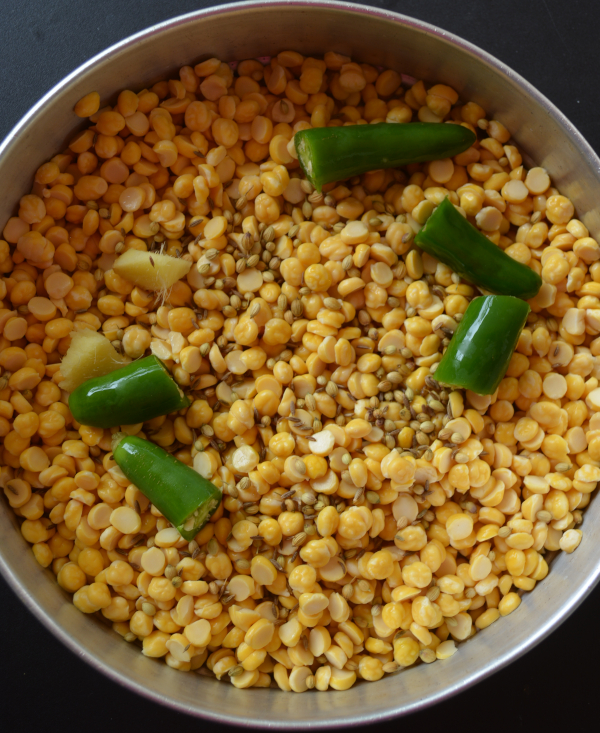
1 cup Bengal gram / chana dal
1 tsp. cumin seeds
1 tsp. coriander seeds
Salt to taste
1 inch piece ginger
2 green chillies
A handful of minced cilantro 
Oil to fry

Or

1 cup Bengal gram / chana dal
or
1/2 cup chana dal + 1/2 cup yellow moong dal 
1 tsp. cumin seeds
1 tsp. coriander seeds
1/4 tsp. peppercorns
Few cloves
Salt to taste
Chili powder to taste
Oil to fry

Directions:
* Soak Bengal gram / chana dal for about 2 - 3 hours in water and drain. Keep aide a handful of soaked chana dal. Add all ingredients except cilantro and the oil to a food processor or blender. (If using the second set of ingredients grind everything together except oil and proceed with the recipe.)
* Grind the ingredients to a coarse thick batter, adding no water. Add a tbsp. of water if needed.
* Transfer the ground batter, the reserved chana dal and minced cilantro to a bowl and gently mix.
* Heat oil in a medium sized wok / frying pan on medium heat. Drop a pinch of batter into the hot oil. If it immediately swims to the surface then the oil is hot enough to fry. If it sinks to the bottom then oil needs some more heating. Don't bring the oil to a smoking point.
* Pinch a big lemon sized portion from the ground mixture and place it on your left hand. Pat it into a thick oblong or round disc using right hand fingers. (It is usually easily to shape them. If one finds it hard to shape them for any reason, add a tbsp. or two of chickpea flour to the batter and proceed.)
* Gently transfer the disc from your left hand to your right hand fingers and carefully drop it into the hot oil from the sides of the frying pan. Prepare discs this way one by one and drop as many discs as the pan can accommodate.  

* Fry them until they turn lightly golden brown on both sides on low medium heat. There is no need to let them completely cook since they are going to be fried again later. Remove them with a slotted spoon / ladle, draining as much oil as possible. Drain them on a plate covered with absorbent paper towel.
* Repeat the process with the remaining dough to make vadas and turn off the stove.

* Let them sit for a while to cool down. Cut each disc into two or three pieces. 

* Heat the oil again on medium flame to deep fry the vadas. Keep the cut pieces of partially fried vadas ready.

* Deep fry vadas in batches on low medium heat, flipping intermittently, until they turn golden brown both sides. They should turn crisp not hard.
* Remove them with a slotted spoon and drain them on absorbent paper towel.

* Serve them hot with green chutney or a sauce. Use them in a kalmi vada chaat recipe if you have any left overs.

Jowar Kothimbir Vadi


Check out the Blogging Marathon page for the other Blogging Marathoners doing BM#104.
You are invited to the Inlinkz link party!
Click here to enter


Comments