HOME        |        ABOUT        |        COPYRIGHT        |        CONTACT        |         RECIPE INDEX        |         INDIAN THAALIS        |         MILLET RECIPES        |        EVENTS' ROUNDUP        

Showing posts with label Snacks. Show all posts

Wednesday, January 19, 2022

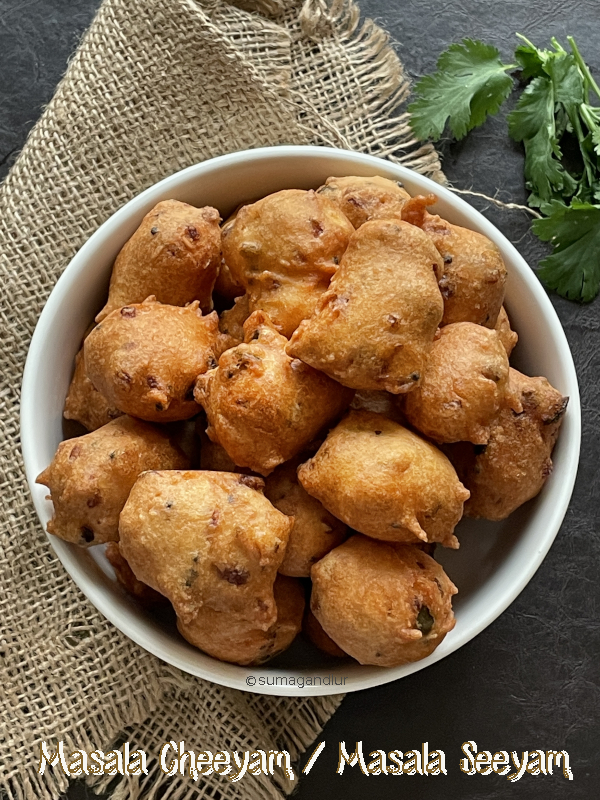
'A - Z' Tamil Nadu Recipe Series ~ C for Chettinad Masala Cheeyam / Masala Seeyam

Southern India is predominantly a rice growing region and the various local cuisines reflect the fact. I did not realize until now that the recipes I planned for this week were all rice based. Akkaravadisal is a sweet rice pudding usually served as an offering to god while brinji is a rice and vegetable based spicy one pot meal. Today's post cheeyam or seeyam is also rice based and is a popular snack from Chettinad cuisine.
 
Chettinad cuisine is perhaps the most well known one among the various regional cuisines of Tamil Nadu, though surprisingly Chettinad / Chettinadu region relatively forms a smaller portion of the state in a geographical sense. It is located mainly in the Sivaganga district and some portion of Pudukottai district. Chettinad is the home of a prosperous banking and business community called Natukottai Chettiars / Nagarathars and in fact, Chettinadu literally means 'Land of Chettiars'.

The Chettiars are known to be traders of salt and spices which is reflected in their cuisine where dishes are made with freshly ground spices. They also use a lot of dried meats and salted vegetables owing to the dry environment of the region. Most of the dishes are either eaten with rice or rice based. The cuisine boasts of both vegetarian and non vegetarian dishes.
Some of the dishes I have previously tried from Chettinad region are

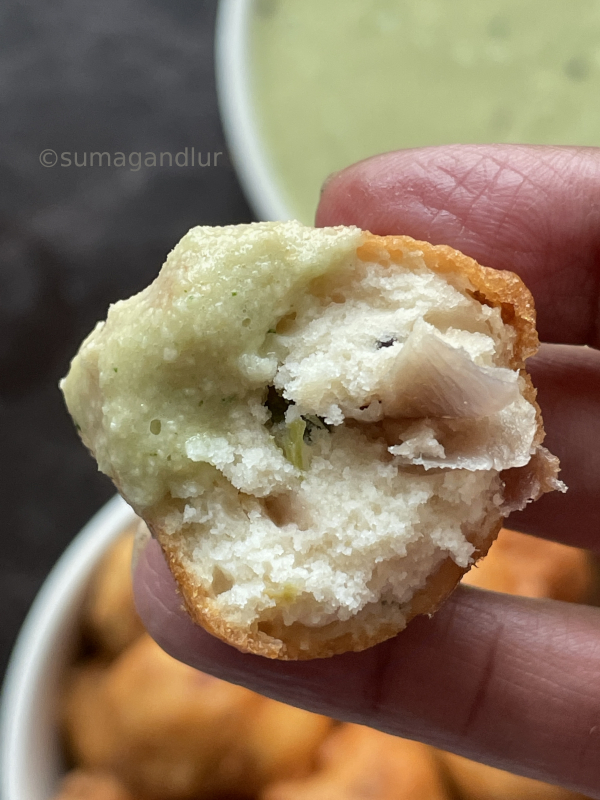
Today's masala cheeyam / masala seeyam also come from Chettinad region as I mentioned above. They are a popular snack from the region, made with a ground batter of rice and skinned black gram. This is a spicy version while there is also a sweet version of seeyam. These delicious fritters make a great evening snack and I read somewhere that people who are fasting also prepare this as an evening meal. 

This spicy version needs advance planning as the rice and black gram needs to be soaked for 2 - 3 hours. Grind the batter fluffy and fine like one does idli batter. Remember not to make it runny. Onions and green chilis are sautéed and added to the batter which add flavor to these fritters though I think the step of sautéing onions can be skipped. Adding raw onions to the batter is not  going to make that of a big difference as they are going to be deep fried anyway.
Ingredients:
1/2 cup rice
1/2 cup skinned black gram / urad dal
Salt to taste
Oil to deep fry 
Ingredients for sautéing:
1 tbsp. oil
1/2 tsp. mustard seeds
1 small sprig of curry leaves, finely minced
1 or 2 green chilies, finely minced
1 medium sized onion, finely minced
2 tbsp. fresh, shredded coconut

Directions:
1. Rinse and soak rice and skinned black gram in water for at least two hours. Drain the water completely after the soaking period.
2. Grind them together into a thick, fluffy batter adding water in small increments. Do not make the batter runny. (Using a grinder would help to use small quantity of water to while grinding. If the batter turns runny, adding a small quantity of rice flour would help but adding too much would turn the cheeyam harder.)
3. Meanwhile, heat a tbsp. oil in a pan and add mustard seeds. When they start to sputter add, green chili and curry leaves. Stir them for few seconds and add onions and salt enough for the onions.
4. Sauté until onion turns translucent and add the coconut. Stir once and turn off the stove.
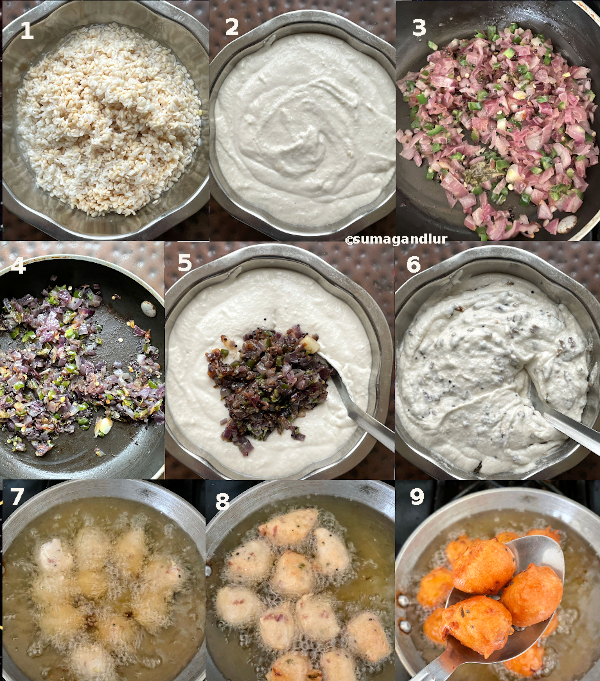
5 & 6. Add the sautéed onions and salt to the batter. (Keep in mind that onions contain salt too). Mix the batter well with a spoon and keep aside.
7. Heat oil for deep frying in a frying pan on medium heat. Drop a pinch of batter to the oil. If it swims to the surface, the oil is ready for frying. If not, heat the oil a little more. Dip your fingers / hand into the batter and shape a small ball. Gently drop into the oil. Repeat the step and drop as many balls as the pan can hold, without overcrowding. (There is no need to fret over the shapes. They don't to be exactly round.)
8. First they sink and soon float to the surface. Keep gently flipping them with a perforated spoon. Lower the heat to low - medium setting and fry until they turn golden brown throughout.
9. Remove them when done and transfer them onto a plate laden with paper towels to absorb the extra grease.
10. Reheat the oil if needed and repeat the steps with the remaining batter.
11. Serve them warm and enjoy with a spicy chutney or some ketchup.

This is going to be my contribution to this week's Blogging marathon, with the theme 'A -Z Series'. Check the page link to see what other marathoners are cooking.


Monday, October 12, 2020

Khichdi Muthia

Muthia are popular dumplings from the Gujarat region that are enjoyed both as a snack and as an addition to side dishes such as  undhiyu. The word 'muthia' is a reference to the way the snack is made, where the dough is shaped into oval dumplings, molding the dough in one's fist. The dough is also fashioned into cylindrical rolls, which are then steamed and sliced. They can either eaten as it is or pan fried with a tempering of mustard seeds and white sesame seeds using a little oil which leave the outer side of muthias slightly brown and crispy. These healthy bites make a fine accompaniment to your evening tea / coffee or can be eaten as a light meal too. They go well with a spicy or sweet chutney.

Muthia fall under 'healthy' recipe category since little or no oil is used to make them. There are variations in the muthia recipe, depending upon the vegetables and the flour base used. Today's version is a recipe that uses any left over khichdi which makes it a perfect recycle recipe. Extra khichdi from the lunch is transformed into a enjoyable, guilt free evening snack. I had used some left over pongal for these crispy, delicious muthia. Khichdi which is not too  watery is preferable or the quantity of the flours need to be adjusted accordingly to form a firm dough. 

Below are the links for some of the muthias I have posted.
Methi muthia (Baked version)

Ingredients for muthia:
1.5 cup khichdi
1.5 cup chick pea flour / besan
3/4 cup semolina / sooji
1/4 cup wheat flour / atta
Salt to taste
1 tsp. cumin seeds
1 tsp. chili powder
1/8 tsp. turmeric powder
2 pinches of asafoetida powder
1 cup chopped spinach (I used frozen spinach after thawing.)
1 tsp. lemon juice
1/4 tsp. baking soda
2 tsp. oil
Ingredients for tempering:
2 - 3 tbsp. oil
1/2 tsp. mustard seeds
1 tsp. sesame seeds
1 sprig of curry leaves
Ingredients to garnish:
Minced cilantro 

 Directions:
* Add all the ingredients mentioned under 'muthia' to a bowl.
* Knead the mixture to a firm dough. If the mixture appears loose, add extra flour. 
* Add water to a steamer or a cooker base and let it come to a boil.  
* Grease a steamer tray or a high rimmed plate. Grease your palms and divide the mixture to 2 or 3 equal portions. Shape each portion into a cylindrical roll of one diameter. Place them on the greased steamer plate / plate. 
* Or they can be shaped into small, oval dumplings with a fist. 
* Close the lid and if using cooker base, don't use the whistle for the lid. Steam them until a tooth pick inserted at the center comes out clean, about 20 - 22 minutes. Below are the steamed muthia in log and dumpling forms.
 
*  Let them cool a bit and then transfer them onto a cutting board and cut into about 1/2 inch thick slices.
* Heat oil in a pan on medium heat. Add mustard seeds and sesame seeds. If you prefer, add one or two sliced green chilis as well. When mustard seeds start to splutter, add curry leaves and muthia pieces. (I add the tadka later if sautéing the muthia pieces to golden brown.)
* One can just toss them for a couple of minutes and turn off the stove. Or the muthia can be sautéed until they turn slightly brown and crisp on the edges, by flipping them gently. Turn off the stove and garnish with cilantro if preferred. 
* Serve them hot with chutney or ketchup. 

Comments

Sunday, September 27, 2020

Andhra Snack and Sweet Platter ~ Fried Cashews

Some 'platters' are going to be posted here this week, as part of the 'Indian Thaalis and Platters' themed month long marathon. I could not decide what to present under this theme among the jumble of ideas I had. Initially I wanted to do a colorful poori platter, a thought I have been nurturing for years now. I however discarded the idea when I cooked three pooris under breakfast theme. Some of the ideas I kept contemplating included a millet platter, steamed dishes one, a platter with variety of pohas, pakoda platter, vrat ka khana, a breakfast platter with Karnataka style 'bhaaths', 'rice' platter, parathas, dosas, guilt free snacks, sandwiches, fusion food and so on. I kept on listing the dishes that could go under each category but ended up altogether with something else when it was time to implement the ideas.

The first one in the series is a traditional platter that would have served as snack time food for kids, up until a generation ago in the state of Andhra Pradesh besides some of them being festive food. This is what my mother and her siblings would have as an after school treat, all freshly homemade and stored in big tins to snack on for a week or two. It was a time when people moved around a lot instead of being couch potatoes and no machines to substitute for their work. It was a time when kids played around instead of being glued in front of televisions and computers. Also a time when low-cal food wasn't a fad yet and hence no guilt attached to eat these high calorie foods. In fact, traditionally sunnundalu is considered to be one of the highly nutritious foods to consume.


I am not into frying that much and it would be a big fat lie if I say that I make these traditional goodies as regularly as my grand mothers used to make. Thanks to a wedding I attended in Los Angeles this February, this platter happened. The bride's parents who happen to be my cousin and his wife had brought all those sweets and chegodi from India and I happened to get a big batch of those. The rest of the savory snacks are store bought. The idea of this traditional platter occurred when I remembered that these were the snacks my mother grew up on. The only exception being jeedipappu burfi / cashew burfis that I included in this platter because I had them though my grandmother never made them. The cashews would be a special treat for guests.

I have ariselu, ladlu and cashew burfi under the sweets category.

Ariselu / Athirasalu - This is a traditional sweet prepared using freshly ground rice flour and jaggery syrup. Freshly ground flour is the key here. Store bought rice flour doesn't work in this recipe. Small portions of the dough is patted and deep fried. This stays fresh at least for two weeks or more. This sweet is commonly prepared in south India, Maharashtra and even in some eastern parts of India and go by different regional names. 

Boondi laddu - These laddus are one of the traditional sweets of India and popular through out the country. These laddus are made with fried, tiny chickpea flour balls added to sugar syrup and shaped into balls. 

Cashew burfi / Jeedipappu burfi - Burfis made with a cooked mixture of ground cashews and sugar.

Sunnundalu - A highly nutritious laddu from Andhra Pradesh which is prepared using black garm / urad dal, both with husked and skinned variety. It can also be made with moong dal. The recipe can be found here.

I have chekkalu, chakli, chegodilu, mixture, spicy cashews under the savory snacks. Chekkalu are fried rice flour crisps that are also made in other parts of south IndiaBoth chakli and chegodi are rice flour based snacks that are deep fried. Chakli are spiral shaped where as chegodilu are tiny rings. Where as mixture is literally a mixture of boondi and spicy sevs with a tempering of curry leaves and peanuts.

The fried, spicy cashews are homemade which are quick and easy to make. They are a savory treat though high in calories. Any spice powders according to preference may be added but I added only salt and chili powder here as my grandmother used to make. Also remember not to fry the cashews in big batches. Cashews turn golden brown quick and by that time all the cashews are flipped / tossed, some may get burnt.
Ingredients:
Cashew nuts
Oil / ghee as needed for shallow frying
Salt to taste
Chili powder to taste

Directions:
* Heat ghee / oil in a pan and don't bring it to a smoking point. Add a handful of cashews.
* Fry them on low heat until golden brown on both sides, flipping them in between. Transfer them onto a plate lined with paper towel and fry the remaining cashews.
* Turn off the stove and transfer any remaining ghee / oil that was used to fry to another cup. Add the fried cashews back to the pan and add salt and chili powder. 
* Toss the pan well so that the cashews are coated well. Serve them immediately or store them in an airtight container.

Saturday, October 19, 2019

Chegodilu

Chegodi is a traditional snack item from Andhra cuisine that is shaped like a ring. The Tamilnadu version is called kola vadai. They may also bring to mind a somewhat similar looking snack from the neighboring Karnataka region called kodubale but the resemblance ends there. Chegodilu, the plural for chegodi are made using just plain rice flour with basic seasonings while kodubale is made with combination of rice flour and all purpose flour, which I realized just now that they are not posted yet in my blog. Another version uses peanut powder as well, as shown here which makes them super crunchy and addictive. 
Despite their popularity online, I would say that chegodilu are not frequently prepared anymore at homes compared to other chakli varieties. However they make a great festive or tea time snack and are quite easy to prepare if choosing to make a small batch. There is also a version made with all purpose flour alone. I had tried making chegodilu with jowar flour too but that recipe still needs some tweaking. Chegodilu can be made bigger and thinner than what I have made. Peanut oil is used traditionally to fry these but I used canola oil here. Any flavorless oil works fine. 
Ingredients: (Yield - About 28)
1 cup water
1 cup rice flour
1 tsp cumin seeds and/or carom seeds
Salt to taste
Chili powder to taste
1 tsp. butter / solid ghee or 2 tsp. oil
Oil for deep frying

Directions:
* Bring water to a boil in a pan and turn off the stove. 
* Meanwhile combine flour, cumin / carom seeds, salt, chili powder and ghee in a mixing bowl. Next add the hot water carefully and mix well with a spoon to combine. Use a ladle if the dough quantity is more. Don't use hands to mix since the water is hot.
Alternatively, the ingredients can be added directly to the hot water pan and mixed. The first method works best when one is used to eye ball the quantities of ingredients rather than working with measuring cups. One can add only as much water as needed to the flour mixture to make a stiff dough.  

* Let the dough come to room temperature or hot enough to handle. Knead the dough to just make sure that it is mixed well once it is safe to handle.
* Heat oil in a frying pan on medium heat. When a small pinch of dough is put into the oil, it must immediately swim to the surface  meaning the oil is at the right temperature to fry. If the dough sinks to the bottom of the pan then the oil needs some more heating. There is no need to bring the oil to a smoking point.
* While the oil is heating, shape some chegodilu. Pinch a marble sized dough and roll into a ball. Shape it into a log of uniform thickness. Bring the edges together and join them to make a ring. Repeat the process with the remaining rings. 
(The logs I made were about 1/2 cm thickness and about 5 inches long. Chegodilu can be made bigger and thinner than mine. Also one can shape only as many rings as needed to fit the frying pan while the rest of the dough can sit covered.) 

* Add the shaped rings to the frying pan and fry on low medium heat, flipping intermittently until it turns golden brown through out.
 
* Remove the fried chegodilu with a slotted spoon, draining as much oil as possible and transfer them to a plate covered with paper towel. Repeat the process of shaping and frying rings with the remaining dough. Adjust the temperature as needed as you proceed with frying. The temperature may need to be increased between each batch as the temperature of the oil falls down.
* Let them cool and store them in an airtight container. (Mine were gone in one sitting.) 

Friday, October 18, 2019

South Indian Mixture / Chow Chow

This mixture -  a melange of various flavored / textured / sized sevs (chickpea flour based snack), fried thick poha (flattened rice), fried chana dal (Bengal Gram), boondi along with a tempering of peanuts, cashews, curry leaves and turmeric makes a great snack for festive occasions like Diwali to share with some one or just to munch on as an afternoon treat. My medley here is influenced by south Indian style spicy mixtures available back home in every nook and corner and these kind of medleys also go by the name 'chow chow' in some parts of Bangalore which literally means a mixture / medley. It brings to mind the popular breakfast combo from the region which is called chow chow bhath for the same reason since it is a medley of savory khara bhath and the sweet kesari bhath. This can be easily customized according to one's taste preferences. Mixture in the first picture doesn't contain boondi or fried chana dal and the second image is of another variety where they were included. If need those 'khatta meetha' mix kind of flavors, add a pinch of citric acid and powdered sugar as needed and also some toasted raisins. It won't remain south Indian hot and spicy mix kind anymore though. I don't recall exactly but when we were kids, I think the store bought kind used to include fried dal moth as well.
 
I am not giving the recipe here since I have already posted recipes for sevs, fried poha aka chivda and boondi. Check my 'Snacks' page if looking for these recipes or any other snacks. I usually have sev, fried chana dal and plain boondi on hand and so making this kind of mixture is not a big deal. If starting from scratch, this recipe does demand some time and patience. There is no hard and fast rules about how much quantity of each variety of fried snacks should go into this mix. Combine varieties of plain and spicy sevs, fried thick variety poha, fried boondi (not the sweet kind), fried chana dal and any extra kind if you prefer in a mixing bowl. Heat 2 or 3 tsp. of oil in  a small pan and fry peanuts and / or cashews and curry leaves. Add turmeric before turning off the stove. Add this to the mixing bowl and toss the bowl well and taste the mixture before adding any seasonings. If you think curry leaves are going to be discarded, wait until the tempering cools down and crush the toasted leaves into bits. No one minds eating the flavorful tiny bits of the leaves. Keep in mind that some of the fried stuff like sev / chana dal are already spicy. Add salt as needed and shake the bowl to combine. Add a bit of chili powder or fried dry red chillies only if the mixture needs to be more spicier.

Saturday, October 12, 2019

Bandh Samosa / Bun Samosa

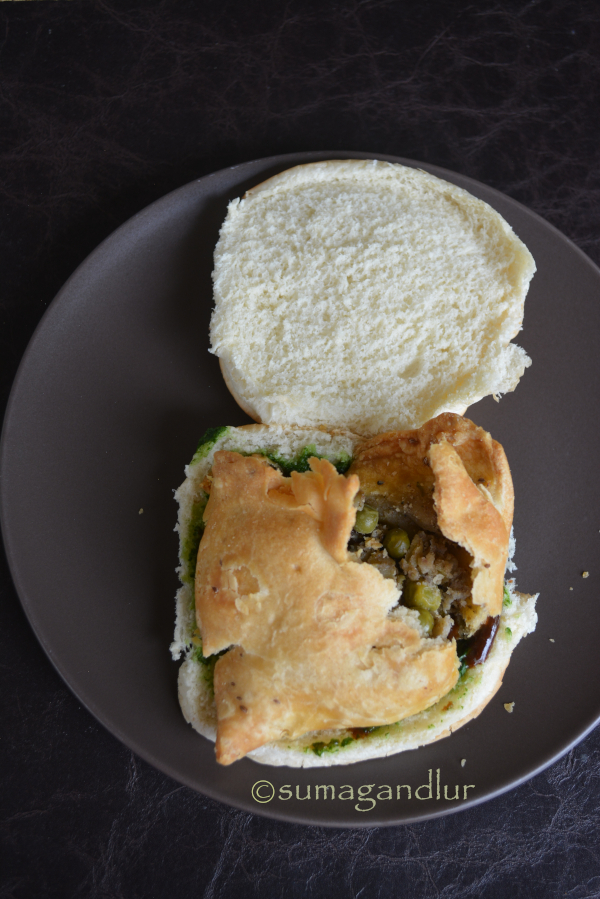
I had prepared this dish to be a part of the regional snacks for the 'Indian Sweets and Snacks' themed September marathon but held onto it once I saw this month's blogging marathon theme of 'stuffed dishes'. This bun samosa seems to be a signature street food dish of  Kasauli, a hilly town in the north Indian state of Himachal Pradesh. I came across this recipe when my husband was browsing through a YouTube video featuring street food from the region and the snack seemed to be right in our alley. We love samosa chaat and this bun is a part of that chaat wrapped in a toasted bun. What can go wrong with that, right? And so I got some buns and samosas from the store immediately and tried these delicious samosa buns. 

The shopkeeper in the video was selling these jamun buns as well to our surprise. He mentioned in the video that decades ago, a south Indian customer requested him to make that bun after giving him the directions for the recipe. He has been selling jamun buns ever since and the other shoppers have also caught on and now jamun bun has become a hot commodity along with bun samosas. My brother in law's family lived in Kasauli during 80's for a considerable amount of time and so we even wondered for a moment whether my brother in law was that customer by any chance since we haven't heard jamun buns outside of my husband's hometown. 😀

These mess free buns make a lip smacking snack or a mini meal on it's own. If one loves samosa chaat as we do, then this bun is for you. In this bun preparation, samosa, chole and the green and sweet chutneys all go inside a bun and then the bun is toasted using a generous amount of butter. For the uninitiated, samosas are a deep fried pastry with a spicy potato and pea filling while chole is the spicy chickpea curry where as the chutneys are the standard flavor boosters in most of the chaat items, a major portion of the Indian street food. Bun samosa is therefore also called as bundh samosa as the stuffing is encased inside the bun. The word 'bundh / bandh' means closed in Hindi. I used store bought buns, samosa and sweet chutney which makes the preparation relatively quicker and easier than starting from scratch.

Ingredients:
4 burger style buns 
Green chutney as needed
Sweet chutney as needed
4 samosas
About 1 cup chole masala
2 tbsp. butter
* I opened the burger bun for pictures sake but the buns can be cut open only slightly and the samosa and curry can be stuffed as in a pocket. Spread green and sweet chutneys liberally on one side of the bun.
* Slightly mash a samosa and place it over the chutney side.

* Pour over a ladeful (about 1/4 cup or as needed) of chole curry. I made it slightly thicker but the consistency of the curry can be like the regular one.
* Cover it with the other side of the bun.
* Heat a griddle and melt a little butter over it. Place the bun over the griddle and toast until golden brown on both sides. Repeat the stuffing and toasting parts with the remaining buns. Serve them immediately.

bmlogo
This post is an entry for Blogging Marathon #105 under 'Stuffed Dishes - Buns' theme. Check what other marathoners are cooking, clicking at the link.

Comments

Wednesday, October 2, 2019

'Indian Sweets and Snacks' - A Recap


Readers who follow my blog might me aware that I am a part of blogging marathon group where we sign up to post recipes each month. April and September months are meant for month long marathons where we post recipes each day with set themes, barring Sundays. I have been part of these mega marathons since it started excepting a few owing to my India trips. I posted some traditional sweets and snacks from India this September. Before posting round up of those recipes, below are links for my previous mega marathons with the mentioned themes. If interested, click on those links and you will find about 26 to 30 dishes in each category.

Apr 2019 A - Z Indian Biryani / Pulao / Khichdi Series
Apr 2018 A - Z Indian Street Food
Sep 2016 A - Z Indian Rice Dishes
Apr 2016 A - Z Andhra Cuisine
Sep 2015 Buffet on the Table
Apr 2015 Fire up Your Oven (Baking Recipes)
Sep 2014 Around the World in 30 Days (International Recipes)
Apr 2014 Indian Food Odyssey - Recipes from 30 States
Sep 2013 A - Z Event with 4 Set Themes
Apr 2013 Event with 4 Different themes


This September's marathon was based on Indian sweets and snacks, divided between four themes. This marathon was a learning curve with some surprises thrown in, indeed. I would have never thought that I would even try making the tricky khandvi or the tedious khakras from Gujarat, at home. For a person who doesn't even make urad dal vadas to avoid deep frying, Uttar Pradesh's dahi gujiyas were a revelation. I had no idea such a recipe even existed where a batter would act as an outer covering for stuffing a gujiya instead of a flour based dough and more surprising was that I enjoyed it with full gusto. Neither I had an inkling that I get to try and enjoy a delicious treat sitting in my home, that was originally created for the officers of British Raj in Ooty, a hill station in the south Indian state of Tamil Nadu. There was this snack from Ratlam in Madhya Pradesh, a spicy sev that was created to satiate the Mughal emperors and now boasts a GI tag to it's name. What was new and extremely pleasing in the sweets category was a simple yet flavorful kheer made with coconut water, coconut milk and the tender coconut meat which has become now my 'favorite' kheer. The black eyed peas based dumpling, pandoli was an interesting addition to my idli repertoire. Apart from these, if you are interested to see what other delicious Indian snacks I got to try this marathon, check out the below links.


The first week was meant for sweets and I went ahead with simple yet festive treats keeping in mind Navratri and Diwali festivals. What conjures up in my mind when I think about an Indian sweet is a laddu / burfi / kheer / halwa, or a stuffed sweet rather than dairy based sweets. My mind automatically associates the latter category or the deep fried varieties like jalebis / jhangri kind to a sweet shop / bakery somehow. I included a recipe from each of the above categories along with the ever popular jamun recipe, a dry one this time. 


Dry Gulab Jamun (North India)


Elaneer Payasam (Tamil Nadu)

Godhuma Sojjappalu (Andhra Pradesh)

The second week's theme was to pick some traditional snacks from one particular state. I did not have to think much and blindly picked Gujarat, a state in the western part of India that happens to be the land of farsans aka snacks. The local cuisine not only has a wide range of deep fried snacks that have become popular among the Indian diaspora but also can boast about guilt free ones. I went ahead with the latter category picking the healthy, traditional snacks that can be enjoyed by everyone, including diabetics. Five of those dishes are steamed snacks and most of them can be enjoyed as a mini meal too. 

Damni Dhokla (Gujarat)


Dal Pandoli (Gujarat)

Sev Khamani (Gujarat)

Methi Khakhra (Gujarat)


The third week was a free choice and we could pick whatever we preferred. I went ahead with some more guilt free, regional snacks that were mostly quick fix ones as well. None were deep fried except the kalmi vada chaat, where I used the vadas that were fried as part of the final week theme.

Bafauri (Chattisgarh / Madhya Pradesh)


Jhal Muri (West Bengal)


The fourth week was meant for eight traditional Indian snacks that were agreed upon beforehand by the participating team. The snacks chosen were from four corners of the country and a few proved to be new and delectable surprises to me.

'Aakukoora' Pappu Chekkalu (Andhra Pradesh)


Ratlami Sev (Madhya Pradesh)

'Jowar' Kothimbir Vadi (Maharasthra)

Kalmi Vada (Rajasthan)

Ooty Varkey (Tamil Nadu)

Dahi Gujiya (Uttar Pradesh)


Check out the Blogging Marathon page for the other Blogging Marathoners doing BM#104.

Comments