HOME        |        ABOUT        |        COPYRIGHT        |        CONTACT        |         RECIPE INDEX        |         INDIAN THAALIS        |         MILLET RECIPES        |        EVENTS' ROUNDUP        

Showing posts with label Fried Snacks. Show all posts

Wednesday, January 19, 2022

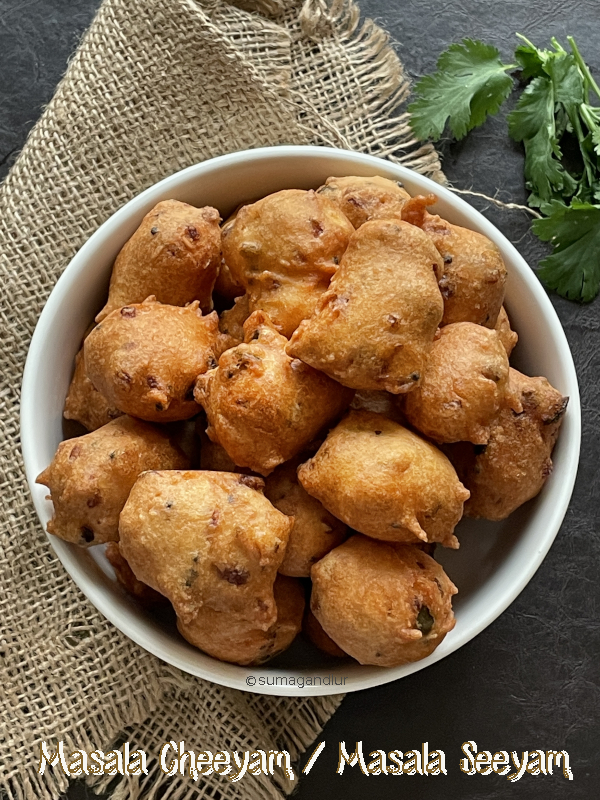
'A - Z' Tamil Nadu Recipe Series ~ C for Chettinad Masala Cheeyam / Masala Seeyam

Southern India is predominantly a rice growing region and the various local cuisines reflect the fact. I did not realize until now that the recipes I planned for this week were all rice based. Akkaravadisal is a sweet rice pudding usually served as an offering to god while brinji is a rice and vegetable based spicy one pot meal. Today's post cheeyam or seeyam is also rice based and is a popular snack from Chettinad cuisine.
 
Chettinad cuisine is perhaps the most well known one among the various regional cuisines of Tamil Nadu, though surprisingly Chettinad / Chettinadu region relatively forms a smaller portion of the state in a geographical sense. It is located mainly in the Sivaganga district and some portion of Pudukottai district. Chettinad is the home of a prosperous banking and business community called Natukottai Chettiars / Nagarathars and in fact, Chettinadu literally means 'Land of Chettiars'.

The Chettiars are known to be traders of salt and spices which is reflected in their cuisine where dishes are made with freshly ground spices. They also use a lot of dried meats and salted vegetables owing to the dry environment of the region. Most of the dishes are either eaten with rice or rice based. The cuisine boasts of both vegetarian and non vegetarian dishes.
Some of the dishes I have previously tried from Chettinad region are

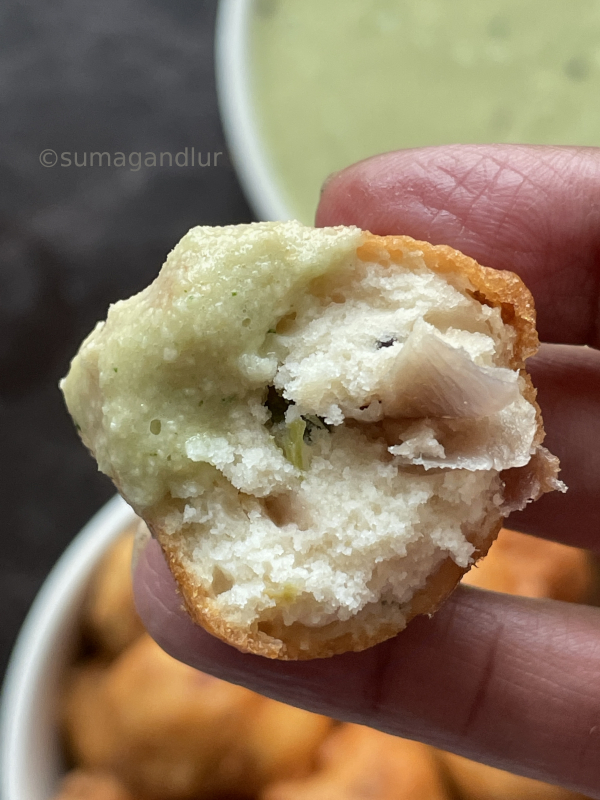
Today's masala cheeyam / masala seeyam also come from Chettinad region as I mentioned above. They are a popular snack from the region, made with a ground batter of rice and skinned black gram. This is a spicy version while there is also a sweet version of seeyam. These delicious fritters make a great evening snack and I read somewhere that people who are fasting also prepare this as an evening meal. 

This spicy version needs advance planning as the rice and black gram needs to be soaked for 2 - 3 hours. Grind the batter fluffy and fine like one does idli batter. Remember not to make it runny. Onions and green chilis are sautéed and added to the batter which add flavor to these fritters though I think the step of sautéing onions can be skipped. Adding raw onions to the batter is not  going to make that of a big difference as they are going to be deep fried anyway.
Ingredients:
1/2 cup rice
1/2 cup skinned black gram / urad dal
Salt to taste
Oil to deep fry 
Ingredients for sautéing:
1 tbsp. oil
1/2 tsp. mustard seeds
1 small sprig of curry leaves, finely minced
1 or 2 green chilies, finely minced
1 medium sized onion, finely minced
2 tbsp. fresh, shredded coconut

Directions:
1. Rinse and soak rice and skinned black gram in water for at least two hours. Drain the water completely after the soaking period.
2. Grind them together into a thick, fluffy batter adding water in small increments. Do not make the batter runny. (Using a grinder would help to use small quantity of water to while grinding. If the batter turns runny, adding a small quantity of rice flour would help but adding too much would turn the cheeyam harder.)
3. Meanwhile, heat a tbsp. oil in a pan and add mustard seeds. When they start to sputter add, green chili and curry leaves. Stir them for few seconds and add onions and salt enough for the onions.
4. Sauté until onion turns translucent and add the coconut. Stir once and turn off the stove.
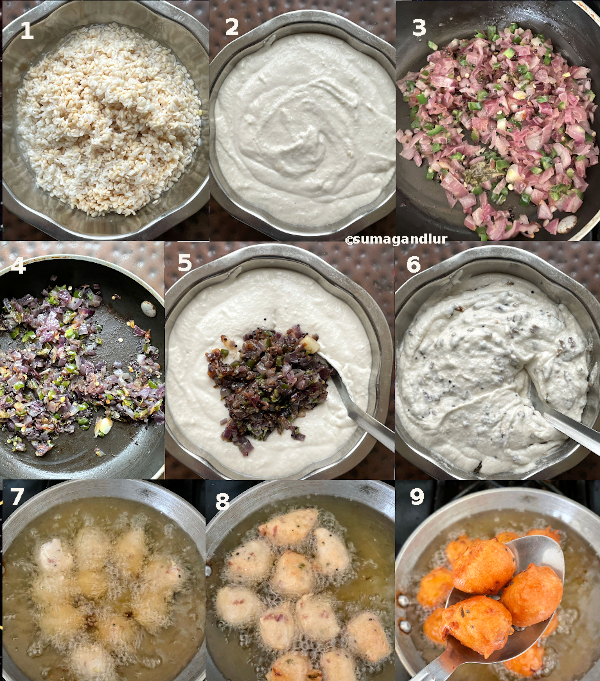
5 & 6. Add the sautéed onions and salt to the batter. (Keep in mind that onions contain salt too). Mix the batter well with a spoon and keep aside.
7. Heat oil for deep frying in a frying pan on medium heat. Drop a pinch of batter to the oil. If it swims to the surface, the oil is ready for frying. If not, heat the oil a little more. Dip your fingers / hand into the batter and shape a small ball. Gently drop into the oil. Repeat the step and drop as many balls as the pan can hold, without overcrowding. (There is no need to fret over the shapes. They don't to be exactly round.)
8. First they sink and soon float to the surface. Keep gently flipping them with a perforated spoon. Lower the heat to low - medium setting and fry until they turn golden brown throughout.
9. Remove them when done and transfer them onto a plate laden with paper towels to absorb the extra grease.
10. Reheat the oil if needed and repeat the steps with the remaining batter.
11. Serve them warm and enjoy with a spicy chutney or some ketchup.

This is going to be my contribution to this week's Blogging marathon, with the theme 'A -Z Series'. Check the page link to see what other marathoners are cooking.


Wednesday, August 25, 2021

Kele Ki Tharuva / Kele Ki Tharua


Tharua / tharuva are crisply fried, vegetable slices that are served as a side dish / snack from Bihar and Jharkhand regions. I came across them on a YouTube video featuring a Bihari meal, from Mithila region to be particular. The home-cook showed tharuva made with both plantains and bitter gourds. The vegetables are peeled, sliced lengthwise and then sprinkled with a mixture of rice flour and spices and then are shallow fried. Mustard oil which is the local cooking medium is used but tharua can be fried using any neutral tasting cooking oil. Making tharuva is quite simple and straight forward and they remain crisp for a longer time. They can be therefore made a couple of hours before serving unlike bhajiya which turn soggy if sitting longer. 

The cook had used small sized green plantains which are widely available in India and chopped them once lengthwise. If chopped in that fashion, one is basically ending up with two thick and long slices from each plantain. I have made this plantain tharua three times so far, each time cutting plantains in different sizes. The first time, I kept the size of the pieces similar to the one I saw on the video and it took longer to cook them. My mother had coincidentally called when I was frying them. She mentioned seeing a similar dish on a cook show and suggested to chop the plantains into small, thin strips, which I followed this time. I have also tried chopping them into thin dices which I enjoyed the most though they may not be the traditional style. Whatever method you chose, try to keep the pieces in similar size and thickness so that they get fried at the same time, uniformly. Peel and remove the seeds if using bitter gourds for tharua.

Ingredients:
2 big sized plantains
3 or 4 tbsp. rice flour
1 tsp. coriander powder
1 tsp. chili powder or to taste
Salt to taste
1/4 tsp. turmeric powder
Oil to fry 

Directions:
* Chop the ends and peel the plantains. Cut each plantain lengthwise into two pieces. Chop each piece lengthwise into three portions. Depending upon the length of each piece, cut them into two or three crosswise.

* Combine rice flour, coriander powder, chili powder, salt and turmeric powder in  a wide plate. Roll the chopped plantain pieces in the mixture and sprinkle a tbsp. or two of water over the pieces to bind. (There may be some leftover rice flour mixture if the plantains are smaller in size.)

* Heat about 1/8 inch oil on medium flame in a wide skillet. There is no need to bring the oil to a smoking point. Drop gently plantain pieces into the hot oil. Add as many as the skillet can fit without overcrowding. Fry them for about a minute and lower the heat. Continue frying, turning them over occasionally until they turn golden brown. 
* Serve them as part of a Bihari thali or as a side dish or as a snack.

This post is an entry for Blogging Marathon and check the link to find out what other marathoners are cooking.

Comments

Saturday, September 12, 2020

Mixed Dal - Spinach Vada ~ Palakoora Vadalu

A fritter of some kind commonly called vada / bajji is usually included in festive menus among south Indians. Pakodas don't figure in the menu as they contain onions, at least in our family. Vadas usually involve soaking and grinding the lentils whereas bajjis are made with vegetable slices dipped in a batter of spicy chickpea flour. The latter is easier as no grinding is involved but both involve deep frying which I usually avoid. These vadas happened because of the thaali theme or otherwise I would have been content with some microwaved papad. My husband needs to thank Valli for sure. 😀
These vadas are made along the lines of masala vadas / chana dal vadas which happen to be my favorite among the vada category and used to be a 'must to have dish' on my birthdays while growing up. Why not include something I like if I am going to fry anyway? was my thought process when I made these. I made it with a mixture of pulses / dals as we sometimes do and also added some spinach instead of onions as it was a festival day. BTW Kannadigas call the masala vada/ vade made without onion as ambode and it is a popular festival snack among Brahmin community. Add some minced onion for extra flavor if not serving on auspicious days. These cripsy vadas make a great addition to any festival meal like this one which I made for Navratri / Dasara or a party platter, when served warm. They also make a great afternoon snack. 

Ingredients: 
1/2 cup split chickpeas (pachi senagapappu / chana dal)
1/4 cup skinned black gram (minapappu / urad dal)
1/4 cup pigeon peas (kandi pappu / toor dal)
2 spicy green chilies / or as needed 
Salt as needed
1 cup washed and finely chopped fresh spinach
A handful of cilantro, roughly minced
2 stalks of curry leaves, roughly minced
Oil to fry vadas

Directions:
* Rinse the dals / lentils with water and drain. Soak them in water for about 2 to 3 hours. 

* Drain the lentils in a colander until all the water is completely gone. Portion out a handful of soaked lentils and keep aside.
* Grind the rest of the lentils along with salt and green chilies to a slightly coarser batter, without adding any water. (I usually grind it in my food processor.)
* Transfer the batter to a wide bowl and add the saved lentils which were not ground and chopped greens. Mix well to combine.
* Meanwhile, heat oil for frying a in a thick bottomed pan or a kadai. The oil should be hot enough to fry but not reach a smoking point. When one drops a pinch of vada batter into the hot oil, it should immediately swim to the surface of the oil which means the oil is ready for frying. If not then heat the oil for some more time. 
* Take a small lemon sized portion of the batter onto your non dominant hand and pat it into a thick disc. (I forgot to click for these steps.)
* Drop it into the hot oil from the sides carefully. Add as many discs as the pan holds without over crowding. Fry them on low medium flame until they turn golden brown on both sides, flipping them now and then. Don't fry them on high heat since they would be under cooked inside while getting brown faster from the outside. Remove them with a slotted spoon and drain them on a plate covered with paper towel.
* Repeat the steps with the remaining batter. 
* Enjoy vadas as part of a festive meal or as an evening tea time snack.
 

Comments

Monday, September 30, 2019

Bengali Veg Chop / Vegetable Chop / Bhejetebil Chop

Today marks the last day of this mega marathon featuring 'Indian sweets and snacks' and day after tomorrow, I am going to post a round up of the dishes I posted this month. The last one in the series is a Bengali street food called vegetable chop or in colloquial terms, bhejetebil chop. It is a Bengali take on the cutlet recipe and the croquettes are oblong shaped. The vegetables used here are beets, carrot and potatoes. Some fry onions and add them as well. The prepared vegetable mixture is well seasoned with a local spice powder called bhaja masala, coated in a flour slurry and seasoned bread crumbs and then deep fried. The resulting chops are very delicious, crispy from outside and soft from inside. The chops are served along with ketchup and onion- cucumber salad but they go good with any spicy chutney. 

I am not into deep frying honestly speaking and as my husband points out I deep fry something only when the blog recipe demands but not upon his requests, which happens to be a fact. My both kids are not at all tempted and don't touch deep fried foods, especially the vadas / bahjias kind of stuff and my mother keeps telling me that it's all my doing. I tell her that it's a blessing in disguise. 😉 And so, I kept postponing this recipe until last month only ending up trying it twice because I was not very happy with the recipe and also the pictures I took. 

I followed Sandeepa's recipe for these chops. The first time I followed the method of boiling and grating vegetables and then cooking to dry up any moisture present. I felt the mixture was on a softer side at that time though on hindsight I realize it was perfect and I did not do two things which would have given me the perfect chops. She mentioned adding some bread crumbs / flour if the mixture appeared to be in need of binding. I did not do it. The second thing was I did not coat the rolls generously with bread crumbs which made some of the rolls to fall apart while deep frying. I shallow fried the remaining chops that time. The second time I chose to grate carrots and beets and saute in a pan, without any water added. I cooked the potatoes separately and dried them thoroughly. The resulting mixture I made for rolls was on a drier side and made perfect rolls. I choose to deep fry the first time going the authentic way but the second time I chose to opt for shallow frying. I coated with seasoned bread crumbs lightly since I was shallow frying but coat generously if deep frying. My husband suggested to try air frying them since everything in the rolls except the slurry was cooked so that I can avoid the hassle of frying. I wasn't sure and went ahead with shallow frying. Also here is an important tip to note. Taste the mixture used to prepare chops before hand and keep it on a spicier side since the vegetables used here are naturally sweet. Otherwise the chops end up being sweeter and one may not enjoy if expecting some chatpata cutlets.

Ingredients for bhaja masala:
1/2 tsp. coriander seeds
1/2 tsp. cumin seeds
1/2 tsp. fennel seeds
6 cloves
12 peppercorns
3 green cardamom
1/2 inch cinnamon piece
2 or 3 dried red chillies
1 tiny bay leaf

Ingredients for the rolls:
2 big sized carrots
2 medium sized beetroot
2 big sized potatoes
2 tbsp. oil
1 tbsp. minced ginger
2 to 4 finely minced green chillies (Adjust the quantity as needed.)
Salt to taste
Red chili powder to taste
1/4 cup toasted, skinned and halved peanuts
1 tbsp. finely minced cilantro
Bread crumbs / all purpose flour (optional)
Oil for frying

Ingredients for the slurry:
1/4 cup chickpea flour
1/4 cup water or more
Step 1 - Directions for preparing bhaja masala:
* Saute the spices individually on low flame without burning. One can make bhaja masala just with cumin seeds and red chillies.
* Let them cool and then grind them together finely.

Step 2 - Directions for preparing the mixture for chops:
The vegetables used are beetroot, carrot and potato. Either you can boil them and then grate / mash them. Or grate and cook beets and carrots while boiling and mashing the potatoes separately. I have tried both the methods and thought the second method makes the veggie mixture firmer compared to the first method. If one is trying these chops for the first time, then I recommend to grate and cook the vegetables. Or if following the first method, drain the cooked vegetables thoroughly and use some binding if needed.

Method 1:
* Peel and pressure cook the vegetables (without chopping) adding enough water for one / two whistles. When the valve pressure is gone, remove the lid and drain the vegetables.
* Mash potatoes. Grate beets and also carrot if you can or mash the latter. The vegetables don't need to be finely mashed. It is ok if they are grainy.
 
* Heat a tsp. of oil and add ginger, green chillies, prepared vegetables, 1 heaped tbsp. of bhaja masala, salt, chili powder. Saute them together until the excess water dries up and the mixture comes together. Add the roasted peanuts and coriander and mix. If needed 2 tbsp. of bread crumbs or all purpose flour can be added for binding. (My mixture still was loose and I did not notice the tip of adding flour or crumbs to bind which is crucial, I guess. Also I sauteed just the vegetables and added other ingredients just to combine.)

Method 2: (I halved the recipe the second time.) 
* Peel, chop and boil potatoes in a microwave or on stove-top and drain completely. Mash and keep it aside.
* Peel and grate beets, carrots and ginger. Chop the green chillies finely.
* Heat oil in a pan and add green chillies and ginger. Saute them for about 30 seconds and add the grated carrot and beets. 
* Cover and cook on low medium flame until the vegetables are done.
* Add bhaja masala, salt, chili powder to the pan and mix. Turn off the stove and add peanuts, and coriander leaves. Taste and add chili powder more if needed. Keep the mixture spicier since the carrots and beets are on the sweet side. 
Step 3 -  Directions for shaping and coating the chops:
* Mix all the ingredients well to combine and shape them into the traditional oblong shapes or as discs. (These rolls were from the first time and the second time, they were very firm. )
* Sieve chickpea flour and make a lump-free slurry adding water. All purpose flour / cornstarch can be added instead of chickpea flour.
* Take a roll gently and dip it in the chickpea flour slurry coating it's entire surface.
* Gently lift the roll and let any extra liquid coating it drip into the flour slurry bowl. Immediately roll in seasoned bread crumbs. Repeat the steps of dipping the roll in slurry and coating them in bread crumbs with all the vegetable rolls. If deep frying, coat them with bread crumbs a little more than my rolls shown below. I have coated them lightly. Refrigerate them for about an hour. The rolls at this step can be refrigerated for 3 - 4 days and can be fried later when needed. Or can even be frozen for a longer period of time given that they are thawed before frying them. (These rolls were made following the second method where beets and carrots were grated and then cooked. The rolls were easy to shape and they held the shape even after dipping in slurry.) 
* I coated a batch of rolls in semolina since the bread crumbs were garlic flavored which I don't prefer. (These rolls were made the first time, from boiled and then grated vegetables. They held the shape but after dipping them in slurry, I had to reshape a few rolls and were not perfect looking.)
Step 4 - Frying the chops:
* Heat oil in a frying pan without bringing it to smoking point. The quantity of oil depends upon whether one is deep frying or shallow frying the rolls. When the oil is hot, add the prepared rolls to the pan. 
* Keep rotating and fry them to golden brown. Remove them with a slotted spoon, draining as much oil as possible. Transfer them to a plate covered with a paper towel. Repeat the frying step with the remaining rolls. Serve them immediately sprinkling some chaat masala and ketchup / spicy chutney.

So far my recipes in the series of 'Indian Snacks and Sweets' are below.

First week - Indian Traditional Sweets
Malaadu / Hurigadale Unde
Dry Gulab Jamun
Coconut Burfi / Kobbari Mithai
Almond Halwa / Badam Halwa
Elaneer Payasam
Godhuma Sojjappalu

Second week - Snacks from Gujarat, India
Damni Dhokla
Doodhi Muthia / Lauki Muthia
Dal Pandoli
Methi Khakhra
Pressure Cooker Khandvi

Jhal Muri
Jowar Kothimbir Vadi
Kalmi Vada
Ooty Varkey
Dahi Gujiya

Check out the Blogging Marathon page for the other Blogging Marathoners doing BM#104
You are invited to the Inlinkz link party!
Click here to enter
Comments

Wednesday, September 25, 2019

Ratlami Sev

It was decided by the blogging marathon group that 'Ratlami Sev' is going to be today's regional snack. Sev / Kara sev, deep fried savory snacks made with chickpea flour are ubiquitous in India. They are sold by sweet vendors, at bakeries and even made at homes. The fine variety sev happens to be a part of many chaats, a group of popular Indian street foods. Then one may start to wonder what so great about Ratlami variety when you can see sev everywhere. I began to explore about it and ended up at this Government of India' geographical indication tags journal where the information about it's origin, preparation and how the ingredients are chosen are given in detail. Besides, I had a seen a Ratlami sev maker in Ratlam on YouTube earlier which came handy.  
Ratlami is pronounced as Ru(as in run)-th(as in thermal)-laa-me. Ratlami sev comes from a town in Madhya Pradesh called Ratlam and is unique in terms of the spice blend used in the recipe. If my memory serves right, the first time I came across the town's name was in the movie, 'Jab we met' which by the way happens to be one of my favorite movies. Enough digression. ðŸ˜Š According to the website mentioned above, the origin of this sev dates back to more than 136 years ago. During 19th century, the Mughal emperors seem to be passing through the Malwa region and wished to have sevaiyan aka wheat vermicelli. However they could not procure wheat locally and and ordered the Bhils, the local tribal people to prepare sevaiyan with the chickpea flour instead, which was available. The sev prepared thus was called Bhildi sev and this is considered to be the predecessor of the present day crispy and spicy Ratlami sev. The Sakhlecha family of Ratlam was one of the first commercial sev manufacturers who had begun to prepare and sell Ratlami sev in their shop about a century ago. The sev now is also prepared in other regions of the state, Gujarat, Maharasthra, and Delhi though Ratlamis seem to claim their uniqueness. The Ratlami seller in the video was attributing it to the water of the region that is used in the sev preparation

No two recipes that I had come across online had a similar spice blend used in the recipe. The person who was enjoying the Ratlami sev on the video had clearly mentioned the spices which matched with those in the journal. I blindly followed the recipe since it seemed to be the most authentic one. The Ratlami sev is made with chickpea flour alone without adding any other flours. Salt and a spice blend of black pepper, cloves, cumin, asafoetida and dried red chillies are used. It seems that the spices used in Ratlam are different than the ones used in Gujarati versions of ratlami sev. Spices can be customized  in the recipe according to one's preferences of course if they cannot handle the spices. However when Ratlami sev is tasted, it wouldn't hit immediately but one would feel the taste of asafoetida and cloves at the back of the throat once they finish eating.

Peanut oil is used for deep frying the sev, which is most common in Indian cooking though I used canola oil. The prepared sev dough needs to be used immediately and is passed through a sieved ladle aka jhara directly over the wok containing hot oil. It seems that the vendors keep the oil hot all the while, fry the sev for 2 to 3 minutes and remove them once the bubbling reduces and sev floats to the surface.  

I used a chakli press instead to make my sev, using a plate with 3 wholes. (Use an attachment with slightly smaller holes if you have one but not the tiny holes one. I had the one I used and the other one was to make fine sev). I forgot the part that mentioned to fry for only a few minutes and was aiming for a light brown color sev that I saw in Ratlam video and was also somehow confused them with the reguar chakli making which need extra time than sev making. And so I ended up frying the first two chaklis more than needed. They are done very quickly, end up being crunchy once they cool down and don't require as much frying as the other chaklis usually take. 
Online recipes mention an extra step of blending the oil, water and baking soda till it gets frothy and then add it to the dry ingredients.  I noticed that the street vendors were not following this step and besides, lemon juice and soda were not even part of the traditional recipe as per the website. I therefore followed the regular method of chakli /sev making since the addition of hot oil and soda in the dough give the sev the desired texture anyway. They are eaten along with tea or poha in Ratlam. 

Ingredients for the spice blend:
3/4 tsp. peppercorns
1/2 tsp. cloves
1/2 tsp. cumin seeds
Ingredients for sev:
1 and 1/4 cup chickpea flour / besan
Salt to taste (somewhere around 1 tsp.)
1/8 tsp. turmeric powder
1/4 tsp to 1/2 tsp. asafoetida powder
Chili powder to taste
1 tsp. lemon juice
1/4 tsp. baking soda
3 - 4 tbsp. hot oil
Water as needed (I used about 1/4 cup.)
Oil to deep fry sev
Equipment:
A deep pan / wok
Chakli / murukku press and attachment plate with holes

Directions:
* Heat about 2 cups of oil in a small sized wok or a deep pan on medium flame. 
* Dry roast cloves and cumin seeds and let them cool. Once cool, grind them along with the peppercorns finely.

* Add this spice powder, turmeric, salt, chili powder and asafoetida to the chickpea flour in a mixing bowl. 

* Add 3 to 4 tbsp. hot oil to the besan mixture and combine. Stir with a spoon if needed. Add baking soda and lemon.
* Then pour a tbsp. of water over the soda. Add remaining water gradually and prepare a dough, the consistency of which is not too thick or runny. 

* Add a pinch of the dough into the hot oil. If it swims to the surface immediately, then the temperature is right to fry the sev. 
* Use chakli press and an attachment with bigger holes than the  one which makes fine sev. I used slightly bigger holed attachment since I didn't have smaller than that.

* Grease the inside of the chakli press and fill with the dough. 

* Press and squeeze the mold over the hot oil to make spirals.
 
* When the dough in the press is all used up, refill it with dough and keep it ready.

* Fry the sev, flipping in between until it turns light golden through out. Remove the sev using a perforated ladle and drain on a paper towel covered plate to absorb the excess oil. 

* Repeat the steps with the remaining dough and prepare sev the similar way.
* Let them cool and once they cool down, crush them gently to make them into bite sized pieces. Store them in an air tight container.
* Serve them along with tea or Indori poha.

So far my recipes in the series,

First week - Indian Traditional Sweets
Malaadu / Hurigadale Unde
Dry Gulab Jamun
Coconut Burfi / Kobbari Mithai
Almond Halwa / Badam Halwa
Elaneer Payasam
Godhuma Sojjappalu

Second week - Snacks from Gujarat, India
Damni Dhokla
Doodhi Muthia / Lauki Muthia
Dal Pandoli
Methi Khakhra
Pressure Cooker Khandvi

Jhal Muri
Comments