HOME        |        ABOUT        |        COPYRIGHT        |        CONTACT        |         RECIPE INDEX        |         INDIAN THAALIS        |         MILLET RECIPES        |        EVENTS' ROUNDUP        

Showing posts with label Chettinad Cuisine. Show all posts

Wednesday, January 19, 2022

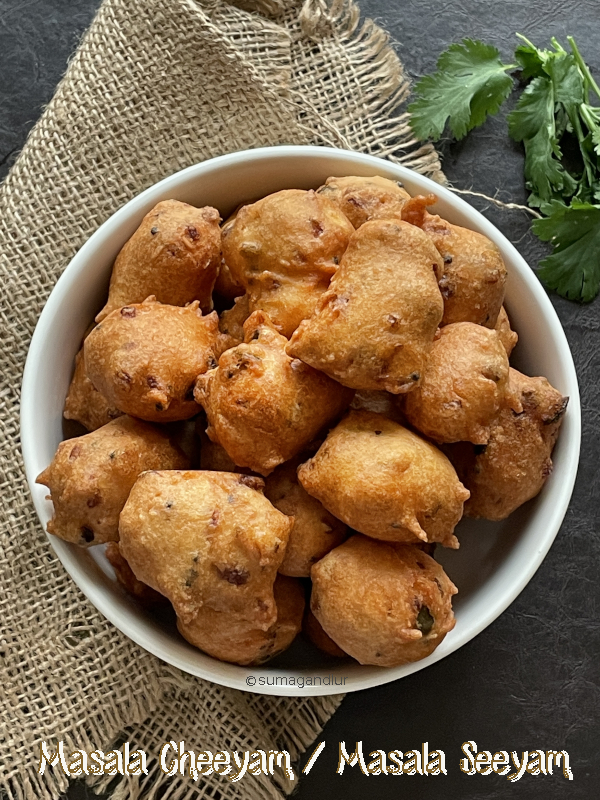
'A - Z' Tamil Nadu Recipe Series ~ C for Chettinad Masala Cheeyam / Masala Seeyam

Southern India is predominantly a rice growing region and the various local cuisines reflect the fact. I did not realize until now that the recipes I planned for this week were all rice based. Akkaravadisal is a sweet rice pudding usually served as an offering to god while brinji is a rice and vegetable based spicy one pot meal. Today's post cheeyam or seeyam is also rice based and is a popular snack from Chettinad cuisine.
 
Chettinad cuisine is perhaps the most well known one among the various regional cuisines of Tamil Nadu, though surprisingly Chettinad / Chettinadu region relatively forms a smaller portion of the state in a geographical sense. It is located mainly in the Sivaganga district and some portion of Pudukottai district. Chettinad is the home of a prosperous banking and business community called Natukottai Chettiars / Nagarathars and in fact, Chettinadu literally means 'Land of Chettiars'.

The Chettiars are known to be traders of salt and spices which is reflected in their cuisine where dishes are made with freshly ground spices. They also use a lot of dried meats and salted vegetables owing to the dry environment of the region. Most of the dishes are either eaten with rice or rice based. The cuisine boasts of both vegetarian and non vegetarian dishes.
Some of the dishes I have previously tried from Chettinad region are

Today's masala cheeyam / masala seeyam also come from Chettinad region as I mentioned above. They are a popular snack from the region, made with a ground batter of rice and skinned black gram. This is a spicy version while there is also a sweet version of seeyam. These delicious fritters make a great evening snack and I read somewhere that people who are fasting also prepare this as an evening meal. 

This spicy version needs advance planning as the rice and black gram needs to be soaked for 2 - 3 hours. Grind the batter fluffy and fine like one does idli batter. Remember not to make it runny. Onions and green chilis are sautéed and added to the batter which add flavor to these fritters though I think the step of sautéing onions can be skipped. Adding raw onions to the batter is not  going to make that of a big difference as they are going to be deep fried anyway.
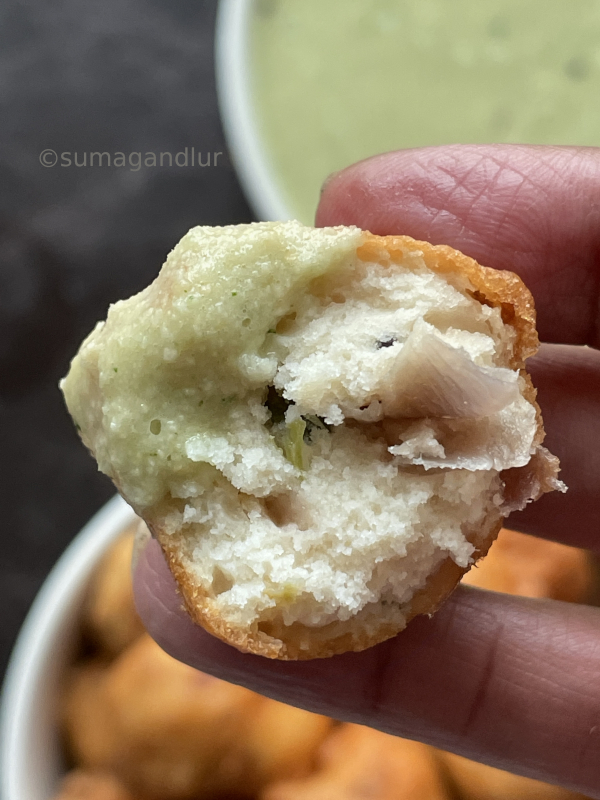
Ingredients:
1/2 cup rice
1/2 cup skinned black gram / urad dal
Salt to taste
Oil to deep fry 
Ingredients for sautéing:
1 tbsp. oil
1/2 tsp. mustard seeds
1 small sprig of curry leaves, finely minced
1 or 2 green chilies, finely minced
1 medium sized onion, finely minced
2 tbsp. fresh, shredded coconut

Directions:
1. Rinse and soak rice and skinned black gram in water for at least two hours. Drain the water completely after the soaking period.
2. Grind them together into a thick, fluffy batter adding water in small increments. Do not make the batter runny. (Using a grinder would help to use small quantity of water to while grinding. If the batter turns runny, adding a small quantity of rice flour would help but adding too much would turn the cheeyam harder.)
3. Meanwhile, heat a tbsp. oil in a pan and add mustard seeds. When they start to sputter add, green chili and curry leaves. Stir them for few seconds and add onions and salt enough for the onions.
4. Sauté until onion turns translucent and add the coconut. Stir once and turn off the stove.
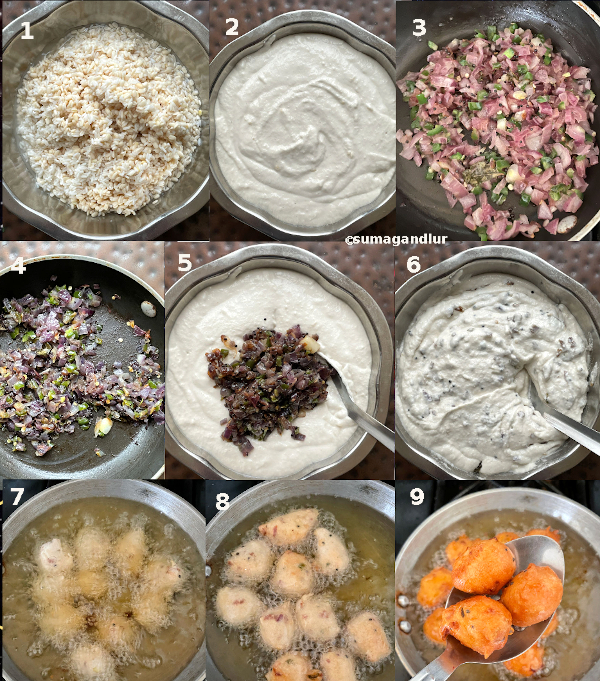
5 & 6. Add the sautéed onions and salt to the batter. (Keep in mind that onions contain salt too). Mix the batter well with a spoon and keep aside.
7. Heat oil for deep frying in a frying pan on medium heat. Drop a pinch of batter to the oil. If it swims to the surface, the oil is ready for frying. If not, heat the oil a little more. Dip your fingers / hand into the batter and shape a small ball. Gently drop into the oil. Repeat the step and drop as many balls as the pan can hold, without overcrowding. (There is no need to fret over the shapes. They don't to be exactly round.)
8. First they sink and soon float to the surface. Keep gently flipping them with a perforated spoon. Lower the heat to low - medium setting and fry until they turn golden brown throughout.
9. Remove them when done and transfer them onto a plate laden with paper towels to absorb the extra grease.
10. Reheat the oil if needed and repeat the steps with the remaining batter.
11. Serve them warm and enjoy with a spicy chutney or some ketchup.

This is going to be my contribution to this week's Blogging marathon, with the theme 'A -Z Series'. Check the page link to see what other marathoners are cooking.


Sunday, February 15, 2015

Chettinad Vegetable Biryani / Kaikari Biryani


We have no aversion towards pulaos / biryanis but we are not great fans either of this rice genre. It may seem surprising coming from an Indian but it is true that they get made once in a blue moon in my kitchen. And so I was contemplating whether to try this Chettinad Vegetable Biryani or not for this month's Indian Cooking Challenge.

I know that a wonderful dish like this biryani do not deserve such a lousy introduction. :) However I would like to point out that we, out of all the people who prefer to stay away from overtly spicy dishes got sold by this biryani. I had thought of giving this dish a try only because I have been missing the recent ICC challenges and oh boy, I am glad that I did. The husband started reminiscing about the biryani he used to eat in his college canteen and applauded it, while my house filled with an aroma that I usually associate with the Indian restaurants. The spice levels were perfect in this dish, tasted wonderful and we thoroughly enjoyed it.

This biryani comes from the Chettinad cuisine, from the south Indian state of Tamil Nadu. Another version I saw on Sanjeev Kapoor's cook show also included coconut, fennel seeds and other spices typical to the region but since this recipe comes from a person native to the region, I did not play with the recipe. This is an apt kind of dish to prepare, when you have company. Even this halved recipe yields a substantial amount of biryani to feed at least 6 - 8, given that you have other dishes to feed them.This recipe uses samba rice that is grown in Tamil Nadu region in India. This grain supposedly has a distinct aroma and is shorter in size. Basmati would be a typical substitute if there is no access to the samba variety. I had only brown Basmati at home and so substituted sona masuri instead.  And of course don't get intimidated by the long list of ingredients mentioned below. Many go in tadka and some are added at the final stages.
Ingredients:
1.5 cups Jeera Samba rice
1 tbsp. ghee
2 tbsp. cashews
1 tbsp oil
3 cloves
2 cardamom
1 inch piece of cinnamon
1 star anise
1 bay leaf
2 Maratha moggu
2 green chillies (I used 1 chilli as they were hot.)
2 pieces of stone flower / dagad phool / rathi puvvu (optional)
1/2 cup minced shallots or 1 big onion, finely minced
1 tsp. ginger-garlic paste
A handful of coriander leaves + extra for garnishing
A handful of mint leaves + extra for garnishing
1 tomato
2 cups mixed vegetables (green beans, carrot, potato and green peas)
1/4 tsp turmeric powder
1 tsp. coriander powder
1 tsp. red chili powder (My chili powder is really hot and so I used 1/2 tsp.)
Salt to taste
2 & 1/4 cups water

Preparation:
* Wash and soak the rice in water for about 30 minutes. Drain and keep it aside.
* Peel and chop shallots / onion. Chop tomatoes. Peel and cube potato and carrot. String and cut the green beans into one inch pieces. Chop green chillies into big pieces.
* Chop finely mint and coriander leaves.

Method:
* Heat ghee in a deep saute pan or directly in a pressure cooker and toast the cashews until golden brown. Remove the toasted cashews with a slotted spoon and keep them aside.
* To the same pan, add oil and heat it. Add cloves, cardamom, cinnamon, star anise, bay leaf, moggu and stone flower. 
* Saute for few seconds and add green chillies and shallots/onion. Fry until the onion turns translucent. 
* Next add ginger-garlic paste and saute until the raw smell leaves. Then add the chopped leaves and saute for about a minute.
* Add vegetables now and fry for about 3 minutes. Next add tomatoes, turmeric powder, chili powder, coriander powder and salt. Continue to cook until the tomatoes turn softer.
* Add about 1/4 cup water to the vegetables and bring the mixture to a boil. 
* Then add the (soaked and drained) rice and water. Stir well and cover with the lid if using pressure cooker and cook for 3 whistles. 
Or if using a saute pan, just cover with a lid and cook on low flame until done. It would take around 15 - 20 minutes to cook this way and don't be tempted to stir and peek often.
(I used a saute pan to fry the vegetables and transferred the whole mixture into a container that could fit in my pressure cooker. I put the container in the pressure cooker without the pressure valve on and steamed the mixture.)
* Once the rice is cooked, garnish with ghee fried cashews and coarsely minced cilantro - mint leaves.
* Serve with onion raita.

Notes:
* Either you can use 1.5 cup (standard American measuring cup size) or about 3 cups (that comes along with the rice cooker) rice.
* The original recipe mentions to use 4 & 1/2 cups water for 3 cups of jeera samba rice. I used sona masuri rice and used about 2 & 1/2 cups of water for 1 & 1/2 cups rice.

Comments