HOME        |        ABOUT        |        COPYRIGHT        |        CONTACT        |         RECIPE INDEX        |         INDIAN THAALIS        |         MILLET RECIPES        |        EVENTS' ROUNDUP        

Showing posts with label Gujarati Cuisine. Show all posts

Saturday, April 6, 2019

F for Fada ni Khichdi (Version 2) / Spicy Cracked Wheat & Moongdal Porridge

I did not need any planning for 'E' or 'F' recipes in the series since I had these dishes on my to do list for sometime now though I have another fada ni khichadi recipe on my blog. Fada ni khichadi is one more wholesome, nutritious and easy to prepare khichdi. As the name indicates it is prepared with fada, which means broken wheat. This one pot meal comes from the state of Gujarat and quite an easy one to put together as a quick lunch or brunch meal. It is almost 'dump and cook' kind of khichdi that needs no expertise in cooking. 

Rice, millet or any other gluten free grain can replace the wheat if on a gluten-free diet. Any combination of mixed vegetables of one's own preference can be used but care need to be taken not to use those vegetables that turn mushy when cookedThe ghee definitely adds loads of flavor here and so don't skimp on it unless counting calories or is vegan. In that case, oil can be used instead of ghee. The khichdi nonetheless would taste delicious even with all the substitutionsI had tried another version earlier and remember liking it. The variations available online are almost the same and differ only in the kind of spice powders added. I tried the pav bhaji powder version, though authentic it may not be but loved it along with a bowl of sabudana papad (home made dried and oil toasted tapioca pearl wafers). 

Ingredients: (Yield - 3 servings)
1/2 cup cracked wheat (I used fine one.)
6 tbsp. yellow moong dal / split and skinned green gram
1 to 2 tbsp. ghee
1 tsp. cumin seeds
1/4 tsp. peppercorns
2 cloves
1 inch cinnamon piece
1/2 tsp. ginger paste
1/2 tsp. green chili paste / 2 dried red chillies (I didn't use any.)
Few curry leaves (optional)
2 pinches of asafoetida powder
1/8 tsp. turmeric powder
1 onion, finely minced
3 cups chopped mixed vegetables (I used carrots, green beans, tomato and peas.)
Salt to taste
Chili powder as needed
1 tsp. pav bhaji masala (Optional. Can add garam masala instead.)

Directions:
* Rinse moong dal and cracked wheat with water and drain. Keep them aside.
* Heat ghee directly in a small pressure cooker. Add cumin seeds, peppercorns, cloves and cinnamon. When the cumin starts to brown, add ginger and chillies if using. Saute for about 30 seconds and add curry leaves and asafoetida.
* Add onions next and saute for  a couple of minutes. Add the other vegetables now. 
* Add moong dal, wheat, 3 cups water, turmeric, salt, chili powder and pav bhaji masala to the cooker.
* Cook for 3 whistles and switch off the stove. When the valve pressure is gone, remove the lid. Mix the khichdi well once and taste the seasonings.
* If the seasonings need any adjustment or extra water needs to be added for a thinner consistency, add them now and bring the khichdi to a boil once more or simmer for few minutes.
* Serve hot along with papad / plain yogurt.

So far in my Biryani / Pulao / Khichdi series,
A for Ambur Biryani
B for Basanti Pulao / Misthi Pulao
C for Corn - Fenugreek Greens Pulao
D for Donne Biryani
E for Ek Toap na Dal Bhaat

BMLogo
Check out the Blogging Marathon page for the other Blogging Marathoners doing BM#99.

Sunday, February 24, 2019

Mixed Flour and Vegetable Thepla


Thepla, a staple bread from Gujarati kitchens is nutritious and can be served for any meal of the day. The bonus point is that one doesn't need to go through the hassle of preparing a side dish to go with them. A spicy pickle and yogurt on the side will do, the two staple ingredients of any Indian kitchen. Theplas remain softer for longer periods unlike the regular rotis and therefore are ideal to get packed in a lunch box, a picnic basket or as a travel food.

I gave a small twist to the traditional recipe adding a blend of flours and vegetables to make it more healthier and filling. You can customize the recipe by adding flours you have on hand and raw vegetables you think would work in theplas. Adjust the spice quantities if serving little ones and they can eat them directly with some ghee smeared over them, if preferred. You can find the classic methi thepla recipe here and oats thepla here.

Ingredients: (Make about 12 theplas)
1 and 1/4 cup wheat flour (gehu ka atta) + extra for dusting
2 tbsp. chickpea flour (besan)
2 tbsp. amaranth flour (rajgire ka atta)
2 tbsp. millet flour (bajre ka atta)
2 tbsp. sorghum flour (jowar ka atta)
1/8 tsp. ground turmeric
Salt to taste
1 inch piece ginger + 2 -3 green chillies (adjust the quantity as needed)
or
1 tsp. ginger - green chillie paste (or adjust as needed)
1/4 cup fresh / frozen green peas
1/2 cup roughly chopped fenugreek greens / methi
1 carrot, peeled and grated
1 tsp. white sesame seeds
1/3 cup yogurt (I used homemade fat-free yogurt.)
1 tsp. oil + extra to toast theplas (I used canola oil.)
Water as needed

Method:
1. Pulse the flours, salt, turmeric, ginger - green chillies (if not using paste) and peas in a food processor until ginger, chillies and peas are chopped into fine bits. Or just coarsely grind the peas alone.
2. Transfer the ingredients to a mixing bowl and add all the remaining ingredients except water. Form a firm dough adding water if needed, in small increments. (You may need a tbsp. or two of water.) Finally add a tsp. of oil and knead for few seconds.

3. The final dough should be soft and pliable, easy to roll into a ball. If it is sticky, add flour as needed and knead it to make it firm. In case it is too dry, add a little water and knead. Cover and set aside for about 30 minutes. Divide the dough into 10 - 12 balls or make lemon sized balls.

4. Work with one flour ball at a time, keeping the rest covered. Coat a ball with flour and press slightly to flatten it. Roll it into a thin circle of about 5 inches diameter, dusting the work surface with flour if needed. (Theplas can be rolled and toasted simultaneously. In case of novice cooks, a few theplas can be rolled before turning on the stove so that the process would not become overwhelming.)  

5. Heat a cast iron or non stick griddle over medium heat. Place the rolled thepla on the pan and cook until the surface appears bubbly. Flip it and add 1/2 tsp oil around the edges and run the backside of the oily spoon over the surface of the thepla just to coat it with oil. Press the edges down with a spatula to cook evenly. As soon as the brown spots appear on the bottom side, flip it once more, cook for 10 seconds or so and transfer it onto a plate.

6. Repeat the steps 4 and 5 until all the theplas are made. 
7. Serve them with some Indian style spicy pickle / achaar and yogurt. Lightly smear with ghee if serving kids.

This post is an entry for Blogging Marathon #97 and BM - 'Kids' Delight' event hosted by Renu this month with 'Travel Food' theme.
bmlogo

Comments

Monday, June 12, 2017

Bajra - Methi Rotis / Methi Dhebra / Indian, Millet Flour Flatbreads

 
Here are some millet flour based flatbreads as part of the 'healthy lunches' I am posting this week. These are inspired from the western state of India, Gujarat and can be converted to a gluten free version if wheat flour is left out from the recipe. These wholesome rotis are spicy on their own and do not need any side dish as such but a spicy pickle and some cool yogurt would make great accompaniments. Dhebras can be made two ways. The first one where wheat flour is completely eliminated, shaped into smaller and thicker discs and are deep fried. The second method is where they are rolled out into thin rotis like I did and are cooked with little oil. The deep fried dhebra make a great evening snack while the thinner version makes a great addition to lunch or dinner menu.
Ingredients: (Yield 8 - 9 dhebra)
About 2 cups firmly packed fresh fenugreek greens / methi leaves 
1 or 2 green chillies
1 tsp. grated ginger 
1 and 1/2 cups millet flour / bajra flour 
1/2 cup wheat flour (optional)  + extra for dusting
1/8 tsp. turmeric powder
Salt to taste
1/2 tsp. red chili powder
2 pinches of asafoetida
1 tbsp. white sesame seeds
1/4 cup yogurt
Oil for toasting dhebras

Method:
* Coarsely chop the fenugreek greens and finely chop green chillies.
* Combine flours, turmeric, salt, chili powder, asafoetida and sesame seeds in a mixing bowl. Next add fenugreek greens, green chillies, ginger and yogurt to the bowl and mix well.
* Add water in small increments and form a firm but a pliable dough. Cover and rest the dough for about 10 to 15 minutes.
* Grease your palms with oil and divide the dough into 8 or 10 portions and shape each ball into a disc between palms. Work with one dough portion at a time and keep the rest covered.
* There are two ways to proceed after this step. Method one involves rolling out the dough balls into thin circles and toasting them on a hot skillet. Method two involves directly placing the dough ball on an unheated, oiled tawa / flat pan, shaping it and then toasting. I am giving below both methods though I don't follow the rolling method. I find the second method convenient and easier since the millet dough tends to be on the stickier side. 
 
Method 1: 
* Heat a skillet on medium flame.
* Roll out each portion into a thin circle of about 5 - 6 inches diameter, dusting with flour if necessary.
* Place the rolled out disc on the hot skillet. Flip it when you notice bubbles on top. Apply oil on the surface after about 10 seconds and then flip it again. Continue  to cook gently pressing it with a spatula until brown spots appear on the bottom side. 
* Apply a little oil over the top side, flip it and cook until the bottom side now develops brown spots. 
* Remove the dhebra and cook the remaining dhebras following the same steps.
* Keep the cooked dhebras covered until serving.
Method 2:
* Pour a tsp. of oil at the center of an unheated tawa / skillet / flat pan. Place a portion of the dough at the center and shape it into a thin circle using fingertips. Turn on the stove and cook on medium flame until there are brown spots on the bottom side, . Brush some oil over the top side and flip it. Cook until the bottom side develops brown spots. Remove the dhebra once it is cooked on both sides.
* Let the skillet cool down a bit before cooking the next one since the dough can not be shaped on a hot skillet. To cut down the waiting time, the skillet can be washed in cold water or two skillets can be used instead. 
bmlogo
This post goes to Blogging marathon #77 under the theme "Healthy Lunches". Check out the page to read what other marathoners are cooking.

Comments

Saturday, March 11, 2017

A Simple Gujarati Thaali

 
Today's spread comes from the western state of India, Gujarat. I have a simple thaali from the region and most of the dishes are simple and quick preparations.

Dishes that are on the menu today:
A simple salad of cucumber and carrot
Kakdi nu shaak
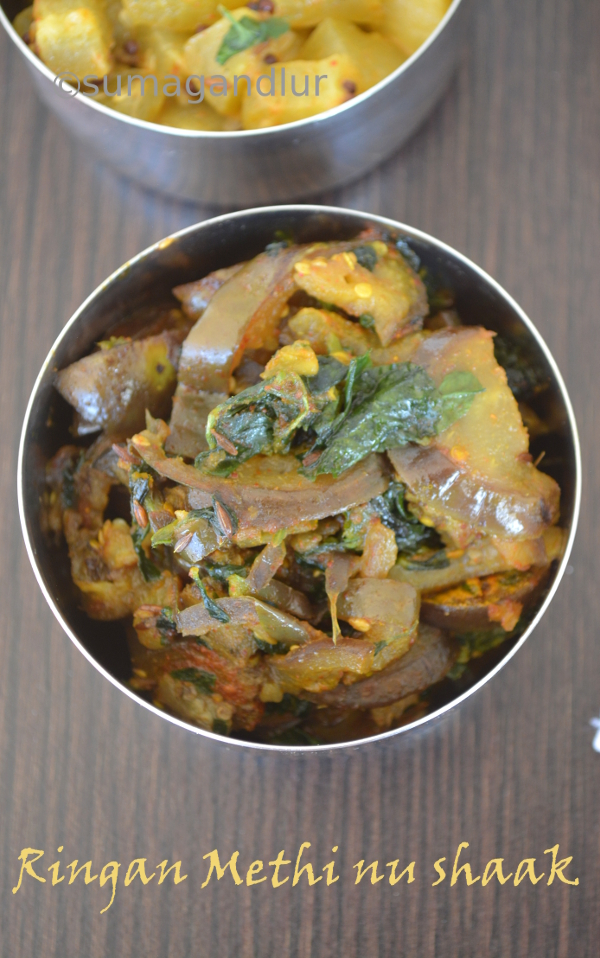
Ringan methi nu shaak
Trevti dal
Vagareli khichdi
Kadhi
Rice
Roti 
Khaman
Sukhdi / Gud Papdi
Chaas
Mango Pickle
Sweet Chutney & Green Chutney

Kakdi nu Shaak - A simple and quick cucumber curry lightly spiced, Gujarati style.
Ringan mehi nu shaak - A flavorful curry with eggplants and fenugreek greens. The recipe for this simple preparation can be found here.
Trevti dal - A dal prepared with three different kind of pulses -  pigeon peas, split chickpeas and moong dal with light seasoning.
Vaghareli khichdi - A flavorful, spicy one pot meal with rice, dried and fresh lentils and vegetables. The recipe can be found here.
 
Gujarati kadhi - A flavorful and really tasty chickpea flour - yogurt gravy.
 
Khaman - A savory, steamed cake made with ground and fermented batter of split chick peas. The recipe can be found here. It was served with green cilantro chutney and sweet chutney.
Sukhdi / Gud papdi - A sweet prepared using with wheat flour, ghee and jaggery. The recipe can be found here.
 
The meal was rounded off with chaas - Yogurt and water churned, salted and lightly sprinkled with ground cumin.

 bmlogo
This goes to Blogging marathon #74, under the theme 'Thaalis/Spreads'. Check out the page to read what other marathoners are cooking.

Comments

Monday, February 13, 2017

Celebrating 10th blog anniversary with Sukhdi / Gud Papdi


This post has been due for a couple of months now but the lazy me kept postponing it. My blog reached a milestone last December, hitting the 10th year mark. Quite an achievement from a personal stand considering that I lose interest in things after a while. Thanks to my readers and fellow bloggers who visit and leave a positive trail and keep me going.
I thought the celebration deserves a treat and so, here comes the sukhdi aka gud papdi. This sweet dish seems to be a quite popular one in Gujarat and the neighboring state of Rajasthan. The basic preparation includes only three ingredients - wheat flour, jaggery and ghee which all are considered to be healthy ones. Yes, in spite of the flak the butter receives because of it's calorie content, the traditional belief in India is that ghee in moderate amounts is good for the body. I am neither fond of nor prepare ghee laden sweets, the only exception being 'Mysore Pak' which is a favorite of everyone at my home including the father-daughter duo who claim to be sweet phobics.
This is a quick preparation but tests your arm strength since you need to keep stirring the mixture the whole time. Properly made sukhdi has a melt in mouth texture. Additional ingredients like nuts / spices can be added to the basic preparation. I used very pale colored jaggery and my sukhdi had a brownish yellow hue but somehow they are looking yellow in the pictures. (That's for people who are wondering why my sukhdi have that color. And also they look firm since they were in the refrigerator for a week or so by the time I took pictures.)
Ingredients:

1 cup whole wheat flour / atta
1/2 cup ghee 
1/2 cup powdered jaggery
 
Method:
* Grease a plate or a circular pan which is at least one inch deep. Take care to powder the jaggery leaving no bits and chunks.
* Heat ghee in a wide non stick pan on medium flame and add the wheat flour. Stir well so that the whole flour is coated with ghee. Continue to stir without stopping until the flour attains a darker hue than the one you started with and you begin to notice the aroma, about 5 to 7 minutes. (If the mixture appears dry while stirring, add a tbsp or more of ghee and continue to stir.)
* Turn off the stove and remove the pan from the heat. Place it on the counter top or any solid surface and immediately add the jaggery and stir quickly to mix until the jaggery gets incorporated into the mixture.
* Pour the mixture into the greased plate and even out the surface with the back of a spatula. Cut into desired shapes when the mixture is still warm and set it aside to let cool. When the sukhdi cools, separate the pieces and store in an airtight container.
This goes to Blogging marathon #73, under the theme 'Sweets prepared in less than an hour'. Check here to find out what the other marathoners are cooking as part of the BM.

Comments

Wednesday, September 14, 2016

A - Z Rice Dishes ~ L for Lilva Khichdi

 
A layered biryani would have been a scrumptious choice for today's alphabet, 'L'. By the time that idea occurred to me, this dish has already been cooked and drafted. I was aiming at quick and simple one pot meals when I initially planned for this rice series and that's how I ended up cooking this khichdi that I found online. It suited my criteria well and this makes a delicious lunch box idea. It takes hardly ten minutes to prepare the dish if cooked rice is handy. Fresh field beans or pigeon peas or seeds from val / broad beans can be used in the recipe. Aromatic and spicy base of cilantro and ginger lend a wonderful flavor to this healthy meal.

Ingredients:
3 cups cooked rice (I used sona masuri.)
1 cup surti papdi lilva / toor lilva (I used fresh pigeon peas.)
3/4 cup packed cilantro
1 inch piece of ginger
2 to 4 green chillies (I used 3 spicy, Serrano peppers.)
1/2 tbsp. lemon juice
2 tbsp. ghee
2 cloves
2 cinnamon sticks
Salt to taste
Method:
* Microwave the frozen lilva papdi with few tbsp. of water for 2 to 3 minutes.
* Grind cilantro, ginger, chillies and lemon juice to a paste, adding a few tbsp. water if needed.
* Heat ghee in a pan and add cinnamon sticks and cloves. Saute for few seconds and add the ground paste and the lilva. Saute until the water evaporates. Add rice and salt and mix well with a spatula to combine.
* Serve with some yogurt on the side.
 
Recipes so far in A - Z Rice Dishes,
A for Achaari Chole Pulao
B for Bhuna Khichuri
C for Chintapandu Pulihora
D for Dindigul Thalapakatti Veg Biryani
E for Ellorai / Ellotharai  
F for Fodnicha Bhaat 
G for Gongura Pulihora 
H for Hare Moong ki Chaaswaali Khichdi 
I for Iyengar Style Kadambam 
J for Jodhpuri Vegetable Pulao 
K for Kaju - Karivepaku Annam


Check out the Blogging Marathon page for the other Blogging Marathoners doing BM# 68


Monday, November 3, 2014

Shrikhand (Short-Cut Method)

Shrikhand in short can be described as a thick, sweetened yogurt redolent with cardamom and saffron flavors and garnished with nuts. It is a sweet dish that is popular in the Indian states of Gujarat and Maharashtra and ridiculously easy to prepare. It is even eaten as a side dish to pooris in Gujarat. While this would be the basic, traditional version, another version prepared adding mango pulp, called aamrakhand is equally popular in Maharashtra.
Traditionally full fat yogurt is tied in a muslin / thin cotton cloth and allowed to drain until all the whey is separated and one is left with thick yogurt. Usually I follow this method when I have time. I leave the tied yogurt in a colander and place the colander over a container to catch the whey. And I place the whole setup in the refrigerator overnight so that I have the hung yogurt ready by the morning. If you want to prepare shrikhand from scratch then you can follow this method. However remember that the final hung yogurt would be less in quantity than the original yogurt you started with since some of it will be lost in the form of whey.
Then sugar is whisked into the hung yogurt until it is dissolved, garnished with spices and chilled before serving. 
For a short cut method, one can skip above steps and directly use the Greek yogurt as I have used here. I prefer powdered sugar over the granular variety since it is easy to mix. And sometimes I even use a sugar substitute. This shrikhand doesn't need chilling since the Greek yogurt comes from the refrigerator.
My husband and I love shrikhand and I frequently prepare it to eat as a dessert. However I paired it with pooris for the first time today and it was not that bad as I had anticipated. In fact I liked the combo.

Ingredients:
1 cup Greek yogurt (I used non-fat Greek yogurt.)
A generous pinch of saffron strands
1 tbsp. warm water / warm milk 
2 Tbsp. powdered sugar (or as per taste.)
1/4 ground cardamom
Sliced almonds and pistachios to garnish
Method:
* Gently crush the saffron strands between your fingers and add it to the warm water / milk and leave it aside for about 10 minutes.
* Add the Greek yogurt and powdered sugar to a bowl and gently whisk it until blended. 
* Next add the saffron along with the liquid and cardamom to the yogurt mixture and mix gently.
* Garnish with nuts and serve. If not serving immediately, refrigerate it until ready to use.

This 'Poori-Shrikhand' combo goes to BM #46. Check what other marathoners are cooking during this marathon.

Comments

Friday, October 24, 2014

Poha Dhokla


Dhoklas are a quick, tasty and guilt free meal on their own and this poha variation is no different. These dhoklas need not much efforts or time to put together and can be a great tea time snack or can be served for breakfast. If serving young kids, green chili paste can be avoided. These are going to BM #45 under the theme "Healthy Tea time Snacks".

Recipe source: Here
Ingredients:
1/2 cup coarsely crushed beaten rice flakes / poha
1/2 cup semolina / rava
1/2 cup yogurt (I used homemade fat-free yogurt.)
1/2 cup water
Salt to taste
1 tsp green chili paste
1 tsp Eno fruit salt (I used Lemon flavored fruit salt and it added a welcome tanginess to dhoklas.)
2 - 3 tsp oil
1 tbsp white sesame seeds
1 tsp mustard seeds
A pinch of asafoetida powder
Minced cilantro to garnish
Note:
The original recipe mentions to add 1 cup yogurt + 1 cup water for the above quantity semolina and poha. The mixture ended up being so thin that I had to add 1/2 cup semolina and 1/2 cup crushed poha more. I have therefore reduced the quantity of the liquid in the above ingredients' list. If the mixture appears too thick then add water in tbsp. increments. The mixture should be thick with a dropping consistency similar to the idli batter.

Method:
* Combine semolina, poha, salt. green chillie paste, yogurt and water in a bowl and mix ell. Cover and allow it to rest for about 10 - 15 minutes. If the mixture has become too thick / dry, a little water can be added. 
* Grease about a 6 to 7 inch diameter thali / stainless steel plate with high edges.
Add fruit salt to the batter just before steaming and mix gently when you notice the effervescence.
Pour the batter into the greased thali and steam it until it is cooked.
* Heat oil in a small pan and add sesame seeds, mustard seeds and asafoetida. When mustard seeds start to pop, turn off the stove.
* Pour this tempering over the steamed dhoklas.
* Let cool the dhoklas and cut them into diamond shaped pieces and garnish with coriander.
* Serve with green chutney and sweet chutney. 

Bloggers who picked this theme were supposed to capture the dish along with their tea. And that is a piece of dhokla along with some hot chocolate as I don't consume tea / coffee. :)

Comments

Wednesday, June 11, 2014

Khaman

Event: Blogging Marathon #41
Theme: Breakfast dishes

I had picked breakfast theme for this week's blogging marathon and we were supposed to choose our dishes from this specific wiki listAn earlier chitchat I had with my Gujarati neighbor had landed me with some authentic recipes from her state and this week's theme provided an opportunity to try her khaman recipe. Khaman, a Gujarati delicacy is prepared using fermented batter made with chana dal / roasted chickpeas. Khaman looks similar to another tasty Gujarati snack  dhokla though the two are different. 

My neighbor's khaman version is kept to a basic version. A tiny quantity of rice can be added along with chana dal to grind, if desired but that is entirely optional. Her version of batter includes only addition of salt (before fermentation) and eno's fruit salt (before steaming.) and nothing else. I think she mentioned that they use the below mentioned garnishing but don't serve chutney along with these khaman. Her mother in law earlier had given me another version which is what close to the one I had posted below. This recipe yields soft, fluffy and yummy khaman.

Ingredients:
1 cup chana dal / split chickpeas
Salt to taste
1/4 tsp turmeric powder
1 tsp lemon/lime juice
1/2 tbsp green chillie - ginger paste
1 tsp Eno's fruit salt
For tempering:
2 tsp oil
1 tsp mustard seeds
1 tsp white sesame seeds
1 - 2 green chillies, finely minced
A pinch of asafoetida
2 tbsp minced cilantro
2 tbsp shredded coconut
Method:
* Soak chana dal in water for about 3 - 4 hours. Drain, wash them thoroughly and grind into a thick batter adding water as needed. Add salt to the ground batter and mix well. Cover and leave it to ferment overnight. (The batter doesn't increase in volume as dosa and idli batters.)
* Keep the steamer / dhokla maker /  pressure cooker ready before preparing the khaman. Grease the dish in which khaman is going to be steamed. I prepared khaman in my pressure cooker without the whistle on. I poured about 2 cups of water in the cooker base and used a utensil that comes along with the cooker to steam the khaman. 
Basically, any round dish with a flat bottom, about 2 inches deep would work. 
* Add turmeric powder, ginger-chillie paste, lemon juice and Eno's fruit salt to the batter just when you are ready to steam and mix well. 
* Pour the batter into the greased container used for steaming. Pour water at the base of a steamer / pressure cooker and place the container in it. If using a pressure cooker, remember to not put the whistle on. 
* Steam on medium flame for about 15 - 20 minutes or until a toothpick inserted at the center comes out clean.
* Gently run a sharp spoon / knife around the edges of the steamed khaman and revert the pan over a plate. 
* Heat oil in a small pan and add mustard and sesame seeds. When mustard seeds start to splutter, add green chillies and fry for about 20- 30 seconds. Add asafoetida and turn off the stove.
* Pour the above seasoning over the steamed khaman. Garnish with minced cilantro and shredded fresh coconut. 
* Slice them into cubes and serve with coriander-mint chutney.
Notes:
1. 1 or 2 tbsp of rice can also be soaked along chana dal for grinding.
2. 2 to 3 tbsp of yogurt can be used to grind but I didn't add any.
3. Combine 1 tbsp of lime juice, 1 tbsp of sugar and about 1/4 cup of water in a small bowl. Drizzle it over the steamed khaman along with the mustard seasoning if you prefer sweetness in the khaman. 

Comments