HOME        |        ABOUT        |        COPYRIGHT        |        CONTACT        |         RECIPE INDEX        |         INDIAN THAALIS        |         MILLET RECIPES        |        EVENTS' ROUNDUP        

Showing posts with label Guilt-Free Snacks. Show all posts

Thursday, September 19, 2019

Roasted Phool Makhana


Euryale ferox or fox nut or makhana as it is called in India is a plant belonging to the water lily family. The plant is cultivated for it's edibles seeds in some parts of the world and the Indian state of Bihar produces about 90% of the total world production of fox nuts. The seeds have been used in ayurvedic preparations and traditional Chinese medicine for their health benefits. The starchy seeds of the plant are edible and popped seeds aka phool makhana are used in cooking in western and northern parts of India.

Phool makhana are soft and bland on their own but become crisp and crunchy when toasted and today's quick fix snack is based on that concept. They are toasted on low flame in a tiny amount of ghee / oil until they become crisp and crunchy, and then flavored with basic spice powders making it a light and guilt free snack. It is a tasty and healthy snack that takes about ten minutes from start to finish and is a great substitute for popcorn. This recipe can be easily customized to suit one's taste-buds. My husband recommends black salt and chaat masala to these kind of dishes and so they went in there. I did not add amchur when I made this but he thought some tanginess would elevate the dish.

Ingredients:
2 cups phool makhana / Puffed fox nut seeds
2 to 3 tsp. ghee / oil
1 or 2 pinches of turmeric powder
Salt / Black salt to taste
Chili powder to taste
Chat masala to taste
Amchur powder to taste 

Directions:
* Add ghee / oil and phool makhana to a pan and roast on low flame. Keep tossing them until they turn crisp and crunchy, about 8 to 10 minutes. Toasting on high flame doesn't accelerate the process of crisping but sure is a way to burn them. We don't need to either burn them or brown them. One way to determine whether they are done is to test whether they break when pressed between fingers. Or just pop one into mouth and determine whether they are crisp enough to stop toasting. Below is the picture of toasted ones.

* Turn off the stove. Add salt and other spice powders being used over the roasted makhana and toss the ingredients well until makhana are well coated with the spice powders. 
* Serve immediately or cool and store it in an air-tight container.
* In case they were not eaten and become soft again for any reason, just roast them in a pan for few minutes and they become crisp again.

So far in the series,

First week - Sweets
Malaadu / Hurigadale Unde
Dry Gulab Jamun
Coconut Burfi / Kobbari Mithai
Almond Halwa / Badam Halwa
Elaneer Payasam
Godhuma Sojjappalu

Second week - Snacks from Gujarat
Damni Dhokla
Doodhi Muthia / Lauki Muthia
Dal Pandoli
Methi Khakhra
Pressure Cooker Khandvi


Check out the Blogging Marathon page for the other Blogging Marathoners doing BM#104.
You are invited to the Inlinkz link party!
Click here to enter
Comments

Tuesday, September 17, 2019

Soya Bean Guggillu / Sundal

So far in the series,

First week - Sweets
Malaadu / Hurigadale Unde
Dry Gulab Jamun
Coconut Burfi / Kobbari Mithai
Almond Halwa / Badam Halwa
Elaneer Payasam
Godhuma Sojjappalu

Second week - Snacks from Gujarat
Damni Dhokla
Doodhi Muthia / Lauki Muthia
Dal Pandoli
Methi Khakhra
Pressure Cooker Khandvi

Third Week - Snacks
Bafauri

South Indians use some of the legumes to prepare spicy salads with a tempering common to the region. A similar tempering commonly goes into the preparation of local dry curry preparations as well.  The dish goes by regional names like guggillu, sundal or usli. It is eaten as a snack and onion-free versions are also offered as neivedyam (An offering to God.). Chickpeas and peas are commonly used to make guggillu and they used to be a common evening snack at our home while growing up. It makes a healthy, filling and nutritious dish. This delicious and healthy dish needs a little preparation ahead, in terms of soaking the legumes and boiling them. Legumes can be boiled in advance and frozen to make quick fix snacks or to use in other dishes. I prepared guggillu using soy beans / soya beans this time and it makes a 'neivedyam' item for Navaratri as well.

Sauteed onions can also be used instead of coconut in the recipe. Some of the recipes I posted earlier are below.
Batani Guggillu / Green Peas Sundal
Black Chickpeas Sprouts Salad
Chori Beans Sprout Usli
Senaga Guggillu
Peanut sundal

Ingredients: 
1 cup soya beans / soy beans
Salt to taste
2 tsp. oil
1 tsp. mustard seeds
1 tsp. cumin seeds
1 tsp. split chickpeas / Bengal gram / chana dal
1 or 2 green chillies, finely chopped
10 - 12 curry leaves
2 pinches turmeric powder
1 pinch of asafoetida powder
1/4 cup fresh shredded coconut
1 tbsp. minced cilantro
Lemon / Lime juice to taste (optional)

Method:
* Soak soy beans overnight or for about 6 - 8 hours and drain the water after soaking is done. Pressure cook the beans for 2 to 3 whistles adding salt or cook in a sauce pan on stove top adding sufficient water. When done, the beans must be tender but still holding the shape. They should not turn mushy.
* Drain the water used to cook and rinse away any beans' skins that come off after cooking. 
* Heat oil in a sauté pan. Add mustard seeds, cumin seeds and Bengal gram. When dal starts to turn reddish, add green chillies and sauté for about 30 seconds. Next add curry leaves, turmeric, asafoetida and stir once.
* Add cooked beans and coconut to the pan and stir to combine. Taste and add salt if needed. Cook on low flame for a couple of minutes and turn off the stove.
* Squeeze lemon juice if using and give a stir.
* Garnish with cilantro and serve warm.

Check out the Blogging Marathon page for the other Blogging Marathoners doing BM#104
You are invited to the Inlinkz link party!
Click here to enter

Comments

Friday, September 13, 2019

Methi Khakhra

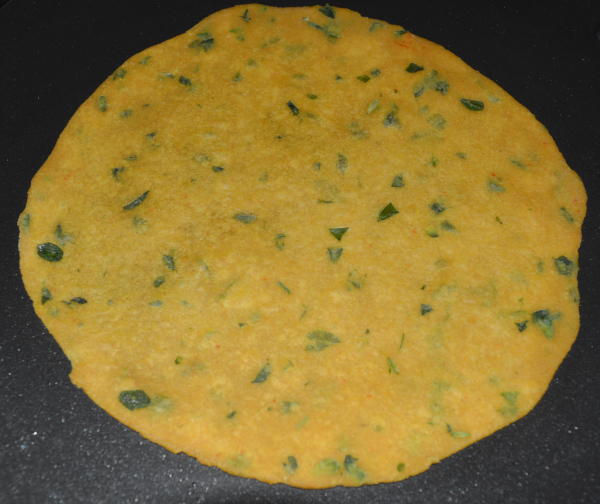
These 'not so perfectly shaped' khakhras hands down win 'the most time taking recipe' among the lot that I has ever tried cooking in my kitchen. Maybe because it was a regional preparation that I did not have any first hand reference to, I don't know. In the time I cooked these, I could have walked, to my local "Patel brothers' store, bought varieties of khakhra and came back home, twice. Even though the recipe tested my patience and time, the silver lining had been that the khakhras were thin and crisp. I think it is hard for beginners to replicate the machine made, commercially sold khakhras that come with a uniform hue through out.

Khakhras are thin, crisp crackers that are made with wheat flour, that are eaten along with tea in the mornings or as a snack both in Gujarat and Rajasthan. Khakhras are sold / made both in plain and flavorful versions like methi/fenugreek green, garlic, mint, and other innovative versions. The modern versions are made with other flours too. They were traditionally made with left over rotis. Or if starting from scratch, the dough prepared is the same as roti dough base, plain or flavors added and they are rolled super thin. They are lightly toasted once, allowed to cool down and again toasted until they turn crisp. It was mentioned in the recipe that I followed that all the lightly toasted rotis would be neatly stacked over one another on the tawa, pressing down applying pressure on the top one while the bottom ones gets crisp. The bottom one will get removed once it turns crisp and the process continues until all are turned into crisp khakhras. I don't think people nowadays have the patience to make these when they are easily available commercially. 

The concept of 'rotis to khakhras' has always been intriguing to me as a non-local and I have always wondered whether the commercially sold version can be replicated at home. If it can be then I marvel at the skilled expertise of those who can do so. We always keep stock of varieties of khakhras bought from store and so until now I never thought of going through the hassle of making them at home since they are easily accessible. While I was planning non fried and guilt-free Gujarati snacks for this week, I thought of giving them a try. The methi khakhras I tried were crispy and kinda tasted plain though they were fenugreek flavored. I know this was my first and last attempt at making khakhras but retrospectively the experience was not bad but it was time consuming and one needs to be in front of the stove constantly. Some of the tips I gathered along the way.

1. Roll the rotis very very thin. I could have easily rolled mine some more thinner but didn't realize at that time but my khakhras were thin anyway.
2. Cut the rolled out dough discs into perfect circles using a sharp rimmed plate. Everyone cannot roll uniformly sized, perfect circles. Mine looked fairly fine shaped when they were rotis but once they were toasted to khakhras, I could see the imperfect edges.
3. The locals use a khakhra press, a wooden disc with a handle to press the khakhras. In lieu of it, a potato masher / rolled kitchen towel works fine. I tried my athirasam / arisela press and after a while, it started to hurt holding the press in the same position. I used a rolled paper towel instead since I didn't want to stain my kitchen towel.
4. Khakhras are toasted on low flame. My first one took about 40 minutes to cook that way and there was not a single brown spot. And then I figured it out that khakhras can be made interchanging the heat setting from low to medium and vice versa, as required. I browned my last khakra at the center on purpose.
5. Use a tawa / low rimmed pan that is slightly concave which gives the khakhras their distinct shape. There is no need to worry if one doesn't own that kind of pan. Also place a pot or something on the khakhras when done to retain the depression at the center. (I did not do it. This is a tip from blogger friend, Vaishali which I noticed after I had made these.)
Recipe source: Here
Ingredients: (Yield - 6 khakra)
1/4 cup washed and roughly chopped fenugreek greens / methi
1 cup wheat flour / chapati atta + extra for dusting
1/4 tsp. turmeric powder
Salt to taste
1 tsp. chili powder or green chili paste (adjust to taste)
2 tbsp. oil 
1 tsp. melted ghee / oil for greasing

Directions:
* Add fenugreek greens, flour, salt, turmeric powder, chili powder / green chili paste and 2 tbsp. oil to a mixing bowl.
* Mix the ingredients well with hand and add water in slow increments and make a soft, pliable dough like chapati / roti dough.
* Allow the batter to rest for about 30 minutes. Add about 1/2 tsp. oil and knead the dough for a minute until smooth. Divide the dough into 6 to 8 equal sized balls.
* Flatten a ball while keeping the other balls covered.
* Roll each ball into a circle, as thin as possible. (I easily could have rolled them even thinner as the recipe needed but somehow I did not.) Use flour if needed for dusting. 
* Roll out all the balls into circles and keep them aside. Mine were not sticking to each other and so I piled them. One can always spread them individually on a wide plate to avoid sticking. 
* Heat lightly a tawa or a lightly concave pan. Don't make it too hot. Place a rolled out disc on it.
* Our purpose is here not to make a roti and so, when it starts to dry and just bubbles start to from, flip it.
* Cook the other side as well until bubbles starts to form. There is no need to cook until you see the spots. 
This is how we need it, lightly toasted without any spots. Finish toasting all the discs this way. This step doesn't take much time.
* Grease on both sides of the prepared rotis, with oil / ghee very lightly. Just very lightly. Let them cool.
* Now comes the part which demands some patience and time. Turning the rotis into crisp khakras. Start from a low flame and keep interchanging the heat between low and a little more higher setting as you keep cooking. Our goal here is not let the bubbles form and turn the soft roti real crisp. Place a partially cooked roti on the warm tawa and when ever you notice bubbles keep pressing them with a khakra press, kitchen towel or a potato masher, whatever works for you.
* Start pressing along the edges first and then keep going to center of the roti. Keep pressing down any bubble that starts to form.
* Flip and keep doing the same step as above.
* (In the middle of it, I realized a paper towel works best.) Pay attention to the heat and keep pressing until it turns crisp. (I took more than 30 minutes for the first one since I did it on the lowest flame possible on my gas stove, through out the process. When I got a hang of it, I realized I could increase the heat and can keep adjusting as needed. I made my first five khakhras patiently without a brown spot.)
* Repeat the process with the remaining rotis. Store them in an airtight container once they cool down.
* Serve them with tea and pickle / methia masala.


Check out the Blogging Marathon page for the other Blogging Marathoners doing BM#104.
You are invited to the Inlinkz link party!
Click here to enter

Comments

Wednesday, September 11, 2019

Dal Pandoli

So far in the series,

First week - Sweets
Malaadu / Hurigadale Unde
Dry Gulab Jamun
Coconut Burfi / Kobbari Mithai
Almond Halwa / Badam Halwa
Elaneer Payasam
Godhuma Sojjappalu

Second week - Snacks from Gujarat
Damni Dhokla
Doodhi Muthia / Lauki Muthia

I came across this recipe while searching for snacks in Gujarati cuisine. Black eyed peas are soaked and ground into a batter and then steamed as small sized portions. If not for this event, I would have been skeptical to even consider trying this recipe but glad that I tried and found out a healthy snack / light meal option. This is like a grain-less idli option for south Indians and also a gluten free recipe if asafoetida is omitted or gluten free asafoetida is used.

Most of the pandoli recipes I came across are made with moong dal but there was this variation where black eyed peas was used. There is basically only one basic recipe online that everyone seems to be following. I am familiar with the steaming ground moong dal concept but black eyed peas version was a novel and interesting one. I wasn't even sure whether the dal would hold without any binding agent but hold, it did. One can include spinach leaves in the recipe and grind it along with the batter. I added cilantro and peas instead and added a bit of tadka to make it more flavorful. I served them with peanut cilantro chutney.

Pandolis are made in an old fashioned way on a cloth tied to a steamer, pouring portions of a big spoonful of batter over it, spacing them apart. However idli tray would be the perfect or even a better substitute for pandoli making which would allow one to use up all the batter at once and for an easier clean up. Pandoli are shaped similar to idli and I made the first batch the traditional way and the rest in idli plates. I made only a small batch as mentioned in the recipe and the pandoli cooked to perfection. I am a person who cooks for six even when there are two people and my husband was surprised to see why I had made a small portion when they tasted good. I am not sure about the results when made in large quantities.

Ingredients: (Yield - 12 pandolis or 9 if made in idli stand)
1/2 cup black eyed peas
1 tsp. grated ginger
1 tsp. green chillie paste / 2 green chillies
Salt to taste
3 - 4 tbsp. sour yogurt 
2 tbsp. minced cilantro (optional)
2 tbsp. fresh / frozen peas (optional)
1/2 tsp. fruit salt (Eno's brand)
Ingredients for tadka:
1 tsp. oil
1 tsp. mustard seeds
1 tsp. cumin seeds
2 pinches of ground asafoetida

Directions:
1. Rinse and soak the black eyed peas in water, for about 3 - 4 hours. Drain the water completely after the soaking period.

2. Heat oil in a small pan (just hot and not to smoking point) and add mustard and cumin seeds. When mustard seeds start to pop, add asafoetida and turn off the stove.
3. Grind the soaked peas along with ginger, green chillies, salt and spinach if using, adding only as much as yogurt needed to make a thick and smooth batter. 

4. Add minced cilantro, green peas and the tadka from step 2 to the batter and mix well to combine.

5. Take a deep and wide vessel or a cooker base and fill half of it with water. (I used less and it is a hassle when the water evaporates and the water needs to be added in the middle of steaming pandolis.)

6. Tie a muslin or thin cotton cloth over the top and heat the vessel until the water to starts to boil.
7. Add the fruit salt to the batter and sprinkle a spoon of water over it. Mix it well to combine.
8. Pour spoonfuls of batter on the cloth, spacing evenly. Cover it with a dome shaped lid or even a cooker lid without the whistle. 

9. Steam them on medium heat, until a toothpick inserted at the center comes out clean, about 15 - 20 minutes.
10. Turn off the stove and let it sit for a few minutes, Remove the pandolis and repeat the steps 5 and 6 to make more pandoli.
Serve them warm with green chutney.

Note:
1. Moong dal can be used instead of black eyed peas for variation.
2. Pandolis can be steamed in an idli stand instead to cook more at once.

Check out the Blogging Marathon page for the other Blogging Marathoners doing BM#104
You are invited to the Inlinkz link party!
Click here to enter

Comments

Monday, December 5, 2016

Baked Vermicelli - Vegetable Cutlets


Here are some guilt free and flavorful vermicelli and vegetable based cutlets or tikkis to munch on along with a cup of tea in the evenings. I have used potato, carrot and beans here though other veggies like peas, cauliflower or greens can be added too. Vermicelli here can be replaced with other kind of noodles but I find the Indian variety short strands of vermicelli more convenient to use here. The tikkis of course can be pan fried or deep fried too instead of baking. (The tikkis in the background plate were pan fried.)
Ingredients: (Yiled 12 cutlets)
1 cup cooked vermicelli*
1 cup peeled, chopped and cooked vegetables (I used potato, carrot and beans.)
1/8 tsp. turmeric powder
1/2 tsp. chaat masala
1/2 tsp. chili powder or to taste
3/4 tsp. amchur powder
Salt to taste
1/2 cup (or as needed) bread crumbs
Oil to spray 
* Indian style 1/2 inch vermicelli strands
Method:
* Drain the cooked vermicelli and set aside to cool. Squeeze out any extra water if present.
* Drain the cooked vegetables taking care that no water is present. Coarsely pulse them using a food processor.
* Preheat the oven to 350 deg F. Line a baking sheet with aluminum foil if preferred and spray it with cooking oil and keep it aside.
* Add the cooked vermicelli, prepared veggies, turmeric, spice powders and salt to a mixing bowl and mix well with a spoon or hand. Add bread crumbs as needed and mix to form a cohesive mixture. 
* Pinch out lemon sized portions and shape them into discs. Arrange them on the prepared baking sheet and spray the tops with oil again.
* Bake them until the bottom portion turn golden brown and flip them and continue to bake until the other side browns too. (I forgot to record the time of baking but it may take around 30 minutes or so.)

This goes to Blogging marathon #71, under the theme 'One Ingredient - Three Courses'. Check here to find out what the other marathoners are cooking as part of the BM.

Comments

Saturday, December 3, 2016

Vermicelli - Cracked Wheat Idli / Semya - Godhuma Rava Idli

Here is an idli idea using vermicelli and cracked wheat that needs no grinding and fermenting. These idli would be ready in less than an hour that includes the prep work and the steaming part. They would be great for any meal of the day and when served along with a sambhar would make a wholesome meal. Cracked wheat in the recipe can be replaced with semolina if preferred. I used the plate idli moulds here and cut the big idlis into triangles.

Ingredients:
1 cup vermicelli
1 cup fine cracked wheat
1.5 cup yogurt or 1 cup yogurt + 1/2 cup water
1 tbsp. oil
1 tsp. mustard seeds
1 tsp. roasted chickpeas / chana dal
1 tsp. skinned black gram / urad dal 
1 green chillie, finely chopped (optional)
Few curry leaves, roughly chopped (optional)
1/8 tsp. turmeric powder
1/4 cup peeled and grated carrot
2 tbsp. fresh / frozen peas 
2 to 3 tbsp. fresh, shredded coconut 
1 tbsp. toasted cashew pieces (optional) 
1 to 2 tbsp. chopped cilantro
Salt to taste
1/4 tsp. baking soda / Eno's salt
1 tsp. ghee / oil to grease the idli plates
(I had added some toasted onions too.)

Method:
* Roast vermicelli and cracked wheat until golden brown and set aside to cool. This step can be done ahead in advance.
* Heat oil in a pan and add mustard seeds, chana dal and urad dal. When mustard seeds start to crackle and the dals turn gold brown, add green chillies, curry leaves, turmeric, carrot and peas. Saute for a minute and turn off the stove. Let it cool a bit.
* Add the roasted vermicelli, cracked wheat, coconut, cilantro, cashews, yogurt and salt to the pan and mix well to form a thick batter of idli consistency. (The amount of yogurt mentioned in the list should be sufficient for the right consistency of the batter. However if the batter seems to thick, add a little amount of water.)
* Allow the batter to rest for about 15 minutes and add baking soda / eno's salt to the batter just before steaming the idli and mix well.
* Pour the batter into greased idli plates and place them in a prepared idli cooker / steamer or a pressure cooker without the valve on.
* Steam them on medium flame until the idlis are cooked, about 20 minutes. Turn off the stove and leave them for about five minutes before demoulding the idlis.
* Serve them warm with chutney / sambhar.
  
This goes to Blogging marathon #71, under the theme 'One Ingredient - Three Courses'. Check here to find out what the other marathoners are cooking as part of the BM.

Comments

Tuesday, December 22, 2015

Recipe Index ~ Snacks / Chaats / Street Food

Pottu Minapappu Garelu / Urad Vada
Punukulu/Punugulu/Puli Bongaralu
Rice Pakora
Sabudana Vada / Sago Vada
Thotakoora Vadalu / Amaranth Leaves Fritters
 
BAKED SNACKS:
Baked Chakli
Baked Dry Samosa
Baked Lotus Root Chips
Baked Namakpara
Baked Nippattu
Baked Plantain Chips 
Baked Punjabi Samosa
Besan Cookies / Chickpea Flour Cookies
Cumin Cookies 
French Fries
Ghugras
Handvo
Khara Biscuits 
Masala Peanuts (Oven Baked)
Masala Peanuts (Microwave Version)
Methi Muthiyas
Millet Handvo
Mixed Dal Vadas
Ooty Varkey
Roasted Chickpeas
Roasted Peas 
Savory Carrot Buns / Rolls 
Savory Carrot Scones 
Spicy Bread Rolls 
Spicy Mexican Brownies 
Spicy Vegetable Stuffed Buns 
Zucchini Parmesan Crisps

 
CHAAT / STREET FOOD:
Aloo Bonda
Aloo Chana Chaat
Aloo Kabli
Aloo Tikki Chole Chaat
Bajra Vada 
Bhel Puri
Biscuit-Corn Chat
Bread Bhel
Chiyali
Jamun Bun
Jhal Muri
Kalmi Vada
Kalmi Vada Chaat
Palak Chaat
Palakhova Bun
Papdi Chaat
Qabuli Chana Chaat
Ram Laddo
Ratlami Sev
Samosa Chole Chaat
Tikki Puri
Uraddal ke Poori
Veg Hakka Noodles
Toasted Corn
Vada Pav
Vegetable Chop / Bhejetebil Chop
White Dhokla
Zafrani Pista Badam Kulfi
Esquites (Mexico)


CHAKLIS:
Baked Chakli
CHIVDAS:
GUGGILLU/ SUNDAL / LEGUME SALAD:

STEAMED SNACKS:

TRADITIONAL INDIAN SNACKS:
'Aakukoora' Pappu Chekkalu
Bhavra
Fried Cashews
Ghugras
Handvo (Baked)
Khandvi (Pressure Cooker Method)

Comments