skip to main |
skip to sidebar
 So far in my 'A - Z' Karnataka recipe series,
A - Akki Halbai
B - Biscuit Roti
C - Congress Kadalekayi
D - Davanagere Benne Dose
E - Ellu Pajji
F - Field Beans / Avarekalu Payasa
G - Girmit
H - Hitakida Avarekalu Huli
I - Iyengar Bakery Style Masala Toast
J - Jolada Vade
K - Kumbalakayi Idli
L - Limbe Hannina Gojju
M - Mysore Pak
So far in my 'A - Z' Karnataka recipe series,
A - Akki Halbai
B - Biscuit Roti
C - Congress Kadalekayi
D - Davanagere Benne Dose
E - Ellu Pajji
F - Field Beans / Avarekalu Payasa
G - Girmit
H - Hitakida Avarekalu Huli
I - Iyengar Bakery Style Masala Toast
J - Jolada Vade
K - Kumbalakayi Idli
L - Limbe Hannina Gojju
M - Mysore Pak
N - Nuchinunde
'O' dishes / culinary terms in Kannada:
There are some traditional and popular recipe choices for the alphabet 'O' from Karnataka cuisine like obbattu, obbattu saaru, oralu chitranna, ottu shavige and open dose. 'O' also stands for 'oota' and 'outhana' which means a meal and a feast respectively. Anything dried is called 'ona' and the tempering / tadka is called oggarane in Kannada.
I opted to go with oodhalu which is barnyard millet in Kannada for today's post in spite of the 'O' choices I had. My A - Z Karnataka Recipe series appeared incomplete with out the inclusion of bisisbele bhath in it. I have already posted the standard version on my blog and I therefore decided to prepare it with oodhalu. Bisibele bhath is a rice - lentil dish in Karnataka cuisine that is both traditional and popular. The rice- lentil- vegetable mixture is leisurely cooked in a pot on stove top and then freshly ground spices are added which lend the characteristic, special flavor to the bhath.
The words 'Bisi-Bele-Bhath' literally translate the essence of the dish in a nutshell. Bisi literally means hot in Kannada, temperature wise. The syllable 'bi' is pronounced as in the word 'Bin' while 'si' as in the word 'Sin'. Bhath is a term generally used for rice dishes. Now coming to the middle part of the name. Though not phonetically correct, somehow the accepted spelling is 'bele'. Now the syllable 'be' is pronounced as 'bay'. 'Le' is pronounced as 'lay'. (Actually English language doesn't have the la sound used here. You kind of roll out your tongue and say it). Here, the la used is the one that comes after the Indian alphabet 'ha'. Now bele refers to the lentils used in the dish. Bisibelebhath so literally means hot rice - lentil mixture.
 Bisibele bhath is a nutritious and filling one pot dish that is delicious as it is but substituting millet for rice makes it more healthier. Don't let the long list of ingredients intimidate you. It doesn't take much time to cook this dish if pressure cooker is used and you have the spice powder handy. I always keep homemade spice powder handy and in fact I cook this dish when I am looking for a quick one pot meal. Store bought spice powder can be used in a cinch though home made spice powder tastes superior. Use equal quantity of spicy and byadai chillies in the spice powder ingredients. The latter add the hue to the powder. I have run out of byadagi variety chillies this time and that's why my bhath is lighter in color. Bisibele bhath is served as a special or festive meal at homes / functions and also as a breakfast / lunch option at restaurants. If you are looking for other variations, check these posts.
Bisibelebhath
Brown Rice Bisibelehulianna
Cracked Wheat Bisibele Huli
Oats - Masoor Dal Bisi Bele Huli
Poha Bisibelehuli
Quinoa Bisibelehuli
Ingredients: (Yield - 6 generous servings)
3/4 cup barnyard millet / oodhalu
1/2 cup pigeon peas / yellow lentils / toordal
About 2 cups chopped vegetables (I used 2 small carrots, 2 small potatoes, 1 big sized tomato, 25 -30 green beans)
1/8 tsp. turmeric powder
1 tbsp. tamarind puree
Salt to taste
Ingredients for bisibele bhath masala powder:
1.5 tbsp. split chickpeas / chanadal
1.5 tbsp skinned black gram / uradadal
1 tbsp. coriander seeds
2 one inch cinnamon pieces
4 pieces of moggu
4 spicy red dried chillies
2 - 3 tbsp. grated dried coconut
Ingredients for tadka:
2 tbsp. ghee
1 tsp mustard seeds
2 tbsp. cashews
A sprig of curry leaves
Directions:
* Wash millet and lentils thoroughly and drain the water. Add them along with vegetables, turmeric powder and about 2 cups of water to a pressure cooker directly and cook till they are done. Alternatively, they can be cooked in a sturdy pot. It needs intermittent stirring and the water needs to be added accordingly.
* Meanwhile add split chickpeas and skinned black gram to a sauté pan and dry roast them on medium heat. Add the remaining ingredients mentioned under 'the masala powder' list when they start to change their color. Toast until the coriander seeds start to turn a few shades darker and the split chickpeas and black gram had turned reddish. Turn off the heat and let cool the toasted ingredients. Once cool, grind them into a fine powder.
* When the valve pressure is gone, remove the cooker lid. Add the prepared bisibele bhath powder, salt, tamarind to the cooked millet- lentil mixture and mix well. Add water as neededto adjust the consistency (about 1 cup). Let the mixture come to a boil and then simmer the mixture for about 5 minutes.* Meanwhile, heat ghee in a small sauté pan. Add the tadka ingredients and toast till the cashews turn golden brown. Remove from heat and add the tadka to the cooked bisibele huli and mix well.* Serve with papads, chips or kara boondi.
Rajma chawal - a spicy kidney beans curry served with rice is a perennial favorite among Punjabi households. The classic combo must be the inspiration to modern day versions of pulao and biryanis prepared using rajma or the kidney beans. Rajma pulao is a nutritious and protein packed pulao prepared using kidney beans. It usually do not contain any vegetables but any favorite vegetables/greens can go into the dish to make it wholesome.
This pulao needs advance preparation unlike other versions since the kidney beans that are going to be used need soaking overnight or for about 10 hours. Raw kidney beans, uncooked ones or it's sprouts are not recommended for consumption as they are toxic. Kidney beans need to be thoroughly cooked before eating them. Pressure cook the soaked kidney beans until they are soft and then use in the recipe. This pulao can be fixed as a quick meal if you have cooked / canned kidney beans and some leftover rice handy. Just plain yogurt or a simple raita is enough if the pulao is made spicier. Or shorva, korma or any gravy curry would go well with this pulao.
 Ingredients:(Yield 2 servings)
1/4 cup kidney Beans
1/2 cup basmati Rice
2 tbsp. ghee / oil
1 tsp. cumin seeds / caraway seeds (jeera / shahjeera)
2 cloves
2 cardamom
1 inch cinnamon piece
1 bay leaf
1 green chillie
1 big onion, thinly sliced
1 tsp. ginger - garlic paste (I used 1 tsp. grated ginger)
1/8 tsp. turmeric powder
1/2 tsp. chili powder
1/2 tsp. garam masala
About 1.5 tsp. salt (or adjust as needed)
Ingredients:(Yield 2 servings)
1/4 cup kidney Beans
1/2 cup basmati Rice
2 tbsp. ghee / oil
1 tsp. cumin seeds / caraway seeds (jeera / shahjeera)
2 cloves
2 cardamom
1 inch cinnamon piece
1 bay leaf
1 green chillie
1 big onion, thinly sliced
1 tsp. ginger - garlic paste (I used 1 tsp. grated ginger)
1/8 tsp. turmeric powder
1/2 tsp. chili powder
1/2 tsp. garam masala
About 1.5 tsp. salt (or adjust as needed)
 Method:
1. Rinse and soak kidney beans in water overnight or at least for about 10 hours.
2. Drain away the water used to soak and rinse the beans with fresh water. Pressure cook adding about 2 cups of water until they are cooked. (I cooked for about 12 whistles in total, including step 6.)
3. Heat oil directly in a pressure cooker and add cumin seeds. When they brown, add cloves, cardamom, cinnamon, bay leaf and saute for 30 seconds. Add green chili and onion and saute until brown. Then add garlic - ginger paste and saute until raw smell disappears.
4. Wash the rice and drain. (I don't soak rice even if it is basmati.)
5. Next add turmeric, chili powder, garam masala, salt and drained rice. Saute for a minute. Add 3/4 cup water and the drained, cooked kidney beans.
6. Pressure cook for 3 whistles and turn off the stove. When the valve pressure is gone, fluff and serve.
Method:
1. Rinse and soak kidney beans in water overnight or at least for about 10 hours.
2. Drain away the water used to soak and rinse the beans with fresh water. Pressure cook adding about 2 cups of water until they are cooked. (I cooked for about 12 whistles in total, including step 6.)
3. Heat oil directly in a pressure cooker and add cumin seeds. When they brown, add cloves, cardamom, cinnamon, bay leaf and saute for 30 seconds. Add green chili and onion and saute until brown. Then add garlic - ginger paste and saute until raw smell disappears.
4. Wash the rice and drain. (I don't soak rice even if it is basmati.)
5. Next add turmeric, chili powder, garam masala, salt and drained rice. Saute for a minute. Add 3/4 cup water and the drained, cooked kidney beans.
6. Pressure cook for 3 whistles and turn off the stove. When the valve pressure is gone, fluff and serve.
Notes:
1. The pulao can be cooked in a pan instead of a cooker. If using a pan, cook covered on low flame, adding about a cup of water.
2. Here is another method to prepare a fail proof pulao where the rice grain stands apart. Pressure cook kidney beans until soft. Pressure cook rice separately for 3 whistles adding 3/4 water. Use a pan for steps 4 and 5 and add the cooked kidney beans and cooked rice. Fluff to mix and serve.
So far in my Biryani / Pulao / Khichdi series,
A - Ambur Biryani
B - Basanti Pulao / Misthi Pulao
C - Corn - Fenugreek Greens Pulao
D - Donne Biryani
E - Ek Toap na Dal Bhaat
F - Fada ni Khichdi
G - Gutti Vankaya Biryani
H - Hyderabadi Vegetable Dum Biryani
I - Iyengar Puliyogare
J - Jaipuri Mewa Pulao
K - Kashmiri Pulao
L - Lucknowi Biryani
 Check out the Blogging Marathon page for the other Blogging Marathoners doing BM#99.
Military hotels are a standard feature of many towns across the parts of southern India. Though no one is sure about the story behind the name, they have nothing to do with niether the military nor the lodging. Indians have a habit of loosely calling an eatery as a hotel though it has nothing to do with lodging facilities. These miltary hotels are usually small eateries that serve non vegetarian food. These kind of tiny establishments with the boards 'Ragi mudde oota tayaar' outside (meaning ragi mudde lunch is ready), dot the parts of Bangalore city. Ragi mudde, the cooked balls of finger millet flour are served with non vegetarian curries here. Rustic farmer food from the plains of Karnataka is the staple food in these humble hotels and women wouldn't step into these hotels in the olden days.
Some hotels are so well known in Bangalore that they are running over a hundred years. Many military hotels in and around Bangalore, like Shivaji Military Hotel display an unmistakable Maratha influence according to this interesting excerpt about the history of Military hotels in Bangalore. It is believed that Maratha soldiers who garrisoned in Bangalore area during the 17th century might have brought their traditional non-vegetarian cuisine with them and those families were the forerunners of Bangalore's miltary hotels, which were obviously heavily influenced by the Saoji-style eateries, that they were used to back home.

Mutton biryani slowly cooked over coals, using short grain rice and coriander, mint and green chili paste takes precedence at these Maratha influenced eateries over ragi mudde. The meat dishes here tend to be spicier, influenced by the fierce Saoji and Kolhapuri cuisines of central Maharashtra. This kind of biryani is also called donne biryani and it seems to be a signature dish of especially, the Shivaji military hotel in Bangalore mentioned above. Mutton and chicken seems to be the popular choices for the preparation of donne biryani.
I lived in Bangalore area almost all my life before moving to US more than two decades ago but being a vegetarian, the name 'donne biryani' never crossed my radar during that time. Donne biryani seems to be a popular choice in military style hotels of the region. This biryani is called so since it is served in a donne. Donne, pronounced as 'though - nnay' (with a stress on n) is a Kannada word (the local language) used for the biodegradable cups made with areca nut palm leaves / banana leaves and so on.
 The recipe is a secretly guarded one and so, basically the recipes floating online are own interpretations of food bloggers. I did not pick any particular recipe to cook this biryani from and chose to pressure cook it making it an easy, quick and flavorful meal. Basmati rice is not used to make this biryani but seeraga samba rice, a popular choice in Karnataka and Tamilnadu is used. If the preferred rice is not available, go with regular rice. Mint flavor is the most dominating one in this biryani unlike most of other biryanis.
I have made it a vegetarian version using soy chunks and my husband thought potatoes and capsicum would have been a nicer addition. Any combination of preferred vegetables can be used to make this biryani. This is one of the biryanis that I had on my to do list even before this marathon theme was announced and so, it was the first biryani I tried for this series. I am so glad that I tried this biryani and that too with soy chunks since they were like the selling point of this biryani. Soy chunks were so succulent, each infused with the cilantro - mint base flavor and I don't think the vegetables would have created the same effect. Serve it with a simple raita / plain yogurt.

Ingredients to saute and grind:
1 - 2 tbsp. ghee / oil
2 cloves
1 inch cinnamon piece
2 pieces of stone flower / dagad phool
1 onion, chopped
2 green chillies (Mine were very spicy chillies. adjust the quantity depending upon the spiciness of the chillies used.)
1 inch piece ginger, finely chopped
2 garlic cloves (I didn'y use any)
1 cup cilantro and mint leaves
Other Ingredients:
1 cup soy chunks, hydrated (or substitute vegetables)
2 tbsp. ghee and /or oil
2 cloves
2 cardamom
1 inch piece cinnamon
1 bay leaf
1 onion, thinly sliced
1/8 tsp. turmeric powder (optional)
2 tbsp. yogurt
1 tsp. biryani masala
1 and 1/4 cup water
Salt to taste (I used about 1 and 1/4 tsp.)
1/2 tsp. lemon juice
3/4 cup rice (I used sona masuri rice.)
Directions:
* If using seeraga samba rice, soak it in water for about 15 minutes and drain completely. If using sona masuri or the regular kind, no need to soak. I used sona masuri rice and the water quantity mentioned is for that variety of rice.
* Soak soy chunks in water to hydrate them. If using vegetables, chop them and keep aside. When the soy chunks soften, squeeze out water from them and keep aside.
* Heat ghee / oil directly in a small pressure cooker or a pan. Add all the other ingredients mentioned under 'saute and grind" list except the cilantro and mint. Saute them stirring intermittently until the onions turn pinkish and add cilantro and mint. Saute for about a minute and turn off the stove. Let them cool slightly and grind to a paste adding a little water. If more water is needed to grind, use some from that 1 and 1/4 cup water mentioned under ingredients' list ( so that you would not end up adding more liquid while cooking rice which in turn ends up in a mushy biryani.)
 * To the same pan which is of course empty now, add ghee, cloves, cardamom. cinnamon, bay leaf and saute for few seconds. Then add onion and fry stirring intermittently until it turns pinkish.
 * Next add turmeric, biryani masala and yogurt and stir well. Next add water and salt to the cooker / pan and bring it to a boil. Add rice, soy chunks and lemon juice.
 * If using sona masuri rice, rinse and add to the cooker. Pressure cook for three whistles if using cooker.
 * If not using pressure cooker, add 1/8 cup more water, cover the pan tightly with an aluminium foil and close the lid. or cover the lid and seal it with a dough ring, to cook it in dum style. Cook on low flame, until rice is cooked, about 15 to 20 minutes.
* Open and check after 20 minutes. If there is stll water, cover and cook until all the water evaporates. If the mixture appears dry and the rice is not cooked through, sprinkle some water and cook some more time.
* If not using pressure cooker, add 1/8 cup more water, cover the pan tightly with an aluminium foil and close the lid. or cover the lid and seal it with a dough ring, to cook it in dum style. Cook on low flame, until rice is cooked, about 15 to 20 minutes.
* Open and check after 20 minutes. If there is stll water, cover and cook until all the water evaporates. If the mixture appears dry and the rice is not cooked through, sprinkle some water and cook some more time.
So far in my Biryani / Pulao / Khichdi series,
A for Ambur Biryani
B for Basanti Pulao / Misthi Pulao
C for Corn - Fenugreek Greens Pulao
Check out the Blogging Marathon page for the other Blogging Marathoners doing BM#99.
Comments
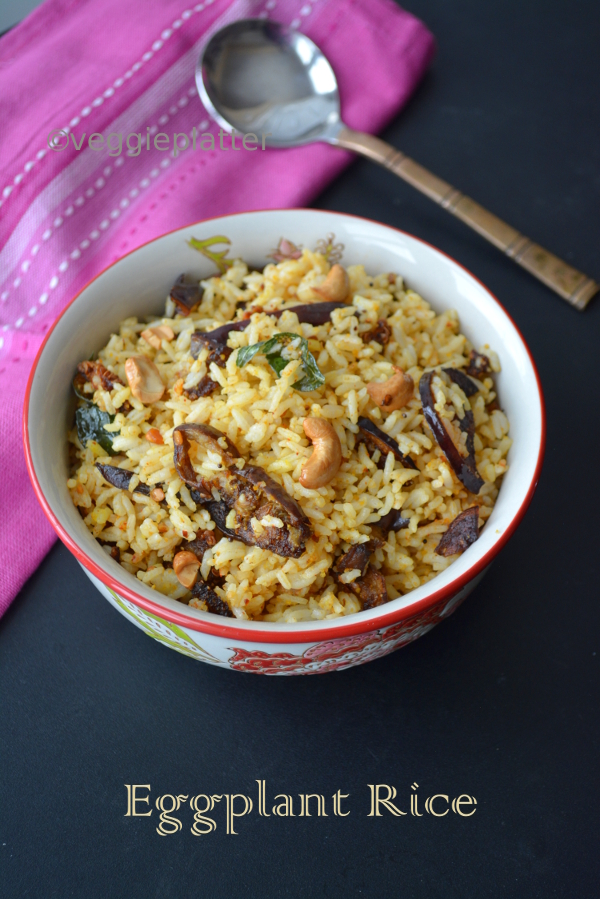
Here is a delicious rice choice for eggplant lovers. Crisply fried eggplants paired with spicy lentil powder yield a great flavor to this rice. The spice powder can be prepared ahead and can be stored in an air tight container for months. I prefer to fry the eggplants but calorie conscious folks can cook eggplants with little oil though crispy eggplants taste better.
Ingredients for spice powder:
1 tbsp. chanadal
1.5 tsp. uraddal
1.5 tsp. coriander seeds
2 tbsp. shredded dry coconut (copra)
5 spicy variety dries red chillies
Ingredients for part 2:
1 cup rice (I used sona masuri rice.)
3 big sized round egg plants (I had about 3 cups eggplant slices.)
Oil to fry the eggplant slices (I used canola oil.)
Ingredients for part 3:
4 tsp. oil
1 tbsp. cashew halves
1 tsp. split roasted chickpeas / chana dal
1 tsp. split black gram / urad dal
1/2 tsp. mustard seeds
10 - 12 curry leaves
1/8 tsp. turmeric powder
1.5 tsp. salt
Red chili powder (if needed)
 Part 1: Preparing spice powder
Toast
chanadal and uraddal individually in a saute pan until they
turn reddish brown. Saute the coriander seeds till they turn slightly
brownish and add the red chillies at the end. Let them cool and grind all the
ingredients finely.
Part 2:
* Rinse rice with water and drain. Pressure cook adding 2 cups of water and let it cool.
* Cut off the eggplant stalks and cut them lengthwise into two. Slice them thinly.
* Heat oil in a pan and fry the eggplant slices in batches on medium flame until crisp and golden brown. Drain them on absorbent paper towels.
Part 3:
*
Heat oil in a kadai or a big non stick pot. Add the cashews and toast
them till they turn golden brown. Remove them with a slotted spoon and
keep aside. Add split roasted chickpeas, split black gram
and mustard seeds to the same oil and sauté until roasted chickpeas turns reddish. Then add curry leaves and turmeric powder.
* Add 3 tbsp. spice powder, salt and fried eggplants to the pan and mix properly so that the eggplant slices are well coated.
* Then add the cooked rice and mix well. Taste and adjust the seasonings if needed. Garnish with the toasted cashews.
Part 1: Preparing spice powder
Toast
chanadal and uraddal individually in a saute pan until they
turn reddish brown. Saute the coriander seeds till they turn slightly
brownish and add the red chillies at the end. Let them cool and grind all the
ingredients finely.
Part 2:
* Rinse rice with water and drain. Pressure cook adding 2 cups of water and let it cool.
* Cut off the eggplant stalks and cut them lengthwise into two. Slice them thinly.
* Heat oil in a pan and fry the eggplant slices in batches on medium flame until crisp and golden brown. Drain them on absorbent paper towels.
Part 3:
*
Heat oil in a kadai or a big non stick pot. Add the cashews and toast
them till they turn golden brown. Remove them with a slotted spoon and
keep aside. Add split roasted chickpeas, split black gram
and mustard seeds to the same oil and sauté until roasted chickpeas turns reddish. Then add curry leaves and turmeric powder.
* Add 3 tbsp. spice powder, salt and fried eggplants to the pan and mix properly so that the eggplant slices are well coated.
* Then add the cooked rice and mix well. Taste and adjust the seasonings if needed. Garnish with the toasted cashews.
 This post goes to Blogging marathon #85 under the theme "Rice / Gravy recipes". Check out the page to read what other marathoners are cooking.
 Comments
 We have reached the final alphabet on my A - Z Rice series and today also marks the final day of the blogging marathon #68. I am winding up the series on a sweet note with a fragrant zafrani pulao. It is a treat from the royal kitchens of Muslim rulers, as all those other flavorful pulao / biryani versions in India. Zafrani pulao, meaning saffron rice is cooked both in savory and sweet versions. This pulao uses minimal ingredients and yet the best ones. The fragrant Basmati rice is cooked in saffron infused milk and rounded up with a garnish of toasted nuts. The saffron is the star of the recipe which lends the flavor and color to the dish and hence the name Zafrani pulao.
This is actually a straight forward
recipe. Just care need to be taken to cook the rice properly where each
gain stands apart rather than being mushy / clumpy. Actually a pressure cooker comes handy here to cook that perfect textured rice, especially if cooking a small quantity of pulao.
We have reached the final alphabet on my A - Z Rice series and today also marks the final day of the blogging marathon #68. I am winding up the series on a sweet note with a fragrant zafrani pulao. It is a treat from the royal kitchens of Muslim rulers, as all those other flavorful pulao / biryani versions in India. Zafrani pulao, meaning saffron rice is cooked both in savory and sweet versions. This pulao uses minimal ingredients and yet the best ones. The fragrant Basmati rice is cooked in saffron infused milk and rounded up with a garnish of toasted nuts. The saffron is the star of the recipe which lends the flavor and color to the dish and hence the name Zafrani pulao.
This is actually a straight forward
recipe. Just care need to be taken to cook the rice properly where each
gain stands apart rather than being mushy / clumpy. Actually a pressure cooker comes handy here to cook that perfect textured rice, especially if cooking a small quantity of pulao.
 Ingredients: (2 servings)
1/2 cup Basmati rice
2 generous pinches of saffron
2 tbsp. warm milk
1 tbsp. ghee
1 to 2 tbsp. chopped / slivered almonds, raisins and cashew halves
1/2 cup + 2 tbsp. water
2 tbsp. sugar
1/4 tsp. ground cardamom
1/8 tsp. ground nutmeg
Ingredients: (2 servings)
1/2 cup Basmati rice
2 generous pinches of saffron
2 tbsp. warm milk
1 tbsp. ghee
1 to 2 tbsp. chopped / slivered almonds, raisins and cashew halves
1/2 cup + 2 tbsp. water
2 tbsp. sugar
1/4 tsp. ground cardamom
1/8 tsp. ground nutmeg
 Method:
1. Wash and soak rice in water for about 20 to 30 minutes and drain.
2. Soak saffron strands in warm milk, in the mean while.
3. Heat ghee in a small pan and toast cashews, almonds and raisins in it. The cashews and almonds must turn golden brown and the raisins should turn plump. Transfer the toasted nuts & raisins to a small bowl, using a slotted spoon.
4. To the same pan, add rice and saute for a minute. Add cardamom, nutmeg and the saffron milk from step 2.
5. Boil water and sugar in another pot until the latter melts. If using the same pan to cook, transfer this sugar water as well to the pan. Cover and cook on low flame until rice absorbs all the water and appears done.
Alternately, add everything (except the toasted nuts) to a small pressure cooker and cook for 3 whistles.
6. Let it sit for about 10 minutes so that the rice grains set and not turn mushy when handled with a spoon. Garnish with the toasted nuts and raisins and serve.
Method:
1. Wash and soak rice in water for about 20 to 30 minutes and drain.
2. Soak saffron strands in warm milk, in the mean while.
3. Heat ghee in a small pan and toast cashews, almonds and raisins in it. The cashews and almonds must turn golden brown and the raisins should turn plump. Transfer the toasted nuts & raisins to a small bowl, using a slotted spoon.
4. To the same pan, add rice and saute for a minute. Add cardamom, nutmeg and the saffron milk from step 2.
5. Boil water and sugar in another pot until the latter melts. If using the same pan to cook, transfer this sugar water as well to the pan. Cover and cook on low flame until rice absorbs all the water and appears done.
Alternately, add everything (except the toasted nuts) to a small pressure cooker and cook for 3 whistles.
6. Let it sit for about 10 minutes so that the rice grains set and not turn mushy when handled with a spoon. Garnish with the toasted nuts and raisins and serve.
 Recipes so far in A - Z Rice Dishes,
A for Achaari Chole Pulao
B for Bhuna Khichuri
C for Chintapandu Pulihora
D for Dindigul Thalapakatti Veg Biryani
E for Ellorai / Ellotharai
F for Fodnicha Bhaat
G for Gongura Pulihora
H for Hare Moong ki Chaaswaali Khichdi
I for Iyengar Style Kadambam
J for Jodhpuri Vegetable Pulao
K for Kaju - Karivepaku Annam
L for Lilva Khichdi
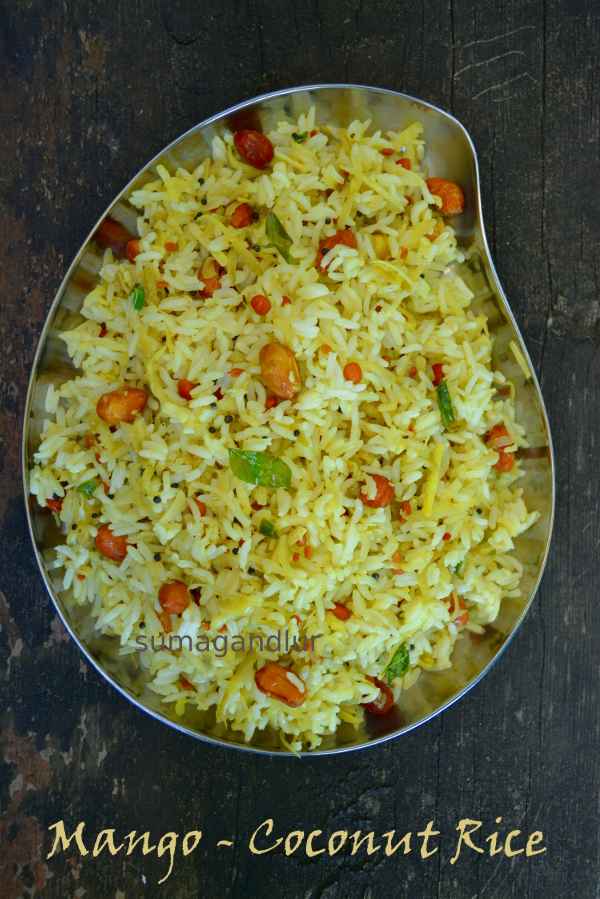
M for Mamidikaaya - Kobbari Pulihora
N for Narali Bhaat
O for Oliya
P for Peas Pulao
Q for Qabooli Biryani
R for Ram Pulao / Rajasthani Gatte Ka Pulao
S for Spinach layered Biryani
T for Tawa Pulao
U for Urad dal Khichdi
V for Varhadi Pulao
W for Waghareli Khichdi
X for Xmas Rice Pudding
Y for Yellina Chitranna
 Check out the Blogging Marathon page for the other Blogging Marathoners doing BM# 68.
An InLinkz Link-up
Check out the Blogging Marathon page for the other Blogging Marathoners doing BM# 68.
An InLinkz Link-up