HOME        |        ABOUT        |        COPYRIGHT        |        CONTACT        |         RECIPE INDEX        |         INDIAN THAALIS        |         MILLET RECIPES        |        EVENTS' ROUNDUP        

Showing posts with label Dry Coconut. Show all posts

Sunday, April 26, 2020

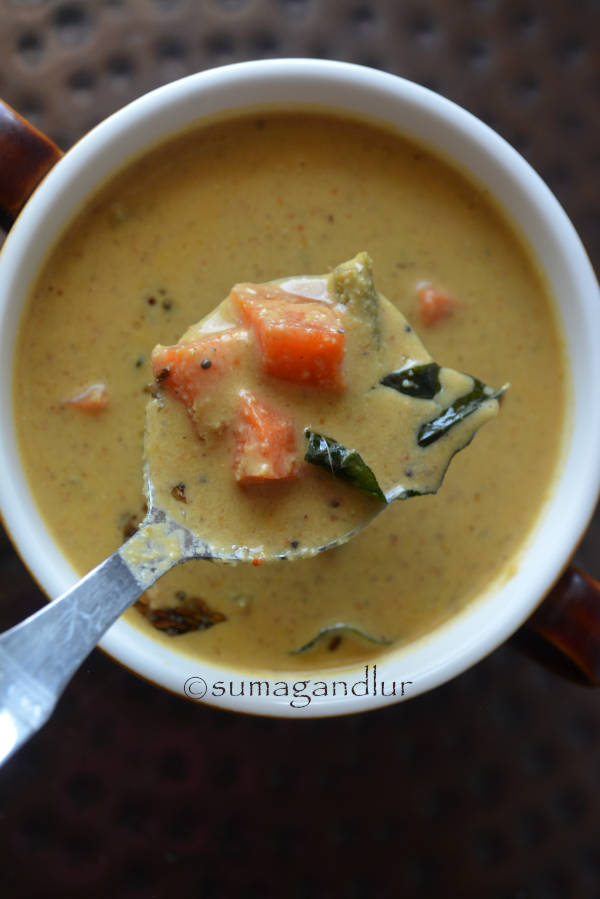
Peanut Sambhar

This recipe had been on my to do list since I noticed it at Pavani's space and am glad that I decided to try it. It was so good that even my coconut hating husband loved it and my mother who watched it over our video chaat found it very appetizing just by the looks of it.

It is not the kind of sambhar where a handful of peanuts are thrown in but is an interesting variation with a peanut base. This delicious sambhar doesn't use any lentils or any kind of beans and makes a flavorful and spicy side dish. The original recipe had sauteed onion, tomato and garlic which I omitted and added some vegetables. One can choose to go either way or one can add vegetables on hand. I also reduced the cumin seeds' quantity and added a little sweetener. 


Ingredients:

For the paste:
1/4 cup peanuts
1 tbsp. coriander seeds
1/2 tsp. cumin seeds
1/8 tsp. fenugreek seeds
3 dried red chillies
1/4 cup dry coconut, grated
For tempering:
1 tsp. oil
1/2 tsp. mustard seeds
1/2 tsp. cumin seeds
A sprig of curry leaves
A pinch of asafoetida powder
For sambhar:
1 cup chopped, mixed vegetables *
1/8 tsp. turmeric powder
Salt to taste
1 tbsp. thick tamarind puree or to taste
1/4 tsp. jaggery / sugar (optional)
* I used peeled and diced carrots and chopped beans. The original recipe had sauteed onion and tomato instead.

Directions:
* Cook the vegetables adding enough water in a microwave, pressure cooker or in a pan on stove top. Keep them aside.
* Dry roast peanuts on low flame, continuously stirring for 3 - 4 minutes. Add coriander seeds, cumin seeds, fenugreek seeds and red chillies next and toast until fragrant and the seeds start to change a shade darker. Add coconut and stir once. Turn off the stove and let the ingredients cool. Grind the ingredients to a smooth paste adding enough water.

* Heat oil in a pan and add mustard seeds, and cumin seeds. When mustard seeds start to splutter, add curry leaves, turmeric, asafoetida and stir. Immediately add the cooked vegetables along with water used to cook them, the peanut paste, salt, tamarind and sweetener if using. Add water to reach the desired consistency like a sambhar / stew. Taste and adjust the seasonings if needed. Simmer the sambhar for 7 to 8 minutes and serve hot with rice.

Comments

Monday, June 10, 2019

Bhindi Ka Salan


Salan is a thick gravied, tangy curry from the Hyderabadi cuisine that is slowly cooked in a peanut, sesame and coconut base. Aromatic, flavor loaded salan traditionally was prepared as an accompaniment to rice / rotis though it has become synonymous with biryanis over the time. If you are interested, go through this interesting excerpt on the origins of the mirchi ka salan in the royal kitchens. Today's recipe of course is not the popular mirchi ka salan version which uses the green chillies but an okra / bhindi based one. 

I prepared this bhendi ka khatta salan to go with my 'Hyderabadi Dum Biryani' during the April Mega marathon. This is a dish to have in one's repertoire, if one is an okra fan. Choose small sized, tender okra while preparing this salan. The okra is fried before adding to the gravy so that the final salan doesn't end up being slimy though one can add okra without frying and cook. I used my air fryer instead of deep frying. I used very little oil to cook this dish and so my final salan doesn't look greasy with oil on the top, which seems to be the signature look of a salan. The dish doesn't demand any fancy ingredients though linked to imperial kitchens and even a novice cook can nail it with satisfactory results. It is a simple and easy enough dish and needs little supervision though it is cooked a little extra time than most of the dishes. 

To toast and grind:
2 tbsp. peanuts
1 tbsp. sesame seeds
2 tbsp. coconut
4 byadagi chillies / less spicy variety dried red chillies
1/2 inch piece of ginger
1 or 2 garlic cloves (I didn't use any.)
Other ingredients:
12 okra / bhindi
Oil to fry bhindi (if frying)
1 tbsp. oil
1/2 tsp. mustard seeds
1/2 tsp. cumin seeds
1/8 tsp. fenugreek seeds
Few curry leaves
1/2 cup minced onion
1/8 tsp. turmeric powder
2 - 3 tbsp. tamarind juice
Salt to taste
Jaggery to taste (I used 2 Stevia packets)
1 tsp chili powder that is not very hot (I used 1.5 tsp )
Water as needed (I used 2 1/2 cups of water in total for grinding the paste and to cook the salan.)

Directions:
* Dry roast peanuts, sesame seeds, coconut and chillies on low flame, until slightly browned. Keep aside and let them cool.
* Grind the toasted ingredients along with ginger and garlic if using, to a smooth paste. Add water as needed to grind. (Ginger - garlic paste can be skipped here and added while sauteing onions instead.)
* Wash the okra, remove the ends and wipe them dry.
* Heat oil if deep frying okra. Fry okra on medium heat until slightly browned. (I used an air-fryer instead.)
* Heat oil in a pan and add mustard, cumin and fenugreek seeds. When mustard starts to sputter, add curry leaves and onion. Saute until golden brown.
* Next add the ground paste, turmeric, chili powder and salt to the pan. Add enough water to make it into a thin consistency mixture (about 1.5 or 2 cups of water). Stir well and cook the mixture covered for about 20 minutes on low flame, stirring intermittently. The mixture would have thickened by the time and the oil would have separated. Add tamarind and sweetener next, taste and adjust the seasonings if needed and cook for about 5 minutes. (I usually add tamarind and sweetener along with the paste at the beginning.) Add the fried okra and cook for a couple of minutes more. Turn off the stove and let it sit for few minutes before serving.
* Garnish with cilantro and serve with biryani / pulao / rice or rotis.


bmlogo

This post is an entry for Blogging Marathon #101 under 'Gravy Curries' theme.

Comments

Tuesday, February 26, 2019

Jowar Flour Laddu / Sorghum Flour - Nut Laddus

When I recently was discussing about travel food with my daughter, she gave me a list of foods that she would prefer to eat on a trip. It occurred to me that those are our family favorites I pack when we take long road trips and I realized with surprise that unknowingly I have created a tradition of our own. My kids one day probably would get nostalgic about our trips and reminisce about how their mom would stuff any vacant space in the car with food and other paraphernalia while dad is watching with dismay. 😇. 

Anyway while we were at it, the girl requested me to make some laddus. My daughter is not big on desserts but prefers a few selected ones like these peanut laddus for instance. I carry a load of homemade spicy snacks, energy bars and other sweets to munch on, especially if we are going to be on the road for a week or two and those laddus are a must for her. She got these energy balls to try this time which we all enjoyed. These laddus are loaded with healthy ingredients like jowar flour, raisins, a medley of nuts and jaggery which all contribute equally to make these laddus delicious and rich. The laddus do not need any ghee and the moisture from the ingredients used is enough to shape them. The laddus are firm though they look moist in the images. Try these easy and quick laddus on a festival day or as a after school treat for little ones. 

Ingredients: (Yield 12 laddus)
3/4 cup jowar ka atta / sorghum flour / jonna pindi
1/2 cup mixed nuts - I used skinned peanuts, almonds, cashews and walnuts
1/2 cup grated, dry coconut
1/4 cup raisins
3/4 cup powdered jaggery
1/8 tsp. ground cardamom

Directions:
* Roast jowar flour stirring continuously, on low flame until you notice aroma, about 7 -8 minutes.
* Toast nuts on low flame for about a minute or so. (I just toasted them in a microwave.)
* Let the flour and nuts cool down.
* Pulse the nuts finely in a food processor until they start to clump if possible and transfer to a mixing bowl. Then add jowar flour, coconut and raisins to the food processor and grind them fine. Now add back the ground nuts, jaggery and cardamon to the food processor. Pulse a few times until all the ingredients are mixed thoroughly and finely ground.
* Transfer the mixture to a mixing bowl and make lemon sized balls from the mixture.
* Store them in an airtight container. Freeze them if wishing to save longer and thaw them before serving.

This post is an entry for Blogging Marathon #97 and BM - 'Kids' Delight' event hosted by Renu this month with 'Travel Food' theme.

bmlogo

Comments

Monday, April 16, 2012

Peanut - Roasted Chickpeas Powder & Carrot - Raisin - Dates Halwa


I am back again with another edition of BM after a relaxed hibernation. I had to take a forced break due to unforeseen reasons after last BM and hence there have been no updates since then. There is going to be some action, at least for the next two weeks because of the marathon. :)
My theme for this week is going to be accompaniments where chutneys, spice powders and dry sautes are allowed. The first one in the series is going to be this simple, versatile and flavorful powder prepared using toasted peanuts and roasted chickpeas / dalia.  These are some of the ways how this delicious podi is used in my kitchen.
1. Sprinkle some ghee and eat it with rice or breakfast dishes such as upma.
2. Adding to vegetable sautes at the final stages of cooking. Or can be used as stuffing for eggplants or other stuffed vegetable preparations.
3. Adding to puffed rice upma at the final stages of cooking for extra flavor.
4. One more idea is to add water to the powder to bring it to chutney consistency and add some mustard seeds - curry leaves tadka. This instant chutney works as a great substitute for the regular version chutney during power cuts.

Ingredients:
1/2 cup peanuts
1/2 cup dalia / roasted chickpeas
1/2 cup grated, dry coconut
12 red, dried chillies
Salt to taste

Method:
Toast the peanuts on low flame, until they turn golden brown. Add red chillies and fry for a minute. Turn off the stove and let cool the peanuts. Skin the peanuts (and this step is optional).
Grind all the ingredients together finely / coarsely and store it in an airtight container.

Check what other marathoners are cooking during BM#15.

Microwave Carrot - Raisin - Dates Halwa:


This microwave version, sugar free yummy halwa is my entry for this month's Magic Mingle with "Carrot and Raisins" theme.

Ingredients:
2 cups grated carrot
1 cup pitted dates
1/2 cup raisins
1 cup milk or as needed to grind the dry fruits
A pinch of cardamom powder
Nuts to garnish

Method:
Grind dates and raisins to a fine puree adding milk.
Combine carrot and ground puree in a microwave safe bowl. Cook in the microwave, stirring in between until it comes together, about 12 -1 5 minutes. Add cardamom at the final stage of cooking and mix well.
Garnish with nuts before serving.


Comments

Friday, January 27, 2012

Sweet Pongal (Dry Version)


If you are noticing the discrepancy between the title and the image, that is my doing. There are a few recipes where I can't beat my mother and this particular one is among them. As the title suggests, this pongal is not suppposed to be wet and mushy as the typical sweet pongal versions. This one is fairly dry and you must be able to notice each grain separately when done in the way it should be done. :) My mother cooks it to perfection but I have never been able to attain the required texture.
I had prepared it on Sankranthi day a couple of weeks ago and this time came closer to my mother's version and so thought of republishing it. It appears moist since I took the images soon after the preparation. It was dry after leaving it at room temperature for a couple of hours. The color of the pongal depends upon the jaggery used and my mother's version always looks darker. This pongal is very delicious but alas I can't prove the point with these images :)

Ingredients:
1 cup rice
1/2 cup moong dal 
1 cup jaggery powder
1/4 - 1/2 cup dry coconut, grated 
1/2 tsp cardamom (elaichi) powder 
Ghee as needed (You can be as generous as you can.)
1 Tbsp each cashews and raisins

2 ½ cups or a little less water


Method:

* Dry roast moong dal until you start to feel the aroma. No need to turn the moong dal red.
* Wash the rice thoroughly. Pressure cook both the rice and moongdal together adding water, until two whistles.
* Heat a pan / wok. Add jaggery and a tbsp of water to it and let it cook on a medium flame till you get the desired consistency.
The desired consistency is that you must be able to form a small ball when you put few drops of syrup into the water. For this purpose, keep a small plate with 2 Tbsp of water near the stove. If you are not able to form the ball out of the syrup and it just melts in the water, then syrup is not ready and you must keep boiling the syrup. It would be done in around 3 –4 minutes.
* After the syrup is ready, turn off the stove. Add the cooked rice - moongdal mixture, grated coconut, cardamom and mix well. You don’t have to cook further.
* Heat ghee in a small pan, toast the cashews and raisins and add to the pongal.


Note:
1. Coming to the ingredients measurements, there is no need to use the standard measuring cup. For this recipe, the ratio of Rice : Jaggery : Moong dal is always 2 : 2 : 1.
2. This pongal is supposed to be very dry and not mushy. I did use 2 & ½ cups of water to the 1 & ½ cups of rice and moongal mixture. It turned out good. I think 2 & ¼ cups of water will yield the right texture (like in my mom’s pongal).

3. Keeping cooked rice- dal mixture ready before preparing the jaggery syrup is a good idea. If you do the other way, the syrup becomes much thicker. 

Linking this to blogging marathon #12 under "delicious dals" theme. Check out the Blogging Marathon page to find out what other marathoners have been cooking.

My posts so far, under "Delicious Dals" theme are -
Masoor Dal Khichdi (Masoordal)
Dalia - Cilantro Chutney Podi (Dalia & Urad)
Chayote Kootu (Chana dal)
Alasanda - Vankaya Pulusu (Chori beans)

Comments

Sunday, August 28, 2011

Sambhar Powder


Sambhar powder is a mandatory pantry item of any south Indian kitchen. It is a blend of ground roasted spices that lend a unique flavor to sambhar - the split pigeon peas stew that appears on daily menus of majority homes. There is no standard recipe for sambhar powder and each family follows its own "favorite recipe", probably handed down from generations gone by. A sambhar powder / masala can use many ingredients or can be as simple as this one, from my mother's kitchen.
I like trying various versions of sambhar powder and make it a point to copy down any recipe that catches my attention. However the two recipes mostly I follow happens to be the one I posted earlier and this one which is perfectly apt for my "cooking with five ingredients or less" themed BM#8 post for today.
Check what my fellow marathoners have posted for today.  

Ingredients: (for 1 cup)
1/4 cup chanadal
3 Tbsp coriander seeds
2 Tbsp skinned black gram / urad dal
1/2 cup grated, dried coconut
8 red, dried chillies

Method:
* Toast chanadal and urad dal individually on medium flame until they turn reddish. Remove them onto a plate and add the coriander seeds and red chillies to the same pan and toast until they start changing color and you start to smell the aroma of the coriander. Let cool all the toasted ingredients.
* Finely grind the toasted ingredients and coconut together. Store in an airtight container.

Monday, July 25, 2011

Chole Panjim

Chole Panjim adapted from: Gourmet Indian in Minutes

Is anyone familiar with Chole Panjim? I wasn't until I saw the recipe in the above mentioned cookbook. Punjabi style chole is so popular in Indian subcontinent that it needs no introduction. Similar with pindi chana but chole panjim is somewhat unknown I should say. This Goan chole recipe is no way related to the standard chole served at North Indian homes / Indian restaurants worldwide. This colorful dish uses some of the common ingredients of the local cuisine such as the coconut and chillies, replacing the spices of a Punjabi chole preparation. I should say I fell in love with this dish more than the standard chole because of the familiar ingredients and flavors. J A 'must try' for chole / chana lovers.
And for people who are not familiar with Indian geography, Panaji / Panjim is the capital of the Indian state Goa.

Ingredients: (3 - 4 servings)
3 Tbsp oil
1 tsp ginger - garlic paste (I omitted garlic.)
1/4 cup grated, dried coconut (unsweetened)
6 dried, very red chillies (I used Byadagi variety.)
1 tsp garam masala (I sprinkled a little at the end and did not use the whole quantity.)
1 tsp cumin seeds
1 big onion, finely chopped
1 tomato, finely chopped (optional and was not part of the recipe.)
2 cups canned / cooked chickpeas
Salt to taste
Minced cilantro to garnish

Method:
* Heat a Tbsp of oil in a pan and add ginger (and garlic if using). Sauté for a few seconds and then add the red chillies and coconut. Fry on low flame until the coconut browns. Turn off the stove and let cool. Grind this fried mixture and garam masala (if using now) to a fine paste adding required water.
* Heat 2 Tbsp oil in another pan and add cumin seeds. When they start to brown, add the chopped onion and fry until translucent. Then add the tomato and cook until mushy.
* Next add the ground paste, cooked chickpeas and salt to the onion - tomato mixture. Add water if needed and bring it to a rolling boil. * Garnish with cilantro and serve with some warm rotis.


Chole Panjim is my "Cooking from Cookbooks" themed, Day 3 post of BM #7. Check what my fellow marathoners are cooking.

Comments

Tuesday, June 21, 2011

Easy & Quick Ragi Laddus


Here is platter of healthy and quick ragi laddus on this 6th day of blogging marathon. The wholesome ragi, the nutritious almonds, the sweet coconut - jaggery combo, flavorful cardamom all together combine resulting in these delicious laddus. It can be put together under 10 minutes and an easy one even for beginners. J

Ingredients: (For 12 laddus)
1/2 cup Ragi flour
1/4 cup Almonds
1/4 cup Sesame seeds
1/4 - 1/2 cup Grated dry coconut (I used 1/4 cup.)
1/2 cup Jaggery powder (or to taste)
1 tsp Cardamom powder


Method:
* Dry toast ragi flour, almonds and sesame seeds individually. Let them cool. Toast ragi flour for a couple of minutes. Almonds and sesame seeds each need around a minute to get toasted.
* Grind all the ingredients to the desired texture in a blender or a food processor.
* Shape the ground mixture into laddus. I did not add any ghee / milk to make laddus. There is no need unless if the mixture is too dry to shape into laddus.
* Store them in an airtight container. They can be refrigerated.


Note:
* You can increase or decrease the quantities of ingredients according to the taste preferred.
* Almonds can be substituted with peanuts. Or a combination of various nuts can be used. Cashews, walnuts, pistachios are good choices.

This is my 'Ragi' themed post on day 6 of this BM#6. Check what the other marathoners are cooking.

Comments

Monday, May 16, 2011

Gasagase Payasa / Gasagasala Payasam / Poppy Seeds Kheer

Recipe Source: Pushpa Gandlur

I am participating in the second group of blogging marathon # 5 that starts today and have chosen the theme of Indian sweets. Kheers / puddings and laddus are the qualifying choices this time. That means you are going to see those kinds of sweets this week here. J
For the first day, I have chosen a delectable kheer from Karnataka. The delightful combo of poppy seed - coconut mixture in a sweetened milk base is truly a treat to your taste buds. And so rightly chosen for festive occasions or to entice guests by Kannadigas. There are several variations in the preparation of this kheer. Fresh / dried coconut can be used, jaggery or sugar can be the sweetener and the ingredients may be soaked or toasted depending upon one's preference. My mother prepares it in a different way and today's version is the courtesy of a SIL, who happens to be a Kannadiga.
And I want to mention that a little quantity of poppy seeds makes a large quantity of kheer and as many claim, you are not going to fall asleep after drinking a cup of kheer. At least I don't. J

Ingredients: (3 servings)
1 Tbsp poppy seeds / gasagase
1 Tbsp rice
6 almonds
2 Tbsp grated, dry coconut
1/2 tsp cardamom powder
4 Tbsp sugar
1.5 cup water
1 cup milk (boiled and cooled)


Preparation:
Soak almonds, rice, poppy seeds and coconut in a little water for a couple of hours. Or soak them in hot water for 30 minutes.

Method:
* Grind the soaked ingredients in a blender to fine paste, adding water if needed.
* Add the ground paste and water to a pan (non stick preferably) and keep cooking until the raw smell disappears. Keep stirring in between.  Add the cardamom powder and sugar. Stir until the sugar melts and turn off the stove.
* Remove the pan from heat and slowly stir in the milk.
* This kheer can be either served warm or cold.


Check out the following marathoners who are participating in BM#5.
Curry in a hurry under 30 min: Priya Suresh, Srivalli, Usha
Seven Days of Colorful Dishes Kid's Special: Vardhini
Seven Days of Indian Sweets: HariniVeena & Me
Seven Days of Regional Specials: Aarthi, Kalyani, Pavani, Shylaja
Summer Coolers: PJVaishali
Under 15 mins Quick Breakfast: Sushma Pinjala


Comments

Thursday, May 5, 2011

Hayagreeva


The name Hayagreeva stands for two important things in the Madhwa Brahmin community of Karnataka - a deity and a sweet dish.
The belief is that Lord Hayagreeva or Hayavadana is an avatar of Vishnu and is the god of knowledge and wisdom. He is a god with human body and a horse's head and hence the name. According to the religious belief, he is brilliant white in color, adorns white garments and sits on a white lotus.
And hayagreeva also happens to be a delicious sweet item that is commonly prepared during the religious celebrations at Madhwa homes and temples (Rayara mata / Raghavendra Swamy temple).
One of my close pals whom I have known since my preschool days happens to be a Madhwa brahmin. Her mother introduced me to this delicacy, which remains to be one of my favorite dishes even for today. My friend would always remember to invite me over to her house whenever her mother made hayagreeva or would lure me with this if she wanted me to visit her. :) Thanks Kala.
Three ingredients remain constant in hayagreeva preparation - the chana dal, jaggery and the dry coconut. Some versions use poppy seeds as well but that is not mandatory. I don't remember my friend's mother ever using it. Ditto with ghee. If you are not counting calories, you can liberally use it or use sparingly as I did. And of course there is cardamom for flavor like the rest of Indian sweet dishes. Though the list of ingredients used strike a resemblance to the other delicacy of the Indian region, the chana dal kheer, the two dishes are way apart. Hayagreeva doesn't use milk and is fairly on the thicker side when done. The dal is cooked until just done so that the shape of the dal is retained in the end product.
When Design a Menu - 2 was announced and I saw chana dal in the list, I knew what was going to be my dessert. In fact, I have a whole menu with chana dal alone but since that is not the rule, we will go with this for the dessert part.


And also linking this to Akila's Dish name starts with H.


Ingredients for 4 - 5 servings:
1 cup chana dal
Jaggery powder to taste (1 - 1.5 cup depending upon the sweetness preferred)
1/2 cup grated copra / dry coconut
1 tsp cardamom powder
1 Tbsp ghee roasted cashews and raisins (optional)

Method:
* Cook chana dal in a pressure cooker adding 2 cups of water. The chana dal should not turn mushy but still hold their shape when cooked.
* Add the cooked chana dal, jaggery, grated dry coconut and cardamom powder to a sturdy pan or non stick pan. Start cooking on medium flame till all the jaggery melts and gets incorporated into the chana - coconut mixture. Turn off the stove.
* Add the toasted raisins and cashews if using.

Note:
Don't add water when jaggery is added since hayagreeva should be a thick mass. And also the chana dal should hold its shape. Mine was a little mushy since I added overnight soaked chana dal.


Sunday, January 23, 2011

Simple & Quick Subzis ~ Capsicum with Coconut


As I mentioned a few times in my earlier posts, what garlic is to me is coconut to my husband. He can't even stand the smell of coconut and so this curry never happens at my home. Usually capsicum is cooked either this or this way. In my mother's kitchen, it is all together a different story. Any thing coconut is appreciated and all most all koora - pulusus (subzi / dals) are usually laden with coconut for that sweet flavor. And this is the only way my mother cooks capsicum, that also happens to be my father's favorite version. I had prepared this capsicum - coconut koora when my parents were visiting us, last summer.

Ingredients:
2 small sized green capsicum / about 1.5 cup deseeded and chopped
1/4 cup fresh coconut (thaw if using frozen)
1 tsp chili powder
Salt to taste
For tadka: 2 - 3 tsp oil, 1 tsp mustard seeds and 1 tsp chana dal

The cooking:
Heat oil in a kadai or a non stick pan, add the dal and mustard seeds and sauté for a few seconds. When the dal turns reddish and the mustard seeds start to pop, add the chopped capsicum. Stir well once and cook the capsicum on low flame, covered. Keep stirring in between till the capsicum turns tender. Then add the coconut, chili powder and salt to the cooked capsicum and mix well. Heat for 2 -3 minutes more and turn off the stove.
Serve with rice or rotis.

Post a comment

Sunday, October 31, 2010

Kayi Holige / Coconut Poli

Holige = Obbattu = Holiga = Poli = Bobbattlu => A sweet delicacy from India


Yes, I have saved the best for the last part of my CFK.
I grew up and have spent two thirds of my life in a state where every celebration, bigger or smaller is impossible with out holige / obbattu on the menu. It would have been a shame if I had not posted a holige recipe when I am hosting an event that is dedicated to festive foods. I see all Kannadigas nodding their heads. :)  Holige plays a major role in Karnataka cuisine and this delicacy enjoys a 'royal' status there. 'Holige oota' - The food including these sweet flatbreads is considered to be the ultimate feast one can serve to their guests. Festivals, engagements / marriages, graduations, welcoming home a new son-in-law or a baby, a new home / job (for that matter, any reason under the sun that one can think of that has brought joy to life) has to be celebrated with these holiges, of course lovingly prepared by dear mothers or chefs if prepared on a big scale!
Holige making is considered an art and usually the job is reserved to the experienced matron figure of the family. As I mentioned above they are flat breads with a sweet stuffing. The usual traditional stuffing can be pureed toordal / chanadal or coconut ones sweetened with jaggery and flavored with aromatic cardamom. Usually when moongdal filling is used, sugar is the preferred sweetener. I have noticed that even a traditional poli could become versatile depending upon one's creativity and experiments. Now coming back to the traditional ones, kayi holige or kayobbattu is said to be one of the tougher ones to nail down. They are supposed to be wafer thin and some experience helps in perfecting them. My mom usually prepares and prefers coconut stuffed ones since they can be stored longer, about a month or so with out any refrigeration. Some stores in Bangalore sell them in plastic packets because of their long shelf life.
The outer layer uses the chiroti rave along with maida. Chiroti rave happens to be finer semolina than the regular version that is used to prepare upmas. As the name suggests, it is used in preparation of another delicacy from the state, chirotis. Chirotis happen to be one more sweet delicacy from Karnataka and usually appear on wedding menus. Their preparation is left to seasoned chefs since the preparation process happens to be an elaborate one.

The following ingredients make around 22 obbattus. My mother though added the ingredients for the stuffing and the dough with out any measuring tools, they were perfect. We were not left with any of the stuffing or the dough.
Since I don't do pictorial explanations, I didn't take pictures for each step. I will try to update the post with new images for a better understanding of the recipe.

Ingredients for the stuffing:
4 cups finely shredded fresh coconut*
3 cups powdered jaggery (or less if you find the mixture sweeter)
1 tsp powdered cardamom

* It is important to note that the coconut needs to be very finely shredded. I had used the frozen, shredded coconut and since the gratings were larger, I just ran it through food processor for a minute so that it was finely shredded.

Preparing the stuffing:
Add everything to a thick bottomed or a non-stick pan and start cooking on medium low flame till it thickens. It took me around 25 minutes to cook it. To know whether it is done, do this test. Take a tsp of the stuffing, make it into a ball and try to pat it on a plastic sheet with your fingers. You must be able to spread it with out any difficulty. It should not curl back.
Let it cool. At this stage, either you can use it to prepare holiges or can refrigerate it to use later. It can be stored refrigerated for at least a couple of weeks. This step can hence be done very well in advance.

Ingredients for the outer layer:
Chiroti Rava / Very fine semolina - 1 & 1/4 cups
Maida / All Purpose flour - Half the quantity of rava
Oil - 6 to 7 Tbsp

Photobucket

Preparing the dough for the outer layer:
Combine the flour and rava in a bowl. Add sufficient water (I added about 1 cup minus 1 Tbsp) and make a thick dough as roti / poori dough. Then add the oil gradually and keep kneading so that the oil gets incorporated well into the dough. According to my mother's instructions I kept kneading it for at least 15 minutes.  My mother swears that this much of kneading (and the addition of that much of oil too) is really important and one shouldn't skip this step. 
Let the dough rest for about 30 minutes.

Making obbattus:
* Pinch about a small lime sized dough and place it on a greased banana leaf or a thick plastic sheet that is greased.
* Now using your fingers, pat and flatten it into a thin circle of about 3 inch diameter.
* Place about a lime sized ball of stuffing at the center of the dough circle. Bring the edges of the dough from all sides to cover the stuffing completely. Now the stuffing should be well inside the dough casing.
* Again flatten it with your fingers and go on patting it carefully so that it results in a thin, flat circle with stuffing not spilled out. Take care that the edges have stuffing too so that you don't end up eating hard edges.
The below one was stuffed by me on my first trial and hence looks like that.:)

Photobucket

* Meanwhile heat a griddle / tava / or a shallow pan. Now place the disc on it and fry it both sides till it is done by flipping it once or twice and adding a half spoon of oil / ghee around the edges while doing so.

Photobucket

* Repeat the procedure with the remaining dough and the stuffing. You can prepare the discs and do the frying part simultaneously. 
Enjoy them with a spoon of melted ghee.
Cool the rest and store them in an airtight container. They remain good atleast for a month, unrefrigerated.

I am really glad to send them over to my CFK - Festive Foods, an event originally started by Sharmi.


Post a comment

Wednesday, October 20, 2010

Kajjikayalu


While chatting casually a couple of days ago, my sister Siri had mentioned that she had a large quantity of endu kobbari / dried coconut shells and was thinking of making kajjikayalu. Though she got the recipe from me, she requested to post it for future references and so here it is.
Kajjikayalu are a part of Andhra 'pindivantalu' - the festive dishes, besides many other mouthwatering sweets and savories like bobbattlu, boorelu, ariselu, ladlu, garelu, pulihora, janthikalu, aavadalu and many many more. :) These half moon shaped, crisply fried shells with a sweet filling inside are a true treat for anyone's taste buds. There are several fillings to go inside the shells but today I am posting the version of coconut - sugar filling accentuated by the aromatic cardamom. Though they fall under the sweet category, kajjikayalu are not overtly sweet as typical Indian mithais do since the outer shell is not sweeter. One can hence enjoy at least a couple at a time. I have thrown diet rules off the window and have been enjoying 3 - 4 per day. :)

Recipe Source: My mother
Time needed: About an hour
Quantity: 25

Ingredients to make kajjikayalu:
For the outer shell:
2 cups maida
a pinch of salt
For the filling:
2 cups grated copra / endu kobbari
1 cup sugar
1 tsp cardamom powder
To fry:
2 -3 cups of oil

Making kajjikayalu:
* Combine the flour and salt in a mixing bowl. Gradually add water and make a thick dough like poori or chapathi dough. (I used about 1 cup minus 3 Tbsp of water.). Let it rest for about 30 minutes.
* Place the coconut, sugar and cardamom in a food processor or blender on pulse mode and run for a few seconds to end up with a slightly homogeneous mixture. This filling can be prepared in advance.

Photobucket

* Heat the oil in a banali / kadai. If you don't own one, any deep bottomed nonstick pan would also work. To know whether the oil is hot enough, put a pinch of dough into the hot oil. If it sizzles and comes to surface immediately, then it is ready.
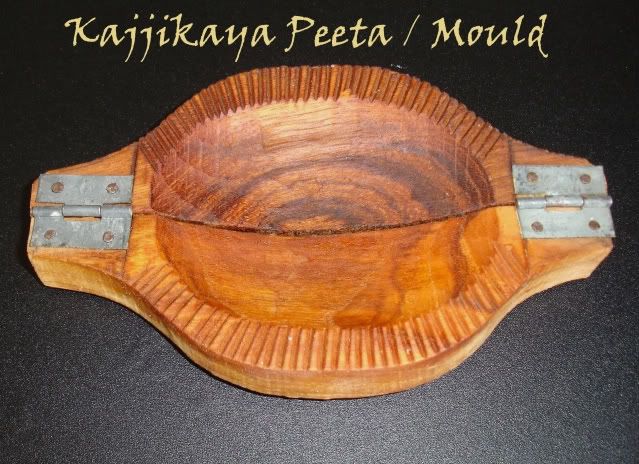
* Meanwhile, divide the dough and shape into small balls. Roll each ball into a thin poori, slightly bigger than the circumference of kajjikaya mould. Spread the rolled out poori on the greased mould.


* Place a couple of tablespoons of the filling in it. Take care that the filling is in the center and not along the edges. If the filling is on edges, you can not seal them.


* Fold the mould and press it firmly so that the filling doesn't come out during the frying process. Trim off the extra dough, outside the mould and put it back into the dough container.


* Now open the mould, gently lift off the kajjikaya and place it on a plate.


* Prepare at least 4 -6 of these and start frying. When frying the first batch, you can prepare the shells for the next batches. Also remember to grease the mould each time you use it, to avoid the shell sticking to it.


* Deep fry the kajjikayalu on low flame till they turn golden brown and crisp. Fry as many kajjikayalu as your kadai can fit without overcrowding. Frying on low flame is crucial in this recipe to achieve the crispiness of the outer shell of kajjikayaku. If fried on higher flame, they brown quickly and the shell would be softer as a roti or poori.

Note:
1. Kajjikaya mould is the gadget needed for this recipe. It is foldable in half and in helps in getting the needed semi circular shape of a kajjikaya and also helps in sealing the edges.
2. If you don't own a mould, place the filling on one half of the rolled out dough. Wet your fingers with water and run around the edges. Fold the other half over the filling so that it is semi circular in shape and seal the edges firmly. If the edges are not sealed properly, the filling would spill out into the hot oil.
3. If the outer shell of the fried kajjikaya seems to be softer, put it back to the hot oil, and fry on low flame till it turns crisp. Using low flame is the key to success in this particular recipe.

They are going to my CFK - Festive Foods, an event originally started by Sharmi.


Post a comment

Tuesday, May 11, 2010

Spinach - Toordal Patoli / Sandiga Koora


I love cumin flavored, protein packed patolis and they keep appearing frequently in our menu. Usually I prepare patoli using chanadal but this time prepared toordal one using M's aunt's recipe.

List of ingredients for 4 generous servings:
A spinach bunch or 2 -3 cups of roughly chopped spinach leaves along with the tender stalks
For grinding:
Toordal - 1/2 cup soaked for a couple of hours, minimum
Cumin seeds – 1 Tbsp
Red chilies - 8 to 10 (depending upon the spiciness you prefer, medium to hot)
Grated, dry coconut / copra;- 1/4 cup (optional)
For tadka: Oil – 2 Tbsp,1 tsp each - mustard seeds, chanadal, uraddal, cumin seeds, few curry leaves and a pinch of asafoetida, 1/4 tsp turmeric powder
Salt to taste


Preparation:
* Soak toordal in water for a minimum of 2 hours and drain.
* Coarsely grind toordal, cumin seeds, coconut and red chilies with as little as water as possible. Place this mixture in a container and cook on medium flame in a pressure cooker without the weight, till it is done (as you steam idlis). When it is done, the mixture would be dry. It would take about an hour or more and you have to remember to keep adding water to the cooker as the water keeps evaporating, during the cooking process. If you forget, you will end up with a burnt cooker. Let it cool for a while.
* Crumble the toordal mixture, which would have become dry at this point. You can either use it immediately or freeze it and use later. Usually I prepare this in large batches and freeze it in small portions so that I can use it next time with out thawing the entire quantity. Also I prefer this steaming method to frying since less oil is used and frying the toordal paste in the oil is messier. It is done while I am taking care of million other things in the kitchen. :)
* Heat oil in a pan. Add chana dal, urad dal, cumin, mustard seeds, curry leaves to the hot oil. When chana dal and urad dal begin to turn reddish, add turmeric powder and the spinach. Sauté for a few minutes or till spinach is done. Then add the toordal mixture and salt to the pan. Sauté for a couple of minutes more. Turn off the stove.
* This patoli can be served with rice or rotis.


Comment

Friday, April 23, 2010

Kulchas and Carrot & Beans in Peanut - Sesame Sauce


Long ago, I had tried home - version naans for a couple of times and felt that it is best left to restaurant chefs who own the neccessary ovens. Though skillet breads like para(n)thas and rotis can be mastered at home with experience, kulchas and naans are totally a different clan. They are usually made in the clay oven tandoor at temperatures around 700 deg F, where the dough is slapped against hot clay walls.
Recently the urge to prepare kulchas started when I noticed them on various blogs, where chefs happen to be home cooks like me. I chose and prepared DK's onion kulchas sans the stuffing. Here are those plain kulchas that I am sending over to Nupur's Blog Bites - CopyCat edition.

Ingredients to make around 12 kulchas:
3 cups Maida / Flour
1/2 tbsp sugar
1 tsp salt
1/2 tsp baking powder
1/8 tsp baking Soda
4 Tbsp oil
1/2 cup Yogurt
1 tbsp Ghee

 Making rotis:
Combine all the ingredients in a bowl. Prepare a soft dough (like rotis) adding water as needed. Let the dough rest for a couple of hours or more. Then divide the dough into 12 equal portions and shape each one into a ball. Roll it out into a circle using a rolling pin. (I happened to roll them a little thicker than what I do usually.)
Fry them on a skillet on stovetop.
Serve them with melted butter and a side dish.
For dough consistency and frying any kind of roti/paratha on a skillet, check here.

My experience:
I tried both broiler and stovetop method. I feel stovetop ones were fried better (notice all those brown spots) than broiler ones. No offense, these kulchas can be tried at home but not a substitute for those tandoor baked kulchas. For the real deal, I would prefer a restaurant.

Carrot & Beans Subzi in Peanut - Sesame Sauce:
I usually go with this kind of sauce when preparing laukis but this time used for carrot - bean combo. This delicious gravy can be used for any combination of vegetables and this subzi is good with any kind of rotis.


Ingredients to serve 4:
4 tsp oil
1 tsp each - Chanadal & mustard seeds
1/4 tsp Turmeric powder
1 Onion - peeled and diced
1 Tomato - diced
Green beans, stringed and cut into 1" pieces - 1 cup
1 Big carrot - peeled and diced
1 tsp Sambhar powder
1 tsp Sugar / jaggery
Salt to taste
Ingredients to powder:  In a spice grinder, grind a handful of toasted and skinned peanuts + 2 Tbsp toasted, white colored sesame seeds + 1/4 cup dry coconut + lightly toasted 8 dried red chilies (I used byadagi chilies. If using other variety, adjust the quantity.)

Making Subzi:

  • Heat oil in a pan / kadai and add chanadal and mustard seeds. When chana starts to turn reddish, add turmeric powder and onions.
  • Fry on low - medium flame till the onion turns translucent.
  • Then add tomatoes and sauté them for a couple of minutes.
  • Next add carrots, beans and cook them tender adding as much water as needed.
  • Add the powdered ingredients, sambhar powder, salt and sugar to the cooked veggies. Mix well. Adjust the ingredients and the quantity of water, if needed.
  • Let it come to a rolling boil and then turn down the heat. Simmer the subzi for about 5 minutes.
Post a Comment