HOME        |        ABOUT        |        COPYRIGHT        |        CONTACT        |         RECIPE INDEX        |         INDIAN THAALIS        |         MILLET RECIPES        |        EVENTS' ROUNDUP        

Showing posts with label Vrat ka khana. Show all posts

Monday, July 5, 2021

Sweet Potato Kheer

This post was originally published in 2009 and needed some revamping both in terms of content and images. I had posted a microwave version but I am updating with the stove-top method too. 

Kheer / payasam is a popular and quick to cook dessert from Indian cuisine. It is equivalent to the pudding recipe from the western world sans eggs. Rice, vermicelli, sago/tapioca pearls, and split chickpeas versions are the most common and traditional kheers prepared across India. There are though several other delicious versions and kheers are mostly easy to prepare. The basic preparation of a kheer remains the same. A grain / lentil / vegetable / other ingredient is cooked in milk and sweetened with sugar or jaggery. Dairy milk is most commonly used though other milks like coconut milk, almond milk can be easily substituted in the recipe. Whole milk adds richness to a kheer but replacing it with half and half or a splash of condensed milk makes it festive. Cardamom is the most common flavor used in south India while saffron, kewra essence and rose water are other flavoring agents that go in north Indian style kheers. A garnish of ghee toasted dry fruits and nuts finishes the dish.

I love simple kheers like carrot / chayote / dates that sound special and unusual. I sometimes combine half & half to my kheers for the extra richness. These are some of the kheers that I have already posted on my blog. The first time I prepared this sweet potato kheer was for my guests who had hard time guessing the contents of the kheer and were bowled over by it's taste. I had never heard about sweet potato kheer before that and it was an experiment done on a whim. I use the pink fleshed sweet potato that is common in USA to make this kheer. The color of this chilled kheer is just because of the yam and no saffron was added. It can be cooked with the Indian variety sweet potato too but the sugar quantity in the recipe needs adjustment as it is a more sweeter variety. This is so delicious that it can be served to guests or can be included in festive meals. It can also be cooked during vrat / fasting since sweet potato is allowed during the period.
Ingredients:
2 tbsp. ghee
1/2 cup peeled & shredded sweet potato 
1.5 cups whole milk or as needed (or substitute with half & half for more richer version.) 
3 - 4 tbsp. sugar or to taste
Seeds ground from 2 cardamom pods / 2 pinches of ground cardamom
1 tbsp. cashews and raisins for garnishing (optional)
(For the original microwave version, I had used a tbsp. of ghee and 1.5 tbsp. sugar.)

Stove-top method:
* Heat ghee in a pan and add cashews and raisins. Toast them until raisins turn plump and cashews turn golden brown. Remove them with a slotted spoon and transfer them to a small bowl.
* Add grated sweet potato to the same ghee and sauté for 5 - 6 minutes, stirring continuously. 
* Next add milk to the pan and cook until sweet potato softens. (It doesn't tale much time.)
* Next add sugar and ground cardamom and cook until the sugar melts. Turn off the stove.
* Garnish with toasted cashews and raisins. 
* I usually serve it chilled but it can be served both warm or chilled.

Microwave version:
* Mix the ghee and the shredded sweet potato in a microwave safe bowl and cook it for a couple of minutes in the microwave. Remove and stir the contents once in between. 
* Add 3/4 cup of milk to the bowl and mix well. Put the bowl back in the microwave and cook until the sweet potato is almost done. Check once in between and if the milk has been absorbed by the sweet potato, add some more. (It may take about 3 - 4 minutes.) 
* Add sugar, remaining milk, and cardamom to the bowl. Mix well and put it back in the microwave and cook for a couple of minutes or until the sweet potato is cooked. Garnish with nuts/raisins if using. Stir well before serving. This kheer can be served warm or cold.
 
Note:
1. For diabetic-friendly version, omit the sugar and add a little sweetener to the bowl just before serving.
2. The time to cook the kheer in a microwave may vary depending upon the strength of the microwave. Use your discretion and cook accordingly.

Saturday, July 3, 2021

Aloo Raita / Indian Potato Yogurt Dip

Potato is one of the limited vegetables that is allowed during fasting in some parts of India. Plantain, sweet potato, colocasia, bottle gourd, pumpkin, cucumber, raw papaya and yam are the other ones. Fruits, dairy products and a few spices are allowed as well. I made this quick and nutritious raita using aloo / potato and other allowed 'vrat' ingredients.

Freshly made, full fat yogurt is what used in raita preparations but I went with fat-free yogurt as that is what eaten at our home. Sendha namak / saindhava lavanam / rock salt is used instead of regular salt during fasting in some parts of India and that is what I have used in this raita. Regular salt can be added if not following the fasting diet. 

The raita can be made just with the base recipe I mentioned below, without adding any optional ingredients, the one which I personally prefer. Cumin powder and black pepper are 'allowed' during fasting and I have added those as well to my raita bowl as my husband absolutely loves them. 

My husband always sprinkles chili powder, black salt and chaat masala to any raita I make and he enjoyed this raita adding those to his portion. Some consume these spice powders and some don't while fasting and so they can be added accordingly. I personally don't prefer that much of spices in my raita and omit them. 

Ingredients:
1 cup peeled and cubed potato cubes
1 tsp. oil
1/2 tsp. cumin seeds
1 spicy green chili, finely chopped
1 cup yogurt (I used homemade fat-free yogurt.)
Sendha namak / rock salt to taste or use regular salt
1 tsp. grated ginger
Minced cilantro to garnish

Optional ingredients that can be added if fasting:
1/2 tsp. toasted and ground cumin 
Ground black pepper to taste 

Optional ingredients that can be added if not fasting:
Chili powder
Black salt 
Chaat masala 

Directions:
* Cook potatoes adding water as needed, in a microwave or on stove-top until done. Drain them and keep aside. Mash the potato when they come to room temperature.
* Heat oil in a small pan and add cumin seeds. When they start to change color, add green chillies and sauté for 20 to 30 seconds and turn off the stove.
* Add yogurt and sendha namak / rock salt to a bowl. (Use regular salt if not fasting.) Beat the yogurt with a spoon for a smooth consistency.
* Add the mashed potatoes, cumin -green chili tadka, grated ginger and minced cilantro to the bowl. Mix them with a spoon to combine. (One can certainly stop at this point and serve this.)
* Add ground cumin and black pepper if preferred and stir to combine. (These are allowed during fasting.)
* Chili powder, black salt and chaat masala are other flavorful additions that can be used if not fasting. (Some eat these spice powders as well during fasting and so need to be used accordingly. I added these spice powders to a portion of raita which is not pictured here.) 
* Serve this with 'allowed breads' during fasting like parathas made with amaranth flour, water chestnut flour or barnyard millet pulao and such.
This post is an entry for Blogging Marathon and check the link to find out what other marathoners are cooking.

Friday, October 12, 2018

Rajgira Sheera / Amaranth Flour Halwa

Coinciding with the Navratri season, here is one more dish associated with it and the fasting regimen. This halwa / sheera is prepared using amaranth flour / rajgira atta and seems to be a popular dessert fit for the season. Not a tricky one to prepare but patiently roasting the flour in ghee without burning it until it turns light brown is important. 
The halwa can be prepared with either milk or water. It is rich because of the ghee and milk used and therefore eaten in small quantities. I used jaggery instead of sugar and 1/4 cup of it makes it not an overtly sweet dish but one can increase the sweetener by a couple of tbsp. more if one prefers a sweeter halwa. The consistency of this halwa would be smoother compared to the sooji halwa since flour is the base here.

Ingredients
1/4 cup ghee (I used less.)
1/2 cup rajgire ka atta / amaranth flour
1 and 1/4 cup milk
4 - 6 tbsp. sugar (I used jaggery instead.)
2 pinches of ground cardamom
Nuts to garnish

Directions:
* Heat ghee in a pan and add amaranth flour to it. Start toasting until you notice the aroma and the mixture changes to light brown color, about 6 to 8 minutes.
* Meanwhile, heat milk and sugar in a microwave or in a pan and keep aside. No need to boil the milk.
* Add milk and cardamom to the toasted flour gradually in small increments from the sides of the pan, stirring continuously and quickly to avoid forming lumps. Cook on low flame covered until the mixture thickens and the ghee starts to release along the edges.
* Garnish with slivered almonds / any other nuts and serve warm.

Comments

Sunday, February 18, 2018

Sabudana Khichdi / Saggubiyyam Upma


Sabudana khichdi is a popular dish in some parts of India, especially in the state of Maharashtra. As the title indicates, the khichdi is made using sabudana / tapioca pearls. It can be eaten for any meal of the day and is considered as one of the fasting foods given that the regular salt in the recipe is replaced by rock salt.

This khichdi requires a bit of advance preparation since the tapioca pearls need soaking until they turn translucent and soft. The time of soaking depends upon the variety of tapioca pearls used. Some need only a few minutes of soaking where as some need 4 to 5 hours of soaking. I don't soak tapioca pearls in plenty of water but instead use only enough water to cover them. I cover the tapioca pearls' bowl and forget for few hours. Usually they absorb all the water by that time and would have turned translucent and fluffy, ready for use.

Grated ginger, fresh shredded coconut and sugar can be added as well to the recipe though I don't use them.

Ingredients: (Yield 2 servings)
1 cup sabudana / tapioca pearls
1/2 cup peanuts
1 medium sized potato
1 tbsp. oil
1 tsp. cumin seeds
10 curry leaves
1 or 2 green chillies, finely chopped
Salt to taste
Lemon juice to taste
Minced cilantro to garnish

Prep work:
* Rinse tapioca pearls in a colander under running water until it is not cloudy anymore. This helps to get rid of the starch to some extent. Soak tapioca pearls in a bowl by adding water just enough to cover them. Cover the bowl and leave aside for 4 to 5 hours or overnight. 
* Press a soaked pearl between thumb and forefinger to check whether it easily squishes. If not, sprinkle some more water and soak for some more time. (My tapioca pearls took about 5 hours to soak.) Drain any extra water if present.
* Toast the peanuts and skin them. Save about 2 tbsp. peanuts and coarsely grind the rest of the peanuts.
* Peel and cube the potatoes.

The cooking part:
* Heat oil in a pan, preferably a non stick one and add cumin seeds. When they start to brown, add curry leaves and chillies. Saute them for about 20 seconds and add potato cubes. Cover and cook on low flame until the potato cubes turn tender.
* Mix soaked tapioca pearls, peanut powder and salt in a bowl. Add them to the pan and cook covered on low flame until tapioca pearls turn slightly translucent.
* Garnish with cilantro and the saved peanuts.
* Squeeze some lemon juice while serving or it can be added while cooking tapioca pearls.

bmlogo
This goes to Blogging marathon #85, under the theme 'Breakfast Recipes'. Check out the page to read what other marathoners are cooking.

Comment

Thursday, March 26, 2015

Sabudana Laddu

 
I chose to cook with sabudana this week just because I had around 5 to 6 pounds of sabudana lying in my pantry and as far as I remember I haven't posted a single sabudana recipe so far. Growing up I saw my mother using sabudana / saggubiyyam basically in two recipes - a payasam (that was less preferred over the vermicelli one) and the saggubiyyam vadiyalu or the vadi. Later on came the sabudana dosa, sabudana vada and the khichdi to my life when I had my own home and hearth. For today's post it was decided that I would do a dessert and kheer seemed like an easy way out. I have grown a penchant towards the sago kheer over the years and besides, my son loves it too. However change in plan happened because of Ugadi. I thought of preparing something with sabudana for the neivedyam and this laddu came to the rescue. The laddus were so yum and appealing that even my sweet-phobic husband ate a couple of them without any coaxing from me. They looked so tempting to him that he wanted to taste a bit of it and couldn't stop himself from tasting more. That means a lot coming from a person who wouldn't even glance the sweet dishes.

Ingredients:(Yield 15 - 16 laddus)
1 cup sabudana / sago / tapioca pearls
1 cup powdered sugar (or adjust the quantity)
1/4 tsp cardamom powder
2 tbsp. ghee
1 Tbsp. raisins
1 Tbsp. cashews
Extra ghee / milk to shape the laddus

Method:
* Dry toast sabudana on low flame, continuously stirring until they turn slightly brownish. It would take around 15 - 20 minutes to toast sabudana this way. The hard sabudana would have attained a crunchy texture by the time toasting is done. Transfer the sabudana to a wide plate and let it cool.
* Heat 2 tbsp. ghee in a small pan and add raisins and cashews. Stir and toast them for few seconds until the raisins turn plump and cashews turn golden brown. Turn off the stove and keep the pan aside.
* Grind the toasted sabudana to a fine powder. This step can be done in batches. Grind the mixture and sieve it if it appears coarse. Collect the fine powder and again grind the coarse powder left in the sieve and repeat the process until you are left with finely ground sabudana.
* Combine the ground sabudana, sugar powder, ground cardamom and the toasted cashew-raisin mixture along with the ghee in which they were toasted in a mixing bowl. Add extra melted ghee / milk to the mixture until you are able to hold it together. 
* Shape lemon sized balls out of the mixture by rolling between your palms.
* Store them in an airtight container.

Notes:
1. In case, one doesn't prefer to use that much of ghee in the recipe, warm milk can be substituted instead to shape the laddus. 3 to 4 tbsp. milk should suffice to make laddus. Please note to add ghee / milk in small increments instead of dumping it all into the mixture at once. If it becomes too wet, you need extra sabudana powder to fix it and extra sugar to balance the flavor and so add milk/ghee in little quantities, combine the mixture and check whether the laddus can be made or not. 
2. If milk is used to make laddus, they would turn harder after a few hours. They just need to be warmed in the microwave for few seconds before consuming them. I used milk to make these laddus and didn't refrigerate them. We ate them in about four days and they stayed fresh for that long.

This goes to Blogging Marathon #50, under the theme of "One ingredient - Three different dishes", Sabudana / Sago / Tapioca pearls being my chosen ingredient. Check out the link to find out what other marathoners are cooking.

Comments

Wednesday, March 25, 2015

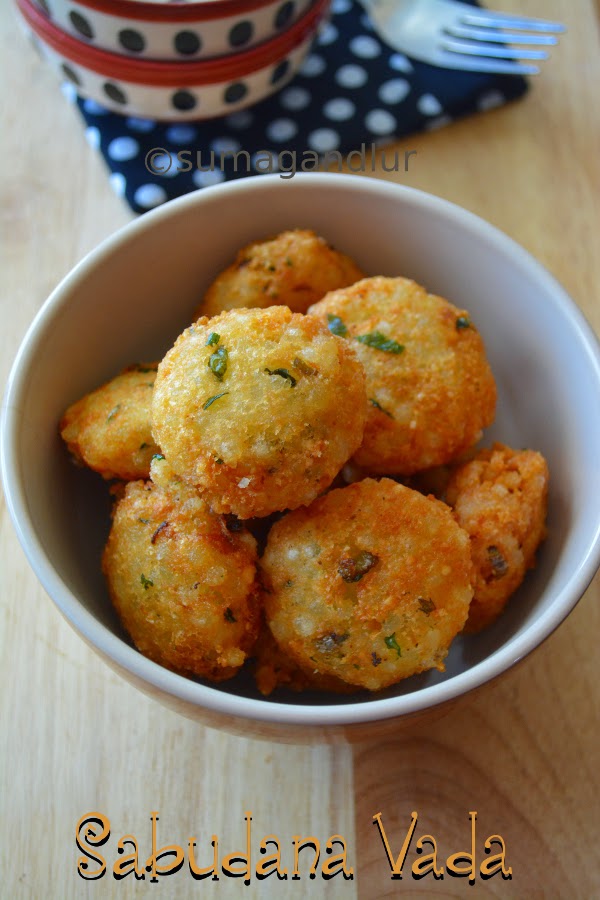
Sabudana Vada / Sago Vada

Honestly speaking, fasting during navratri or the fasting food aka 'vrat ka khana' is an alien concept to me as a south Indian. As a vegetarian, I know that onion and garlic are taboo during religious occasions and rice is not consumed sometimes when fasting. However I had no clue that there is a long list of ingredients that people wouldn't consume during fasting in other parts of the country until I moved to U.S. and saw some of my Indian friends fasting at the drop of a hat in the name of festivals.  
Sabudana or tapioca pearls is one of the ingredients that is allowed during fasting and can be used to prepare yummy, light snacks such as khichdi or vadas. Sabudana vada, a traditional deep fried snack from Maharashtra is also equally popular as a fasting food. They are yummy but the flip side is that they are deep fried and need a bit of pre-planning since sabudana needs soaking. This 'crunchy on the outside and softer inside' vadas make a great snack along with your evening cup of tea.
 
Ingredients:
1 cup sabudana / sago pearls
2 small sized potatoes
1/4 cup peanuts
2 -3 green chillies, finely chopped (adjust the quantity as per preference.)
1 - 2 tbsp. finely minced cilantro
Salt to taste (or rock salt if fasting.)
1 Tbsp. rice flour (optional and if fasting, rice flour can be replaced with buckwheat flour or chestnut flour.)
Oil to fry (I used canola oil. Vegetable / peanut oil can be substituted.)
  
Preparation:
* Soak sabudana in just enough water to cover them for about 2 - 3  hours or overnight depending upon the sabudana variety. Drain in a colander and keep it aside until all the water is completely drained. (check notes.)
* Peel and cook the potatoes in a pressure cooker. Drain completely and then mash finely.
* Roast and skin the peanuts. Grind them coarsely and keep aside.

Method:
* Heat oil in a kadai / frying pan to deep fry the vadas.
* Add soaked and drained sago pearls, mashed potato, peanut powder, green chillies, cilantro, salt and flour if using to a wide bowl. Mix well to combine. 
* Pinch about lemon sized portions from the mixture.
* Gently pat them into patties and gently slide them into hot oil. Fit as many patties as the pan could hold without overcrowding.

* Deep fry them until they turn golden brown and are done.
 Notes:
1. I have used large sabudana pearls here. The soaking time depends upon the quality and the variety of sabudana. I have heard from my mom that the best quality sabudana needs just sprinkling of water to make the pearls soften but the variety I usually get here requires overnight soaking. Some soften in lesser time than the other and so check accordingly. When you press a soaked sago pearl between your finger tips, it should be moist and spongy.)
2. I usually deep fry keeping the flame at somewhere between low and medium. Vadas cooked at high temperature would brown faster leaving the insides uncooked while a low cooking temperature would make vadas greasier.
3. During fasting months, amaranth flour / buckwheat flour or water chestnut flour can be substituted for rice flour and rock salt can be used in place of regular salt.
4. For a healthier version, they can be shallow fried in a appe pan.
5. Minced ginger, 1 tsp of sugar or lemon juice can also be added to the recipe.

This goes to Blogging Marathon #50, under the theme of "One ingredient - Three different dishes", Sabudana / Sago / Tapioca pearls being my chosen ingredient. Check out the link to find out what other marathoners are cooking.

Comments