skip to main |
skip to sidebar
Chinese started drinking tea way before the English caught the fancy. However the afternoon tea which started during 18th century is considered an quintessential English tradition though it is relatively new and started centuries later. The English just didn't drink their cuppa during evenings. Instead the ladies made it into a tradition, a fashionable social event which demanded dress code and etiquette. The afternoon tea which was served in drawing rooms between 4 and 5 pm was a small meal, not a drink. It included an array of snacks which in guise were calorie inducing and mouthwatering treats like rich teacakes (which are not cakes by the way), dainty sandwiches like cucumber ones, small sweet pastries, freshly baked scones served with cream and jam and so on. However the ladies were expected not to eat their heartful, which otherwise would have been impropriety.
Elevenses on the other hand was a simple affair compared to the evening tea and was a simple refreshment served at around 11 in the morning. It would include tea served with a snack or two which were less savory. Muffins (the English kind and not the American ones), simple bread and butter, biscuits or scones and so on were mostly served. Scones was the common theme of both the tea times, I noticed while looking for elevenses recipes. Tea and freshly baked scones served with cream and jam is known as cream tea. I wanted to try a classic version English scone for quite some time now but the American counterpart always wins when the time to bake them comes. This time, I decided to stick with the English version for my Blogging Marathon - Elevenses theme and tried these classic scones that I had bookmarked from Newyork Times.
These traditional scones are barely sweet since they are eaten with sweet jams and clotted cream. I made them today and served them with strawberry spread to accompany our evening tea and chocolate milk. We noticed that more jam is needed compared to what we spread on our toasts. They were lighter, and flakier than American versions as the recipe suggested.
Ingredients:
1 tbsp. flaxmeal for flax egg
2 cups cake flour + extra as needed
1/2 tsp. salt
2 tsp. baking powder
3 tbsp. sugar (divided)
5 tbsp. cold butter, cut into pieces (or grated)
1/2 to 3/4 cup heavy cream + extra for brushing (Milk can be substituted.)
 The original recipe suggests to bake at 450 deg F but the reviewers of the original recipe suggested to lower the temperature and I baked them at 425 deg F. If you don't have cake flour on hand, combine 1/4 cup cornstarch and 1 and 3/4 cups all purpose flour and use instead. If eating eggs, skip the flax egg and substitute with an egg. Heavy cream can be substituted with milk. Start with 1/4 cup cream or milk and go on adding in small increments until dough can be formed. I had to use about 1/2 cup + 1 tbsp. milk and the dough was easy to work with. The original recipe mentions that the dough should be sticky but not messy. Add 1/2 cup of currants or raisins if preferred. I think they will add a little sweet punch to these barely sweet scones.
 Directions:
* For flax egg, combine 1 tbsp. flaxmeal and 3 tbsp. warm water in a small bowl and keep aside for about 5 minutes.
* Preheat the oven to 425 deg F.
* Add flour, salt, baking powder, and 2 tbsp. sugar to a food processor and pulse to combine. Next add butter and pulse until the mixture resembles cornmeal.
or
Mix the dry ingredients in a bowl and grate the butter which was frozen beforehand, directly into the bowl.
* Add egg and enough cream to form a slightly sticky dough. If the mixture appears too sticky, add a little flour. The final dough should be a little sticky to hands.
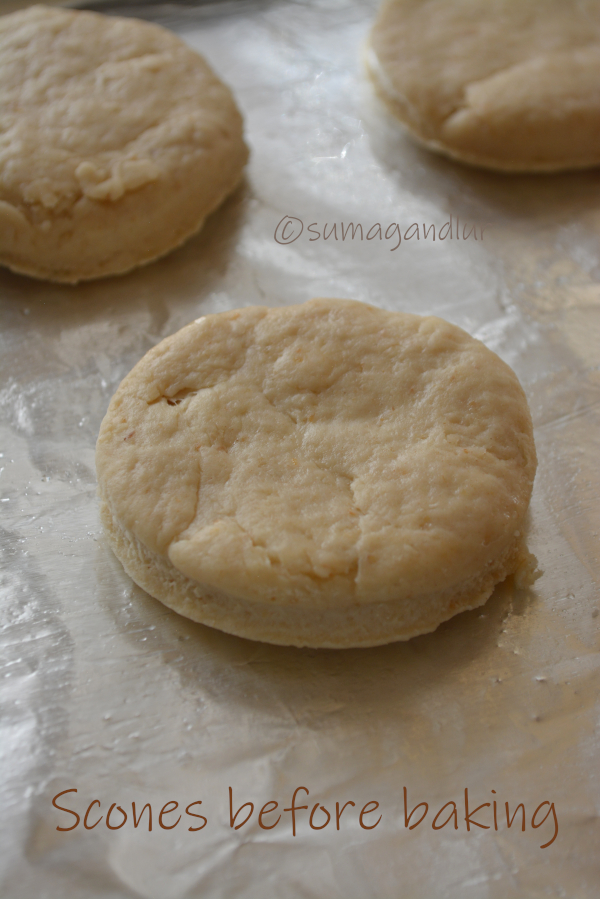
* Turn the dough onto a slightly floured surface and knead the dough once or twice. Then press it into a 3/4 inch thick circle and cut it into 2 inch rounds with a biscuit cutter or glass. Gently reshape the leftover dough and cut again until all the dough is used. Put the rounds on an ungreased baking sheet. (I lined the baking sheet with aluminium foil. I made 3 inch rounds of 1/2 inch thickness and got 8 scones.)
Or
Pat the dough into a circle of 3/4 inch thickness directly on a greased or lined baking sheet and cut into 8 wedges with a sharp knife.
Directions:
* For flax egg, combine 1 tbsp. flaxmeal and 3 tbsp. warm water in a small bowl and keep aside for about 5 minutes.
* Preheat the oven to 425 deg F.
* Add flour, salt, baking powder, and 2 tbsp. sugar to a food processor and pulse to combine. Next add butter and pulse until the mixture resembles cornmeal.
or
Mix the dry ingredients in a bowl and grate the butter which was frozen beforehand, directly into the bowl.
* Add egg and enough cream to form a slightly sticky dough. If the mixture appears too sticky, add a little flour. The final dough should be a little sticky to hands.
* Turn the dough onto a slightly floured surface and knead the dough once or twice. Then press it into a 3/4 inch thick circle and cut it into 2 inch rounds with a biscuit cutter or glass. Gently reshape the leftover dough and cut again until all the dough is used. Put the rounds on an ungreased baking sheet. (I lined the baking sheet with aluminium foil. I made 3 inch rounds of 1/2 inch thickness and got 8 scones.)
Or
Pat the dough into a circle of 3/4 inch thickness directly on a greased or lined baking sheet and cut into 8 wedges with a sharp knife.
 * Brush the top of each scone with bit of cream and sprinkle with the remaining sugar.
* Bake for about 9 to 11 minutes or until the scones are golden brown.
* Brush the top of each scone with bit of cream and sprinkle with the remaining sugar.
* Bake for about 9 to 11 minutes or until the scones are golden brown.
 * Serve the scones warm with jam, mascarpone, clotted cream, or creme fraiche.
 Comments
 We are moving towards England today for some oatcakes. When I say oatcakes, they are not actually cakes but
are yeast based savory pancakes which are eaten as a breakfast item. These oatcakes are a regional specialty of North Staffordshire area of England, specifically the Stoke-on-Trent region and prepared with a fermented batter of oat, wholemeal and all purpose flours. They are normally referred to as North Staffordshire cakes by non locals because they were once made only in and around Staffordshire and Cheshire. These oatcakes are treated as a delicacy in the region and the locals supposedly pay a trip to the nearby vendors on weekends to pick fresh oatcakes to savor them leisurely at home serving along with cheese, bacon, eggs and tomato. Those fillings / sides along with the oat pancakes is what the dish is about. Without those, they would be plain, pitiful pancakes I guess.I sprinkled cheddar cheese over our oatcakes.
These oatcakes were / mostly still a local fare and they go even by some nicknames like 'Potteries Chapati' and 'Tunstal Tortilla'. The oatcakes are supposedly made for hundreds of years and naturally there are are several myths surrounding the origin of the dish. One being linked to the times when India was a British colony. Some claim that the local soldiers who served in India took a liking to chapatis and they tried to recreate them on their return to Staffordshire. They used the locally grown oats while doing so, resulting in these oatcakes.
Oatcake recipe has been a closely guarded secret for many years and the recipe varies among oatcake makers. The rural tradition of oatcake making had become a booming cottage industry during industrial revolution because of the local availability of oats and the expansion of pottery and mining business in the Potteries region. It was once common for oatcakes to be sold directly from
the window of a house to customers on the street, through out the
Staffordshire Potteries, the industrial area in the region. However the last business which sold oatcakes in this style closed recently and there are now small and large businesses selling oatcakes.
And these oatcakes are not to be confused with the Scottish version oatcakes. They are also oat based but are biscuits that are baked. The Scottish oatcakes date back
to the 19th century and used to be baked on a hotplate over open fire.
We are moving towards England today for some oatcakes. When I say oatcakes, they are not actually cakes but
are yeast based savory pancakes which are eaten as a breakfast item. These oatcakes are a regional specialty of North Staffordshire area of England, specifically the Stoke-on-Trent region and prepared with a fermented batter of oat, wholemeal and all purpose flours. They are normally referred to as North Staffordshire cakes by non locals because they were once made only in and around Staffordshire and Cheshire. These oatcakes are treated as a delicacy in the region and the locals supposedly pay a trip to the nearby vendors on weekends to pick fresh oatcakes to savor them leisurely at home serving along with cheese, bacon, eggs and tomato. Those fillings / sides along with the oat pancakes is what the dish is about. Without those, they would be plain, pitiful pancakes I guess.I sprinkled cheddar cheese over our oatcakes.
These oatcakes were / mostly still a local fare and they go even by some nicknames like 'Potteries Chapati' and 'Tunstal Tortilla'. The oatcakes are supposedly made for hundreds of years and naturally there are are several myths surrounding the origin of the dish. One being linked to the times when India was a British colony. Some claim that the local soldiers who served in India took a liking to chapatis and they tried to recreate them on their return to Staffordshire. They used the locally grown oats while doing so, resulting in these oatcakes.
Oatcake recipe has been a closely guarded secret for many years and the recipe varies among oatcake makers. The rural tradition of oatcake making had become a booming cottage industry during industrial revolution because of the local availability of oats and the expansion of pottery and mining business in the Potteries region. It was once common for oatcakes to be sold directly from
the window of a house to customers on the street, through out the
Staffordshire Potteries, the industrial area in the region. However the last business which sold oatcakes in this style closed recently and there are now small and large businesses selling oatcakes.
And these oatcakes are not to be confused with the Scottish version oatcakes. They are also oat based but are biscuits that are baked. The Scottish oatcakes date back
to the 19th century and used to be baked on a hotplate over open fire.
Ingredients: (Yield 6 oatcakes)
1 & 1/4 cup oat flour
1/3 cup all purpose flour
1/3 cup wholemeal flour
1/2 tsp. salt
1 tsp. sugar
1/2 tsp. rapid rise yeast *
1 cup warm water
1 cup warm milk
Oil if necessary
Fillings as needed
* The original recipe uses dry yeast or fresh yeast. I used less yeast since I was resting it for about a couple of hours.
Method:
* Sieve together flours and salt in a mixing bowl.
* Combine sugar, yeast and warm water in a bowl and leave aside for about 10 minutes or until the mixture turns frothy.
* Add the yeast mixture and warm milk to the flour mixture and mix well to combine.
 * Leave the batter to rest in a warm place for about 2 hours.
* The fermented batter would be frothy. Gently stir the batter with the ladle to combine.
* Leave the batter to rest in a warm place for about 2 hours.
* The fermented batter would be frothy. Gently stir the batter with the ladle to combine.
 * Heat a griddle on medium flame and grease it if necessary. Pour a ladleful of batter and spread it tilting the griddle or using the back of the ladle. Cook until the bottom side turns golden brown and flip. Cook until the other side is done too.
* Repeat the steps with the remaining batter.
* Oatcakes are served with fillings such as cheese, tomato, onion, bacon, egg and sausage. They can be eaten plain buttered / grilled with cheese. They can be served with jam / syrup / bananas though it would not be a traditional version.
* The leftovers can be reheated in a microwave.
* Heat a griddle on medium flame and grease it if necessary. Pour a ladleful of batter and spread it tilting the griddle or using the back of the ladle. Cook until the bottom side turns golden brown and flip. Cook until the other side is done too.
* Repeat the steps with the remaining batter.
* Oatcakes are served with fillings such as cheese, tomato, onion, bacon, egg and sausage. They can be eaten plain buttered / grilled with cheese. They can be served with jam / syrup / bananas though it would not be a traditional version.
* The leftovers can be reheated in a microwave.
 Check out the Blogging Marathon page for the other Blogging Marathoners doing BM# 56
Comments
 It seems that my yesterday's post gave everyone the wrong idea that I am doing 'Flourless Bakes" this week. Actually I thought about that theme, cooked a few dishes based on it but the dishes got scattered under various themes when the final planning happened. I divided my posts under six themes based on the days of the week rather than basing on the varieties of bakes. My post titles are going to represent my themes and I had reserved 'Wednesdays' to showcase vegetables while 'Thursdays' are meant for tea time snacks. Now that's off my chest, I will move towards these subtly lemon flavored scones made with nuts meal. :)
A scone is according to wiki, a single serving cake / quick bread. They are a basic part of a Devonshire tea / Cream
tea where scones are served along with clotted cream and jam during tea
time. The pronunciation of scone rhymes with the word 'gone' in England regions while it rhymes with 'cone' in the U.S. I have never been in England to vouch for the authentic texture of scones and have eaten mostly the ones that have come out of my oven. Most of the recipes I have tried so far have been flaky, slightly on the crispier side and subtly sweeter ones. And I had never felt the need of a sweeter jam or cream to go along with it even though they are traditionally eaten that way. Yesterday I was going through some discussion boards regarding scones and read that British scones are more like dense cakes and are lightly sweetened. If that is the case, this recipe is a winner and for the first time, I understood why jam is needed to enjoy these subtly flaky dense cakes. The exterior was very slightly crispy and the scones were redolent with lemony flavor.
It seems that my yesterday's post gave everyone the wrong idea that I am doing 'Flourless Bakes" this week. Actually I thought about that theme, cooked a few dishes based on it but the dishes got scattered under various themes when the final planning happened. I divided my posts under six themes based on the days of the week rather than basing on the varieties of bakes. My post titles are going to represent my themes and I had reserved 'Wednesdays' to showcase vegetables while 'Thursdays' are meant for tea time snacks. Now that's off my chest, I will move towards these subtly lemon flavored scones made with nuts meal. :)
A scone is according to wiki, a single serving cake / quick bread. They are a basic part of a Devonshire tea / Cream
tea where scones are served along with clotted cream and jam during tea
time. The pronunciation of scone rhymes with the word 'gone' in England regions while it rhymes with 'cone' in the U.S. I have never been in England to vouch for the authentic texture of scones and have eaten mostly the ones that have come out of my oven. Most of the recipes I have tried so far have been flaky, slightly on the crispier side and subtly sweeter ones. And I had never felt the need of a sweeter jam or cream to go along with it even though they are traditionally eaten that way. Yesterday I was going through some discussion boards regarding scones and read that British scones are more like dense cakes and are lightly sweetened. If that is the case, this recipe is a winner and for the first time, I understood why jam is needed to enjoy these subtly flaky dense cakes. The exterior was very slightly crispy and the scones were redolent with lemony flavor.
 We all loved these scones to the core and enjoyed them for our yesterday's evening tea and today's breakfast. This recipe gave the inspiration for these scones and I was attracted to the beautiful images captured there. Mine looks different in color than the original one probably because I used pistachio meal more and used flax meal. However they rose as they should be and tasted good, with only subtle hint of sweetness.
Ingredients:
2 cups flour
3/4 mixed nut meal (I ground almonds, pistachio and walnuts together finely and substituted for almond meal.)
2 tbsp. sugar
2 & 1/2 tsp baking powder
1/2 tsp baking soda
1/2 tsp salt
1/2 cup / 1 stick frozen butter, grated (This method proved a lot easier and if not following it, cut the butter into small cubes)
Substitute for 1 egg (I combined 1 tbsp. flax meal + 3 tbsp. water for about 5 minutes.)
1 cup buttermilk
1/2 tsp almond extract
2 tsp grated lemon zest
2 - 3 tbsp. almond slices to garnish
We all loved these scones to the core and enjoyed them for our yesterday's evening tea and today's breakfast. This recipe gave the inspiration for these scones and I was attracted to the beautiful images captured there. Mine looks different in color than the original one probably because I used pistachio meal more and used flax meal. However they rose as they should be and tasted good, with only subtle hint of sweetness.
Ingredients:
2 cups flour
3/4 mixed nut meal (I ground almonds, pistachio and walnuts together finely and substituted for almond meal.)
2 tbsp. sugar
2 & 1/2 tsp baking powder
1/2 tsp baking soda
1/2 tsp salt
1/2 cup / 1 stick frozen butter, grated (This method proved a lot easier and if not following it, cut the butter into small cubes)
Substitute for 1 egg (I combined 1 tbsp. flax meal + 3 tbsp. water for about 5 minutes.)
1 cup buttermilk
1/2 tsp almond extract
2 tsp grated lemon zest
2 - 3 tbsp. almond slices to garnish
 Method:
* Preheat oven to 375 deg F. Line a baking sheet with parchment paper.
* Combine all the dry ingredients (From flour to salt in the list) in a mixing bowl. Toss in the grated frozen butter.
* In another bowl whisk the egg substitute, buttermilk, almond extract and the lemon zest. Add them to the dry ingredients' bowl and gently combine with a fork.
* When the dough roughly comes together, transfer to a lightly floured surface and gently knead just until it comes together into a ball. (My dough was on the sticky side and I lightly greased my hand to work.)
Method:
* Preheat oven to 375 deg F. Line a baking sheet with parchment paper.
* Combine all the dry ingredients (From flour to salt in the list) in a mixing bowl. Toss in the grated frozen butter.
* In another bowl whisk the egg substitute, buttermilk, almond extract and the lemon zest. Add them to the dry ingredients' bowl and gently combine with a fork.
* When the dough roughly comes together, transfer to a lightly floured surface and gently knead just until it comes together into a ball. (My dough was on the sticky side and I lightly greased my hand to work.)
 * Transfer the dough to the prepared baking sheet and gently pat it into a circle of about 9 inches in diameter. Score into 8 wedges, keeping the circle intact. Sprinkle slivers of almond over it.
* Place the baking sheet in the oven and bake for about 30 minutes or until golden brown and springs back when gently touched.
* Cut the wedges when they are still warm and enjoy with jam.
* Transfer the dough to the prepared baking sheet and gently pat it into a circle of about 9 inches in diameter. Score into 8 wedges, keeping the circle intact. Sprinkle slivers of almond over it.
* Place the baking sheet in the oven and bake for about 30 minutes or until golden brown and springs back when gently touched.
* Cut the wedges when they are still warm and enjoy with jam.
Alternatively the recipe mentions that they can be cut into 8 wedges and baked for 15- 20 minutes at 400 deg F. I haven't tested it.
Comments