skip to main |
skip to sidebar
 Event: Blogging Marathon #56
Theme: Indian States
My choice: Karnataka
I chose to go with Karnataka today, a state which is dear to me and where I have spent a major part of my life. I had planned to go with dosa recipes for this week's theme and when it comes to Karnataka, there is no dearth of dosa recipes, that are unique to the region. The famed masala dosa comes from the region and there are of course the yummy Mysore masala dose, Davanagere benne dose, set dose to name a few. I chose to go with neer dosa, a specialty of the Mangalore region for it's simplicity and the ease of preparation.
This post has been long due considering how frequently
these are made in my kitchen. I always used to forget to note the amount
of water used in the recipe and hence the procrastination. The
consistency of the batter happens to be the key to achieve a perfect
neer dose. The word 'neer' in the neer dose means water in the local languages of Kannada & Tulu,
a reference to the watery consistency of the dosa batter. They go by the name pan pole (pronounced pun-polay) in Konkani language, 'pan' meaning leaf and 'pole' meaning dosa. It is probably a reference to leafy thin consistency of the dosa or
the way they served folded, shaped like a leaf.
Like the other traditional versions, a neer dosa recipe doesn't use any form of lentils and are made using just rice and coconut. The batter does not need any fermentation and so they are quicker to prepare than a regular dosa. The coconut lends a great flavor to the batter and these taste fabulous. A cast iron griddle / henchu or henchina kallu as called in Kannada is traditionally used to make these lacy pancakes. However it is easy to mess up and so one can go ahead and use a non stick pan in case of lack of expertise and be sure to get decent neer dosa. Perfectly made neer
dose are light, soft, lacy and are white in color. They are as thin as
you probably can get, if not an exaggeration and so one ends up eating more than their usual share. They can be served with any spicy chutney of your choice. And any leftover batter can be refrigerated and can be used the next day.
Ingredients: (Yield 15 dosas)
1 cup rice (Any short grain rice will do.)
1/2 cup fresh shredded coconut
Salt to taste
1 & 1/2 cups water
Oil to make dosas (I used canola oil.
Event: Blogging Marathon #56
Theme: Indian States
My choice: Karnataka
I chose to go with Karnataka today, a state which is dear to me and where I have spent a major part of my life. I had planned to go with dosa recipes for this week's theme and when it comes to Karnataka, there is no dearth of dosa recipes, that are unique to the region. The famed masala dosa comes from the region and there are of course the yummy Mysore masala dose, Davanagere benne dose, set dose to name a few. I chose to go with neer dosa, a specialty of the Mangalore region for it's simplicity and the ease of preparation.
This post has been long due considering how frequently
these are made in my kitchen. I always used to forget to note the amount
of water used in the recipe and hence the procrastination. The
consistency of the batter happens to be the key to achieve a perfect
neer dose. The word 'neer' in the neer dose means water in the local languages of Kannada & Tulu,
a reference to the watery consistency of the dosa batter. They go by the name pan pole (pronounced pun-polay) in Konkani language, 'pan' meaning leaf and 'pole' meaning dosa. It is probably a reference to leafy thin consistency of the dosa or
the way they served folded, shaped like a leaf.
Like the other traditional versions, a neer dosa recipe doesn't use any form of lentils and are made using just rice and coconut. The batter does not need any fermentation and so they are quicker to prepare than a regular dosa. The coconut lends a great flavor to the batter and these taste fabulous. A cast iron griddle / henchu or henchina kallu as called in Kannada is traditionally used to make these lacy pancakes. However it is easy to mess up and so one can go ahead and use a non stick pan in case of lack of expertise and be sure to get decent neer dosa. Perfectly made neer
dose are light, soft, lacy and are white in color. They are as thin as
you probably can get, if not an exaggeration and so one ends up eating more than their usual share. They can be served with any spicy chutney of your choice. And any leftover batter can be refrigerated and can be used the next day.
Ingredients: (Yield 15 dosas)
1 cup rice (Any short grain rice will do.)
1/2 cup fresh shredded coconut
Salt to taste
1 & 1/2 cups water
Oil to make dosas (I used canola oil.
 Method:
* Rinse rice thoroughly with water twice and drain. Soak rice in water for about 3 hours or overnight.
* Drain the soaked water and add the rice, coconut, salt and water to a grinder / blender and grind them to a smooth batter. The batter should be one of a flowing consistency, like the buttermilk. (Adjust the water quantity if needed.)
* Heat a non-stick skillet / shallow pan with a tsp. of oil. Pour a small ladleful of batter at the center of the pan. Immediately hold the (handle of the) pan and gently swirl it so that the batter spreads into a thin circle, covering the entire pan.
* Cover and cook on moderate heat for a minute or so. Once done, the edges of the dosa start leaving the pan. There is no need to brown the dosa or flip it. Fold the dosa twice and serve immediately.
* Repeat the steps with the remaining batter and remember to stir the batter each time a dosa is made.
* Serve immediately with coconut chutney.
Note:
1. The consistency of the batter is the key in making a perfect neer dosa. A thicker batter will not spread and doesn't yield the characteristic thinner version.
2. Do not stack the hot dosa since they get stuck to each other.
3. They are best eaten warm.
Method:
* Rinse rice thoroughly with water twice and drain. Soak rice in water for about 3 hours or overnight.
* Drain the soaked water and add the rice, coconut, salt and water to a grinder / blender and grind them to a smooth batter. The batter should be one of a flowing consistency, like the buttermilk. (Adjust the water quantity if needed.)
* Heat a non-stick skillet / shallow pan with a tsp. of oil. Pour a small ladleful of batter at the center of the pan. Immediately hold the (handle of the) pan and gently swirl it so that the batter spreads into a thin circle, covering the entire pan.
* Cover and cook on moderate heat for a minute or so. Once done, the edges of the dosa start leaving the pan. There is no need to brown the dosa or flip it. Fold the dosa twice and serve immediately.
* Repeat the steps with the remaining batter and remember to stir the batter each time a dosa is made.
* Serve immediately with coconut chutney.
Note:
1. The consistency of the batter is the key in making a perfect neer dosa. A thicker batter will not spread and doesn't yield the characteristic thinner version.
2. Do not stack the hot dosa since they get stuck to each other.
3. They are best eaten warm.

Check out the Blogging Marathon page for the other Blogging Marathoners doing BM# 56
Comments
Event: Blogging Marathon #56
Theme : Indian States
My choice: Tamil Nadu
We are into second week of BM#56 and theme of this week is going to be "Indian States". Owing to my India trip this summer, I had before hand decided that I would neither do elaborate dishes nor I would go with festive ones for this BM. I chose to go with dishes that are simple and doable on any given day and I am starting the series with the south Indian state of Tamil Nadu.
The first thing that pops up in my mind when I think of the restaurants there, is the delicious array of south Indian style breakfast dishes. Yummy dosas, melt in mouth kind idlis, the creamy pongal and the crispy vadas served with delicious sambhar and chutney on the side. A piece of heaven for people like my husband when it comes to food. :) I obviously wanted to try a dosa recipe that is unique for this region and the one that I hadn't tried before. I zeroed in on this kal dosai that turned out to be spongy, and super flavorful dosas. I paired it with Chettinad chutney which turned out to be a terrific combo.
Recipe source: Veena
Ingredients:
1 cup rice (I used extra long grain.)
1 cup parboiled rice (I used idli rice instead.)
1/2 cup / skinned black gram / urad dal
1 tsp fenugreek seeds / methi seeds
1 tbsp. salt
Oil to make dosas (I use canola oil.)
Preparing the dosa batter:
* Rinse both varieties of rice and urad dal thoroughly twice and drain. Soak washed rice and urad dal in water for at least 3 to 4 hours.
* Rinse the fenugreek seeds with water and soak them in little water separately.
* Drain the water used to soak rice and dal before grinding.
* Add the rice mixture, the fenugreek seeds along with the water it is soaked in and salt to a grinder / blender. Grind the mixture to a thick batter adding water as needed.
* Transfer the ground batter to a big vessel / bowl. Cover and place it in warm place to ferment overnight or for about 8 - 10 hours.
Making dosas:
* Heat a tawa / griddle when ready to make dosas. Sprinkle a few drops of water on the griddle to test whether it is hot enough to make dosas. The water would sizzle, form beads and evaporate when it is ready.
* Pour a ladleful of batter (about 1/4 cup) on the griddle and spread gently with the back of the ladle only to shape. Don't try to spread thinly since we are trying to get soft and spongy dosas. Take ½ tsp of oil and spread around the edges of the dosa.
* Cover the dosa with a lid and cook on low - medium flame until it is cooked and you start noticing holes on the top.
* There is no need to flip the dosa. Remove the dosa with a spatula and repeat the process with the remaining batter. (Traditionally, kal dosas are not flipped and roasted on the other side. However if you think you need to roast the dosa on the other side too, it can be done.)
* Serve the dosas warm with a spicy side dish of your choice - chutney/sambhar/milagai podi.
Check out the Blogging Marathon page for the other Blogging Marathoners doing BM# 56
Comments
'Chips and Dip' has to be the most frequently eaten guilt-free snack in my home, next to fresh fruits. Thanks to my husband, our pantry is always filled with a variety of baked chips and dips to beat the evening hungry pangs. Though I rarely make salsa at home, we prefer guacamole freshly made. Guacamole hardly takes anytime to prepare from scratch and tastes awesome with tortilla chips. And so no wonder that this was a part of my plan for this week's theme from the beginning and the first dish I made for this BM.
This avocado based dip is said to be created by Aztecs, in the present day Mexico. Guacamole is equally popular in America and is used as a dip, condiment and salads. The word guacamole comes from an Aztec word 'āhuacamolli', literally meaning avocado sauce. Traditionally this dip is made by mashing ripe avocado just with sea salt using mortar and pestle. Additional seasonings of one's choice like onion, tomato, pepper, cilantro / basil, lime juice and others can be added as well. Using good variety, ripe (not overripe) avocado is the secret behind a perfect guacamole.
Ingredients:
1 cup coarsely mashed avocado (About one and half avocados.)
Salt to taste
Juice squeezed from one lime
2 -3 tbsp. red onion minced
2 tbsp. tomato, desseded and minced
1 tbsp. finely chopped cilantro
1 Serrano pepper , deseeded and finely minced (Start with half pepper if heat is not preferred.)
 Method:
* Cut the avocados lengthwise into two halves and remove the seed. Scoop out the avocado pulp from the peel and add it to a mixing bowl.
* Roughly mash the avocado using a fork. Sprinkle salt and squeeze out some lemon / lime juice over the avocado. Add the remaining ingredients and combine gently with the fork.
* Serve with tortilla chips immediately. If not using immediately, cover the dip with a plastic wrap and refrigerate until use.
Method:
* Cut the avocados lengthwise into two halves and remove the seed. Scoop out the avocado pulp from the peel and add it to a mixing bowl.
* Roughly mash the avocado using a fork. Sprinkle salt and squeeze out some lemon / lime juice over the avocado. Add the remaining ingredients and combine gently with the fork.
* Serve with tortilla chips immediately. If not using immediately, cover the dip with a plastic wrap and refrigerate until use.
Check out the Blogging Marathon page for the other Blogging Marathoners doing BM# 56
Comments
 The word 'Jeon' refers to a Korean style pancake in general and gamjajeon is a variety made by pan-frying finely grated potato until golden brown using vegetable oil. Traditionally, this humble pancake is kept simple and made just with potato, salt and oil and uses no flour of any kind. Additionally onions or scallions, garlic chives, carrots, sliced mushrooms can be added to the batter to add color, texture and flavor. Or these jeon can be garnished with shredded fresh red or green chilies as well while frying. I think I made these jeon a tad thicker but recommend a thinner and crispier version. Gamjajeaon is usually served with a dipping sauce called choganjang, that can be made in a jiffy with soy sauce and vinegar.
The potatoes used to make jeon can be either finely grated or blended. Either way, a gamjajeon recipe recommends to remove some of the water content from the blended / grated potatoes so that the final batter is not watery. The potato is drained in a sieve and the starch water is allowed to sit for a while until the starch sinks to bottom. And that starch gets used in the recipe as well.
Ingredients: (Yield 5 pancakes)
2 large potatoes, peeled and cut into big chunks
1 medium onion, peeled / A bunch of scallions, chopped
Salt to taste
Pepper to taste / 1 - 2 green chilies deseeded and finely chopped
Oil to make pancakes
Method:
* Blend onion and potatoes together using a mixer / food processor adding no water. If you find it harder to process, adding a little water is fine. (or you can finely grate the vegetables as well.)
The word 'Jeon' refers to a Korean style pancake in general and gamjajeon is a variety made by pan-frying finely grated potato until golden brown using vegetable oil. Traditionally, this humble pancake is kept simple and made just with potato, salt and oil and uses no flour of any kind. Additionally onions or scallions, garlic chives, carrots, sliced mushrooms can be added to the batter to add color, texture and flavor. Or these jeon can be garnished with shredded fresh red or green chilies as well while frying. I think I made these jeon a tad thicker but recommend a thinner and crispier version. Gamjajeaon is usually served with a dipping sauce called choganjang, that can be made in a jiffy with soy sauce and vinegar.
The potatoes used to make jeon can be either finely grated or blended. Either way, a gamjajeon recipe recommends to remove some of the water content from the blended / grated potatoes so that the final batter is not watery. The potato is drained in a sieve and the starch water is allowed to sit for a while until the starch sinks to bottom. And that starch gets used in the recipe as well.
Ingredients: (Yield 5 pancakes)
2 large potatoes, peeled and cut into big chunks
1 medium onion, peeled / A bunch of scallions, chopped
Salt to taste
Pepper to taste / 1 - 2 green chilies deseeded and finely chopped
Oil to make pancakes
Method:
* Blend onion and potatoes together using a mixer / food processor adding no water. If you find it harder to process, adding a little water is fine. (or you can finely grate the vegetables as well.) * Place a mesh strainer over a bowl and pour the pureed vegetables into it. Let it sit for about 10 - 15 minutes to drain the water.
* After the water has drained, transfer the vegetable mixture to a small mixing bowl. And just don't throw away the water collected in the bowl underneath since it contains the starch that can be added to the batter. (After resting, you would notice that the white starchy stuff sinks to the bottom and forms a dense layer at the bottom of the bowl.) Carefully discard the water until you get to the potato starch sitting at the bottom of the bowl. Add that starch to the potato - onion mixture in the mixing bowl.
* Add salt, pepper / green chilies and scallion if using, to the bowl as well and mix to combine.
* Heat a non stick pan on medium flame and add a tbsp. of oil. Scoop out about tbsp. of batter on pan and toast them until they are cooked through and golden brown on both sides, flipping them once or twice intermittently. Repeat the process with the remaining batter.
* If they are made mini size, you can make as many pancakes as the frying pan can fit at once. (I made a little bigger sized pancakes and so made them individually.)
* Serve them warm with choganjang or ketchup.
* Place a mesh strainer over a bowl and pour the pureed vegetables into it. Let it sit for about 10 - 15 minutes to drain the water.
* After the water has drained, transfer the vegetable mixture to a small mixing bowl. And just don't throw away the water collected in the bowl underneath since it contains the starch that can be added to the batter. (After resting, you would notice that the white starchy stuff sinks to the bottom and forms a dense layer at the bottom of the bowl.) Carefully discard the water until you get to the potato starch sitting at the bottom of the bowl. Add that starch to the potato - onion mixture in the mixing bowl.
* Add salt, pepper / green chilies and scallion if using, to the bowl as well and mix to combine.
* Heat a non stick pan on medium flame and add a tbsp. of oil. Scoop out about tbsp. of batter on pan and toast them until they are cooked through and golden brown on both sides, flipping them once or twice intermittently. Repeat the process with the remaining batter.
* If they are made mini size, you can make as many pancakes as the frying pan can fit at once. (I made a little bigger sized pancakes and so made them individually.)
* Serve them warm with choganjang or ketchup.
Check out the Blogging Marathon page for the other Blogging Marathoners doing BM# 56
Comments
Now from yesterday's dal, let's proceed towards a delicious curry from another neighbor of India. Sri Lanka, that is. I have been never to Sri Lanka but I gather that it's cuisine though appears to be similar to India, it is not. However Sri Lankan cuisine, similar to south Indian states is
built around rice and in fact their national dish is rice and curry. These curries are supposedly fiery than the Indian counterparts and can be
meat based or vegetarian. Rice and curry can be accompanied by a dal, and sambols, the
Sri Lankan version of spicy pickles. I had a vegetable based curry bookmarked from Vaishali's blog which I got to try today. It uses a special blend of spices from the region called Sri Lankan curry powder that is aromatic and flavorful. And by the way it does not taste like garam masala or any of the Indian spice blends. The curry is not that hard to prepare though the list of the ingredients is a lengthy one. The coconut milk - corn starch mixture lend a thick, creamy base to this
yummy curry. Vaishali's version had mushrooms and cauliflower and I used beans and peas instead.
Ingredients:
2 tbsp. oil
1 onion, peeled and chopped
1 potato, peeled and chopped
1 carrot, peeled and chopped
1 cup French beans, stringed and cut into one inch pieces
1 tsp finely grated ginger
1 garlic clove, finely chopped
1 green chili, finely chopped
1 tsp. coriander powder
1 tsp. paprika
2 tsp. Sri Lanka curry powder
1 cup water / vegetable stock
1 big sized tomato, chopped
1/4 cup chopped green capsicum
1/4 cup fresh / frozen peas
1/2 cup thick coconut milk
2 tsp. corn starch
1 tbsp. ground almonds
Salt to taste
 Method:
* Heat oil in a pan and add onion, potato, carrot and beans. Saute on medium flame for about five minutes.
* Next add ginger, garlic, green chili, coriander powder, paprika and curry powder and saute for about a minute.
* Add vegetable stock / water to the pan, cover and cook on low flame until the vegetables are almost done.
* Now add the capsicum pieces, tomato and peas if using. Continue to cook until the capsicum is done.
* Meanwhile, blend cornstarch and coconut milk well and stir into the mixture.
* Add ground almonds and salt to the pan. Check the seasonings and adjust if necessary.
* Simmer for a couple of minutes and turn off the stove.
* Serve with rice / rotis.
Method:
* Heat oil in a pan and add onion, potato, carrot and beans. Saute on medium flame for about five minutes.
* Next add ginger, garlic, green chili, coriander powder, paprika and curry powder and saute for about a minute.
* Add vegetable stock / water to the pan, cover and cook on low flame until the vegetables are almost done.
* Now add the capsicum pieces, tomato and peas if using. Continue to cook until the capsicum is done.
* Meanwhile, blend cornstarch and coconut milk well and stir into the mixture.
* Add ground almonds and salt to the pan. Check the seasonings and adjust if necessary.
* Simmer for a couple of minutes and turn off the stove.
* Serve with rice / rotis.
Check out the Blogging Marathon page for the other Blogging Marathoners doing BM# 56.
Comments
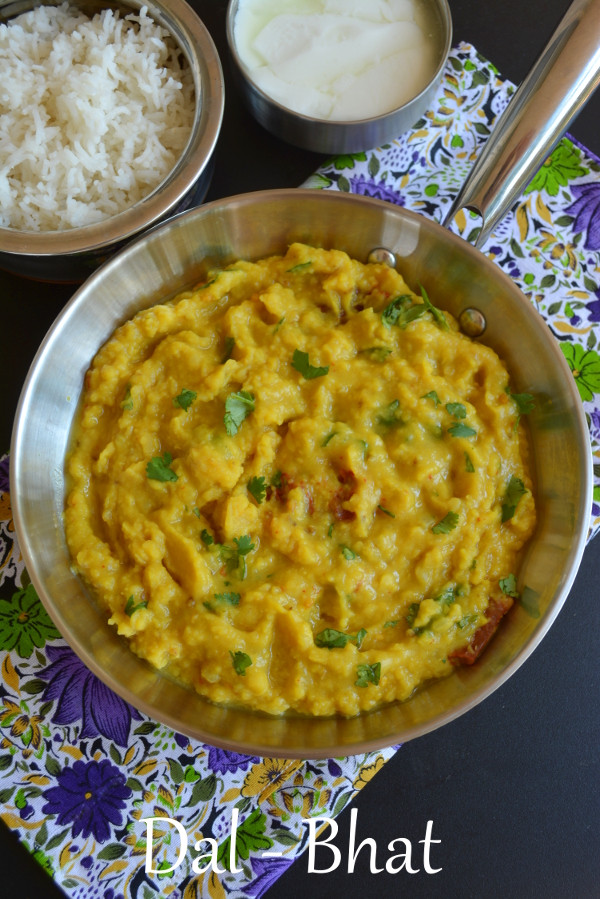
For the second day of BM#56, I am bringing a comfort combo dish from Nepal to the table. Dal, a simple, flavorful lentil dish along with bhat, the cooked rice forms the traditional, everyday meal of Nepal besides being it's national dish. Just as in it's neighboring countries of India and Bangladesh, dal-bhat forms the staple diet of the majority of the people in Nepal. If served along with a vegetable side dish, the dish would be dal-bhath-tarkari, tarkari referring to the vegetables. From an Indian context, I found the dal preparation simple yet flavorful and loved it served along with Basmati rice. The dal preparation varies region wise in Nepal and I found this version more appealing and authentic.
Ingredients:
2 tbsp. ghee / oil
3 dried red chilies
1 big onion, finely chopped
1 or 2 garlic cloves, finely chopped
1 tsp. finely grated ginger
1 tsp. crushed coriander seeds
1/8 tsp. turmeric powder
1 cup toordal / yellow lentils (or other colored lentils can be substituted.)
Salt to taste
2 tbsp. minced cilantro leaves to garnish
 Method:
* Heat ghee / oil in a pan or directly in a pressure cooker, if using the cooker to cook lentils.
* Add chili and saute for few seconds. Then add onion, garlic, ginger and ground coriander and continue to fry on low flame until onion turns translucent.
* Wash lentils in two exchanges of water and drain. Add the rinsed lentils, turmeric and about 2 cups of water to the pan / pressure cooker.
* Cook for 2 - 3 whistles if using pressure cooker. If using a sauce pan, cook until lentils are done, stirring and adding water intermittently as needed.
* Add salt and minced cilantro to the cooked lentils and mix well to combine. (If the pressure cooked dal appears thick, add some water and bring it to a boil.)
Method:
* Heat ghee / oil in a pan or directly in a pressure cooker, if using the cooker to cook lentils.
* Add chili and saute for few seconds. Then add onion, garlic, ginger and ground coriander and continue to fry on low flame until onion turns translucent.
* Wash lentils in two exchanges of water and drain. Add the rinsed lentils, turmeric and about 2 cups of water to the pan / pressure cooker.
* Cook for 2 - 3 whistles if using pressure cooker. If using a sauce pan, cook until lentils are done, stirring and adding water intermittently as needed.
* Add salt and minced cilantro to the cooked lentils and mix well to combine. (If the pressure cooked dal appears thick, add some water and bring it to a boil.)
Note:
Squeeze and add juice of half a lemon / lime to the dal if desired.
Check out the Blogging Marathon page for the other Blogging Marathoners doing BM# 56
For those who are wondering where I went kaput, I am back with a month long blogging mararthon. Yes, you read it right. This is again time for that part of the year where we, a group of food blogger friends feature a food post each day of the month on our blogs, excepting Sundays. This time around, the marathon is named 'Buffet on the Table" and is going to be a weekly based one. The first one in the series is going to be "Combos from Countries" where the dishes usually served as a pair need to be featured.
I am going with an Indian breakfast combo on the first day, a popular one from the south Indian state of Kerala. Appams, Kerala style lacy pancakes served with mild vegetable stew or ishtoo, as it is colloquially termed. I am posting the recipe for the stew today. Though the list of the ingredients seem lengthier, this is one of those simple side dishes that you can prepare with no fuss. It doesn't involve any elaborate preparation and even a newbie can nail it. This traditional Kerala dish is mildly flavored and usually paired with paalappam though it tastes equally good with rotis as well. After standing a while, the dish ended up with a mild yellow tinge, because of the carrot used.

Source:
Kurryleaves
Ingredients:
Oil / ghee as needed
3 cardamom pods
3 cloves
1" piece of cinnamon
8 - 10 peppercorns
1 tsp. finely grated ginger
1 tsp. finely chopped garlic (I didn't use it.)
2 to 3 green chillies, slit lengthwise (or adjust the quantity as needed.)
1 to 2 sprigs of curry leaves
1 big onion, finely chopped
1 carrot, peeled and cubed
1 potato, peeled and cubed
10 French beans cut into 1" pieces
1/2 cups peas, (frozen or fresh can be used.)
1/2 cup thick coconut milk
1.5 cup thin coconut milk
Salt to taste
Method:
* Heat oil in a pan and add cloves, cardamom, cinnamon and peppercorns. Sauté them until fragrant and then add ginger, garlic, chilies, a sprig of curry leaves and onion.
* Fry them until onion turns translucent and then add all the vegetables. Add thin coconut milk and salt to the pan. Cover and cook on low flame until the vegetables are done.
* Next add the thick coconut milk, stir and cook for a few more minutes.
* Heat a tsp. of ghee / oil and toast curry leaves for few seconds. Remove and add the toasted curry leaves to the cooked stew and stir gently.
* Turn off the stove and serve the stew warm with palappam, idiappam or rotis.
Check out the Blogging Marathon page for the other Blogging Marathoners doing BM# 56.
I am doing weekend brunch dishes this week and trust me, nobody has the patience to skip breakfast and wait for a brunch in my household. Everyone including me start to get grumpy when breakfast is not served by 8 am, which is actually late in our books. The kids are used for a 6.30 am breakfast on weekdays and so asking them to skip one on weekend seems lousy. This was supposed to be posted a couple of months ago when I picked the 'Brunch Dishes' theme for the blogging marathon. However I got lazy when I noticed how lengthy the recipe was turning out to be and so it sat in my drafts folder up until now. The post finally gets to see the light of the day as it fits in perfectly for this week's 'Lentils' themed BM.
These dal parathas are stuffed ones and obviously is based on chanadal stuffing. The stuffing turned out so yummy and spicy that we absolutely loved these parathas. These parathas are filling and nutritious and taste good on their own if the stuffing is kept on a spicier side. If the stuffing is mild, go along with a spicy pickle and a bowl of yogurt on the side and your meal is taken care of. Both the paratha dough and stuffing can be made ahead the previous night and a hearty breakfast can be made in minutes the next day.
Ingredients for the parathas: (Yield - 6 parathas)
1 cup wheat flour + extra for dusting
Salt to taste (optional)
1 tbsp. oil + Extra for toasting (I used canola oil.)
 Preparation of dough:
* Combine wheat flour and 1/4 tsp salt in a mixing bowl. Add water in small increments and prepare a soft, pliable dough. (I added little less than 1/2 cup water.)
* Next add oil and knead the dough for a couple of minutes. Cover and allow it to rest anywhere between 30 minutes to a few hours.
(You can proceed with the below recipe to make parathas at this point or refrigerate it to use the dough within a day or two. If refrigerating, bring the dough to room temperature before rolling out the parathas. Or to quicken the process, cover the dough and put it in a microwave safe bowl. Microwave for about 10 - 15 seconds depending upon the quantity. The refrigerated dough would be ready to work with, in a jiffy this way.)
Preparation of dough:
* Combine wheat flour and 1/4 tsp salt in a mixing bowl. Add water in small increments and prepare a soft, pliable dough. (I added little less than 1/2 cup water.)
* Next add oil and knead the dough for a couple of minutes. Cover and allow it to rest anywhere between 30 minutes to a few hours.
(You can proceed with the below recipe to make parathas at this point or refrigerate it to use the dough within a day or two. If refrigerating, bring the dough to room temperature before rolling out the parathas. Or to quicken the process, cover the dough and put it in a microwave safe bowl. Microwave for about 10 - 15 seconds depending upon the quantity. The refrigerated dough would be ready to work with, in a jiffy this way.)
Ingredients needed for the stuffing and preparation:
3/4 cup chana dal / Bengal gram
1 tbsp. oil
1 tsp. cumin seeds
1 tsp. grated ginger
2 green chillies (adjust as needed.)
1/4 tsp. chili powder
Salt to taste
1 tsp. amchur powder
2 pinches of turmeric powder
1 tbsp. minced cilantro
 Method:
* Soak chana dal in water for about a couple of hours or so. This step is optional if pressure cooker is used to cook the dal but I follow it anyway.
* Drain the soaked water and rinse the dal thorougly. Add dal and 1 & 1/2 cups water to the pressure cooker and cook until soft, to about 1 or 2 whistles. When the valve pressure is gone, transfer the dal to a colander. Let the dal sit for a while until all the water is completely drained.
* Heat oil in a pan add cumin seeds. When they start to sizzle and brown, add the ginger. Fry until it starts to turn golden brown and add chillies. Saute for about 30 - 40 seconds. Add cooked dal, turmeric, chili powder, amchur powder, cilantro and salt. Give a stir to combine and cook for a minute or so. Turn off the stove and let cool the stuffing.
* The stuffing can be prepared ahead at night and can be used to prepare the breakfast the next morning. (Just remember to cool the stuffing and refrigerate it overnight.)
Method:
* Soak chana dal in water for about a couple of hours or so. This step is optional if pressure cooker is used to cook the dal but I follow it anyway.
* Drain the soaked water and rinse the dal thorougly. Add dal and 1 & 1/2 cups water to the pressure cooker and cook until soft, to about 1 or 2 whistles. When the valve pressure is gone, transfer the dal to a colander. Let the dal sit for a while until all the water is completely drained.
* Heat oil in a pan add cumin seeds. When they start to sizzle and brown, add the ginger. Fry until it starts to turn golden brown and add chillies. Saute for about 30 - 40 seconds. Add cooked dal, turmeric, chili powder, amchur powder, cilantro and salt. Give a stir to combine and cook for a minute or so. Turn off the stove and let cool the stuffing.
* The stuffing can be prepared ahead at night and can be used to prepare the breakfast the next morning. (Just remember to cool the stuffing and refrigerate it overnight.)
 Rolling the parathas - Method 1:
* Divide the mixture into about 6 portions and roll them smoothly between your palms to shape them into balls.Work with one dough ball at a time and keep the rest covered.
* Roll a dough ball into 3 - 4 inch disc and place about 1 - 2 tbsp. of filling, depending upon how comfortable you are with the rolling part. Place the stuffing at the center of the disc, leaving the edges free. Bring the edges together so that there are no gaps and the stuffing is inside intact.
Rolling the parathas - Method 1:
* Divide the mixture into about 6 portions and roll them smoothly between your palms to shape them into balls.Work with one dough ball at a time and keep the rest covered.
* Roll a dough ball into 3 - 4 inch disc and place about 1 - 2 tbsp. of filling, depending upon how comfortable you are with the rolling part. Place the stuffing at the center of the disc, leaving the edges free. Bring the edges together so that there are no gaps and the stuffing is inside intact.
 * Press it into a disc taking care that there are no gaps anywhere so that the stuffing wouldn't spill out while rolling. Roll the disc carefully into a 5 to 6 inch thin circle, dusting with flour if necessary. Take care not to break it or let the filling coming out. Repeat the steps of paratha making with the remaining dough.
Rolling the stuffed parathas - Method 2:
* Divide the mixture into about 12 portions and roll them smoothly between your palms to shape them into balls.Work with one dough ball at a time and keep the rest covered. Roll out a couple of balls into 4 inch discs, dusting with flour if necessary
* Press it into a disc taking care that there are no gaps anywhere so that the stuffing wouldn't spill out while rolling. Roll the disc carefully into a 5 to 6 inch thin circle, dusting with flour if necessary. Take care not to break it or let the filling coming out. Repeat the steps of paratha making with the remaining dough.
Rolling the stuffed parathas - Method 2:
* Divide the mixture into about 12 portions and roll them smoothly between your palms to shape them into balls.Work with one dough ball at a time and keep the rest covered. Roll out a couple of balls into 4 inch discs, dusting with flour if necessary.
* Spread about 2 tbsp. stuffing evenly on one disc, leaving out the edges. Cover it with another rolled disc.
* Neatly seal them so that the stuffing wouldn't spill out when they are rolled again.
Dust the work surface and stuffed disc lightly and proceed with the rolling part. Gently roll it into a thin disc. Toasting the parathas:
* Heat iron griddle or a shallow, non stick pan and place the rolled out paratha.
* Toast the parathas, brushing generously with oil / ghee, until both sides are cooked well and brown spots appear.
* Repeat the steps of rolling and toasting the parathas with the remaining dough balls and the stuffing. Serve them hot with yogurt and a spicy pickle.
Toasting the parathas:
* Heat iron griddle or a shallow, non stick pan and place the rolled out paratha.
* Toast the parathas, brushing generously with oil / ghee, until both sides are cooked well and brown spots appear.
* Repeat the steps of rolling and toasting the parathas with the remaining dough balls and the stuffing. Serve them hot with yogurt and a spicy pickle.
 This goes to BM #54 under the theme "Cooking lentils in 3 ways". Check here to see what other marathoners have come up with, for today.
Comments
This goes to BM #54 under the theme "Cooking lentils in 3 ways". Check here to see what other marathoners have come up with, for today.
Comments

When I made the peanut sundal recently, the craving to eat the green peas version hit so badly that I had to make it the next day. Growing up, this was one of the standard evening snacks that my mother used to prepare and I hadn't eaten it in ages. This legume based dish goes by different regional names like guggillu, usli or sundal and is a common dish among south Indian states and the neighboring regions. The recipe remains typically the same in southern regions and sometimes coconut may be replaced with sautéed onions / tomatoes and grated carrot as such. They usually are prepared as an evening snack and onion-free versions are also offered as neivedyam (An offering to God.). This nutritious, guilt free snack is quite filling one though some versions need planning ahead as some of the legumes need pre soaking before cooking. There are a variety of legumes that can be used in this kind of guggillu dish and each one is delicious in it's own way. For today's version it is green peas. (I had the extra spice powder from Peanut sundal recipe and I used a tsp. of that powder as well to enhance the flavor.)
Ingredients: (3 servings)
1 cup dried green peas (or 2 cups cooked)
2 tsp. oil
1 tsp. mustard seeds
1 tsp. split chickpeas / chana dal
1 or 2 green chillies, finely chopped
10 - 12 curry leaves
2 pinches turmeric powder
2 pinches asafoetida powder
2 tbsp. fresh shredded coconut
Salt to taste
1 tbsp. minced cilantro
Lemon / Lime juice to taste
Method:
* Soak dried peas overnight or for about 8 hours. Pressure cook the peas for 2 whistles or cook in a sauce pan on stove top adding sufficient water. When done, the peas must be tender but still holding the shape. They should not turn mushy.
* Heat oil in a sauté pan. Add mustard seeds and chana dal. When dal starts to turn reddish, add green chillies and sauté for about 30 seconds. Next add curry leaves, turmeric, asafoetida and stir once.
* Add cooked peas, salt and coconut to the pan and stir to combine. Cook on low flame for a couple of minutes and turn off the stove.
* Squeeze lemon juice to taste and give a stir.
* Garnish with cilantro and serve warm.
This goes to BM #54 under the theme "Cooking lentils in 3 ways". Check here to see what other marathoners have come up with, for today.
Comments
 This has become a recent favorite of mine though normally I abhor the soup kinds. I came across this spicy and yummy on an Indian food channel and tried it instantly as somehow I loved the idea. This is one of those hearty and healthy soups that can fill you up and so the soup alone would take care of a meal.
Ingredients:
1 tbsp. oil
1/2 tsp. garlic paste (optional)
1 tsp. peppercorns
1 onion, peeled and finely chopped
1 tomato, chopped
1 big carrot, peeled and chopped
1/2 cup cooked mung beans / green gram (whole, green ones)
Salt to taste
1 cup fat-free milk
This has become a recent favorite of mine though normally I abhor the soup kinds. I came across this spicy and yummy on an Indian food channel and tried it instantly as somehow I loved the idea. This is one of those hearty and healthy soups that can fill you up and so the soup alone would take care of a meal.
Ingredients:
1 tbsp. oil
1/2 tsp. garlic paste (optional)
1 tsp. peppercorns
1 onion, peeled and finely chopped
1 tomato, chopped
1 big carrot, peeled and chopped
1/2 cup cooked mung beans / green gram (whole, green ones)
Salt to taste
1 cup fat-free milk
 Method:
* Heat oil in a small sauté pan and add garlic if using. Sauté for few seconds and then add peppercorns, onion, tomato and carrot.
* Cover and cook until the vegetables are tender.
* Transfer the cooked mixture, salt, cooked mung beans and milk to a blender. Puree the mixture and if the mixture appears too thick for your liking, add extra milk or water until the desired consistency is reached.
* Add the puree back to the pan and heat it.
* Serve warm.
This goes to BM #54 under the theme "Cooking lentils in 3 ways". Check here to see what other marathoners have come up with, for today.
Comments
Method:
* Heat oil in a small sauté pan and add garlic if using. Sauté for few seconds and then add peppercorns, onion, tomato and carrot.
* Cover and cook until the vegetables are tender.
* Transfer the cooked mixture, salt, cooked mung beans and milk to a blender. Puree the mixture and if the mixture appears too thick for your liking, add extra milk or water until the desired consistency is reached.
* Add the puree back to the pan and heat it.
* Serve warm.
This goes to BM #54 under the theme "Cooking lentils in 3 ways". Check here to see what other marathoners have come up with, for today.
Comments