HOME        |        ABOUT        |        COPYRIGHT        |        CONTACT        |         RECIPE INDEX        |         INDIAN THAALIS        |         MILLET RECIPES        |        EVENTS' ROUNDUP        

Showing posts with label West Bengal recipes. Show all posts

Friday, April 24, 2020

Bengali Style Tomato Chutney

A traditional Bengali every day meal is a six course one, unlike the other regional cuisines of India. I am assuming the modern households don't have the time or energy needed to cook such elaborate meals but a typical lunch in a Bengali household of the olden times was by itself a mini thaali, dishes ranging from bitter to savory to sweet. A meal with a total blast of flavors in sharp contrasts.

The chutney or chaatni, as the locals call it is a part of the meal and  tomato chutney is one of the commonly prepared one locally. It is served at almost at the end and is not eaten as an accompaniment or side dish in the meal as they do in other regions. It is a sweet and spicy condiment, served typically after the savory dishes and before the dessert as a palate cleanser. The traditional tomato - date chutney typically contains tomatoes, dates, raisins, sweetener like jaggery / sugar and cooked in mustard oil. I did not have dates on hand but had dried mango slices and used them in the recipe as Sandeepa suggested. It is not the typical south Indian variety chutney which I am used to and was too sweet to my palate. It can be eaten as a condiment with starters or even some slathered on a toast.
Ingredients:
1 tbsp. mustard oil
1/2 tsp. mustard seeds
1 red chili broken into bits (I used 2.)
2 big sized tomatoes
A pinch of turmeric powder
Salt to taste
2 tbsp. dried mango pieces (optional)
1 tsp. ginger juice (I used grated ginger)
1/4 cup water
1/4 cup sugar
1 tsp. tamarind chutney / tamarind extract to taste

Directions:
Heat oil and add mustard seeds and red chili. When the mustard seeds start to splutter, add tomato pieces, turmeric and salt and continue to cook. 

When they are almost done, add the dry mango, ginger juice and water. Continue to cook until the tomatoes are cooked to a soft pulp. 

Add sugar and to make the chutney tangy, add a tsp. of tamarind chutney

* Continue to cook until it thickens and turn off the stove.


Comments

Tuesday, April 2, 2019

A - Z Indian Biryani / Pulao / Khichdi Series ~ B for Bengali Basanti Polao / Mishti Polao

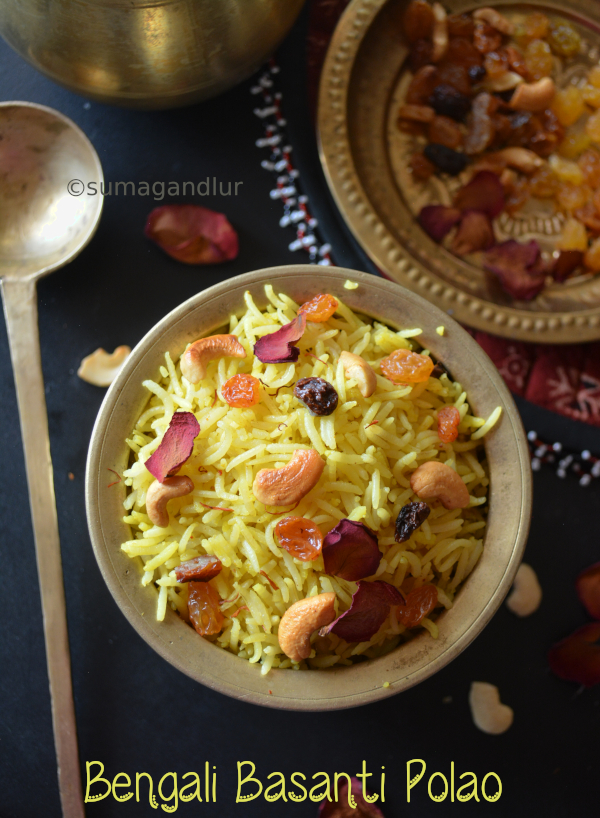
Many basic versions of pulao exist in Indian regional cuisine that pair well with a spicy curry or gravy. Most of them sound similar and vary very minutely and today's basanti polao is one such dish. Yes, it's not a typo. It's called polao instead of pulao. It is a specialty from the Bengal region and is usually reserved there for auspicious occasions like Durga pooja, new year celebration and so on. The word 'basanti' has nothing to do with basant, the spring season but stands for the polao's bright yellow color. The rice is also called holud polao for the same reason. This rice delicacy is  called misthi polao as well since it is on the sweeter side unlike the regular pulao dishes. 

It is usually served with a spicier side dish to balance out the sweetness from the polao. The use of saffron lends a yellow tinge to the dish and food color is added as well for the yellow color of the pulao but not turmeric, according to some Bengali food bloggers. (I am not a fan of food colors to be honest and turmeric is of course an healthier choice. The bloggers were mentioning that one should not feel the whiff of turmeric from the dish.) 


It is distinctly yellow in color, subtly rose flavored and unmistakably sweeter. Not enough sweeter that it can be served as a dessert on it's own but sweet enough to put it apart from the savory versions. If one is counting calories then feel free to decrease the quantity or totally skip the sugar even if purists may scoff at the suggestion since it may no longer be called a misthi polao.

Bengalis use a locally cultivated rice called Gobindobhog rice which is a short grain, sticky and aromatic rice. The rice supposedly imparts an inviting aroma and flavor to this rice delicacy. I used aged Basmati rice instead. The addition of rose water lifts the flavor of the dish. The dish is subtly spicy and serves as a base for spicy curries. The most popular Bengali accompaniment to this polao seems to be a mutton curry called kosha mangsho. Vegetarian side dishes like aloor dum and aloo phulkopir dalna would go well with this polao. I preferred a gravy curry instead.
Ingredients:
1 cup rice *
2 tbsp. ghee
2 tbsp. cashew nuts
2 tbsp. raisins
2 - 3 cardamom
2 - 3 cloves 
1 inch cinnamon
1 bay leaf
1 and 1/2 cups water
3 tbsp. sugar
Salt to taste
1/2 tsp. garam masala
A pinch of saffron strands soaked in a tbsp. milk 
A few drops yellow food color
Few drops of rose water
* Use Gobindobhog rice if available and if not, Basmati rice would be a great substitute. 

Directions:
* Rinse and soak rice for about 30 minutes. Drain and keep aside.
* Heat ghee directly in a small pressure cooker and add cashews and raisins. Toast until cashews are golden and raisins turn plump. Remove them with a slotted spoon onto a plate and keep them aside.
* To the same ghee, add cardamom, clove, cinnamon and bay leaf. Toast them for 30 seconds and then add drained rice. Saute them for few seconds.
* Add water and the remaining ingredients. Stir them once and pressure cook for 3 whistles. Wait until the valve pressure is gone. Add the toasted cashews and raisins to the polao, fluff and serve with a spicy side dish.

So far in my Biryani / Pulao / Khichdi series,
A for Ambur Biryani

BMLogo

Check out the Blogging Marathon page for the other Blogging Marathoners doing BM#99.

Thursday, April 26, 2018

A - Z Indian Street Foods ~ V for Veg Hakka Noodles

Chinese food has become an integral part of Indian cuisine today. Thanks to a small Chinese community of “Hakka’ origin that immigrated and lived in Calcutta during the 18th and 19th centuries. These Hakka people, the first Chinese immigrants to settle in India adapted their native cooking techniques and seasonings to vegetarian dishes to suit the Indian palates. However, the interesting fact to be noted is that the modern fusion Indo-Chinese cuisine bears little resemblance to traditional Chinese or Hakka cooking. 

Today’s dish, Hakka noodles is a fusion Indo-Chinese dish that also has it's origins tracing back to Kolkatta (formerly Calcutta), the capital city of west Bengal. The signature aspect of the Hakka cuisine was Hakkas blended the Chinese spices and ingredients with the local ones to flavor dishes. These Hakka noodles are no exception and it is a quick stir fry of noodles with crunchy vegetables in a base of garlicky and spicy 'Indo-Chinese' flavors. The dish would be completely dry and no sauce left after the noodles are cooked. My husband prepared gobi machurian to go with it but I did not include it in the pictures.

The recipe source is this post from ecurry. The blogger gives a glimpse on the background of the Hakkas and Hakka cuisine in Calcutta. I am not a fan of garlic and prepared it exclusively for my husband who loves Hakka noodles. He enjoyed them very much and had already asked a couple of times to prepare it again. I therefore consider it a hit and recommend it to those who are looking for the recipe. 

Ingredients for the sauce:
4 garlic cloves
one inch piece of ginger
1 tbsp. sriracha / green chili sauce 
2 tbsp. ketchup or tomato paste
1 tsp. white sesame seeds

Ingredients:
200 gm Hakka noodles *
1 carrot, peeled and cut into match sticks
1 capsicum, julienned (I used 3 colors of capsicum.)
1 cup shredded cabbage
1 cup beans, cut diagonally
1 onion, sliced into thin half moons
1/2 bunch scallions / green onions chopped
1 tsp. red chili flakes
2 tbsp. Asian sesame oil
2 tbsp. soy sauce
1 tbsp. vinegar
Salt to taste
* (I used organic semolina spaghetti noodles instead.)

Method:
* Combine all ingredients of the 'Sauce' in a food processor and pulse to a fine paste. Add a tbsp. or two of water if the mixture appears too dry. However do not make the sauce runny.
* Cook noodles al dente along with some salt and a splash of oil, according to the instructions on the package. Drain immediately, spread the noodles on a wide plate and splash a little more oil to prevent them from sticking together.
* Heat the sesame oil in a wok and add chili flakes. Saute for about 20 seconds or so and add onions. Cook on high heat until they are just clear and add the ground sauce and salt. Continue to cook on high heat until the raw smell of garlic disappears. 
* Then lower the heat and add vinegar and soy sauce. Stir well to combine and increase the heat to high again. Add capsicum, carrot and beans. Cook for a couple of minutes and turn off the stove. The vegetables should retain their color and crunch. 
* Stir in the noodles carefully until the cooked ingredients in the pan coat the noodles completely. Add the shredded cabbage.
* Again turn on the heat to high and cook the noodles tossing / flipping them frequently so that noodles, sauce and vegetables are combined uniformly. Take care not to stick the noodles to the bottom of the pan. Cook for 3 to 4 minutes and switch off the stove.
* Combine the chopped green onions and serve immediately with some hot oil. (Ours was served with gobi manchurian.)

BMLogo
Check out the Blogging Marathon page for the other Blogging Marathoners doing BM# 87

Wednesday, September 9, 2015

Soru Chakli Pithe

Event: Blogging Marathon #56
Theme: Indian States
My choice: West Bengal

When I chose to makes dosas this week, I was confident that I would get at least 4 savory versions from the south Indian states, them being the home of dosas. And by the way, for the uninitiated, dosas are rice - lentil based, Indian version savory pancakes. I planned to do a sweet version as well to post this week and was going back and forth to patishapta, the festive, sweet pancakes from West Bengal. That planning happened before my India trip and now considering the amount of binging we did in India, it is time to go on a diet rather than indulging in a pancake filled with khoya (milk solids) and coconut and dunked in milk syrup.

Patishapta seems to be the most favorite pithe prepared in Bengali households during 'Poush Parbon' or Makar Sankranthi. When I sat down to learn more about the dish, I realized that hoards of rice based dishes are prepared on the occasion including a savory version of pancakes called soru chakli. No wonder there considering that India was once an agrarian community and the festival was/is to celebrate the harvest season. However it was a moment of epiphany connecting it to the south Indian version of the festival though a dosa / pancake is never part of the festival in south though they are a staple breakfast in the region. A south Indian sankranthi meal revolves mainly around sweet and savory version pongal dishes while the Bengalis seem to have turned it into a culinary indulgence, celebrating the new harvested rice, jaggery and so on.

Soru chakli is prepared using rice and black gram / urad dal similar to the south Indian dosas but the batter is on a thinner side and grated ginger is added just before using it. And the good thing is this batter needs no fermentation. Majority of the recipes I came across mentioned that no fermentation is needed while some did. I did not leave the batter to ferment but left the batter to sit for about an hour before making pancakes and it was fine. Though the batter is not runny, it is thinner and the resulting pancakes are thin and softer like neer dosa, albeit redolent with ginger flavor.
Ingredients:
1 cup rice
1/2 cup urad dal / black gram
Salt to taste
1 tbsp. peeled and grated ginger 
Oil to make dosas

Method:
* Wash rice and urad dal thoroughly and soak them in water for at least 3 hours or overnight.
* Drain the soaked water and grind it into a smooth batter adding salt and enough water. The batter should be thinner than the regular dosa batter. (I added about 1&1/2 - 1&3/4 cups of water to grind.)
* There is no need to ferment the batter to make soru chakli. However it is totally fine if you decide to do so. Add grated ginger to the batter and mix well with a ladle.
* Heat a non stick or an iron griddle to make pithe on moderate heat.
* Gently grease the pan with oil. Pour a ladleful of batter at the center and gently swirl the pan in a circular motion so that the the batter spreads thinly into a circle.
* Cover and cook for a minute or two or until the edges start to leave the pan. Flip, cover and cook the other side too. Remove the pithe with a spatula.
* Grease the pan again and repeat the pithe making.
* Serve warm with your choice of curry. I served with potato masala.
Check out the Blogging Marathon page for the other Blogging Marathoners doing BM# 56

Comments

Wednesday, April 30, 2014

Baigun Bhaja

Baigun bhaja is a fried, yummy dish, which serves as an accompaniment to rice - dal meal in Bengali households. "Bhaja" literally means deep fried and the common vegetables used to prepare bhajas are eggplants, potatoes, pumpkins or parval. There are several spice laden versions online with besan / poppy seeds / rice flour / sooji coatings. However after going through recipes online by Bengali cooks, I realized that this is supposed to be a simple delicacy. The eggplants are marinated just in a simple, salt-turmeric mixture and are deep fried.
I eat eggplants but not a great fan of them. This one however was particularly hard to resist. Earlier I had tried a chili powder smeared version too and it was a mess. The spice mixture seeps into the oil and particularly the chili powder keeps scorching in the oil while frying. This version was simple and sensible. If one prefers to eat it spicy, they can sprinkle some chili powder after the frying is done. 

Method: 
* Wash the eggplants and wipe them dry. Slice them into thick rounds or vertically. Smear them with a small quantity of turmeric and salt and keep them aside for about 10 minutes.
* Heat oil in a pan for deep frying. Traditionally, mustard oil is used but I used canola oil here. Gently slide the slices into the hot oil and fry until golden brown. Drain on absorbent towels and serve them warm.