HOME        |        ABOUT        |        COPYRIGHT        |        CONTACT        |         RECIPE INDEX        |         INDIAN THAALIS        |         MILLET RECIPES        |        EVENTS' ROUNDUP        

Showing posts with label Rayalaseema. Show all posts

Monday, April 18, 2016

A - Z Andhra Recipes ~ O for Ottotti

 
Here starts a new week of blogging marathon. For those, who are joining me late, I am doing 'A - Z' recipes based on Andhra cuisine this month, presenting dishes with regional names in an alphabetical order and it's time for the letter 'O' today. The number of recipes with a Telugu name, starting with the alphabet 'O' are very few. The 'few' here meaning where you don't need all your digits on one hand to count them. 

There is no produce or a pantry ingredient in an Andhra kitchen which starts with 'O'. However there are a couple of dishes starting with 'otti', which literally means empty. Otti pappu refers to the plain cooked lentils and is also called mudda pappu / chappa pappu and is an important dish in an Andhra kitchen. The other one is 'Otti pulusu', a sweet, tangy stew cooked sans lentils. 

And of course a spicy pickle which would be a 'pachadi' in Andhra region becomes 'ooragaaya' in Rayalseema area. And speaking of Rayalaseema, here is one more traditional recipe from the region which starts with 'O' and the dish which kinda kick started the event for me. It is called ottotti and used to be a common preparation in brahmin households. It is a healthy, home style preparation using a combination of amaranth greens and vadiyalu*. While the word 'otti' means empty, 'ottotti' is like stressing that point, in reference to the humble greens' saute. In lieu of amaranth greens, other variety of greens can be substituted. This simple and  quick saute is similar to my favorite vadiyala koora recipe where minapappu vadiyalu / urad dal vadi are used where as in the case of ottotti, my mother in law and her mother used to use mainly biyyam pindi vadiyalu (rice floured wadi) and occasionally even the saggu biyyam vadiyalu (sago ones). It is like a old world kind of recipe and is not very commonly made anymore. For blog sake, I broke the vadiyalu into bits and sprinkled some on top. However the vadiyalu are generously used in the recipe and added to the koora just before serving so that they do not get soggy.

* Vadiyalu - Sundried, slightly spicy and crispy spirals made with rice flour. Vadiyalu are called sandige, wadi, vadam in some of the Indian languages.
Ingredients:
1 big bunch of amaranth leaves / Thotakoora
2 spicy variety red chillies, broken into bits
Salt to taste
Biyyapu vadiyalu / Rice flour wadi
1 tbsp. oil + extra to fry vadiyalu

Method:
* Wash the amaranth leaves and chop them finely. Chop the stalks as well if they are tender.
* Heat oil, add red chillies and saute for 15 to 2nd seconds.
Next add the greens along with the chopped stalks and salt. Cook until the greens are done and appears dry. (This is supposedly a dry saute. I used frozen variety greens and the curry kind of became mushy.)
* Meanwhile, deep fry vadiayalu in a frying pan and keep them aside.
* Add them to the cooked greens just before serving and mix.
* Serve it with hot steamed rice and a tsp. of ghee as first / second course of Andhra meal.
 
So far on my 'A - Z' Andhra Cuisine,
A for Alasanda Vada
B for Bellam Garelu
C for Chiyali
D for Dondakaaya Kaarapu Kaaya
E for Endu Kobbari Podi
F for Fine Biscuits 
G for Gongura - Mamidikaya Pappu
H for Halwa Holigalu
I for Idli Karam Podi
J for Janthikalu
K for Kobbari Koora


Check out the Blogging Marathon page for the other Blogging Marathoners doing BM# 63.
 

Friday, April 15, 2016

A - Z Andhra Recipes ~ M for Matikkaaya Karam Koora

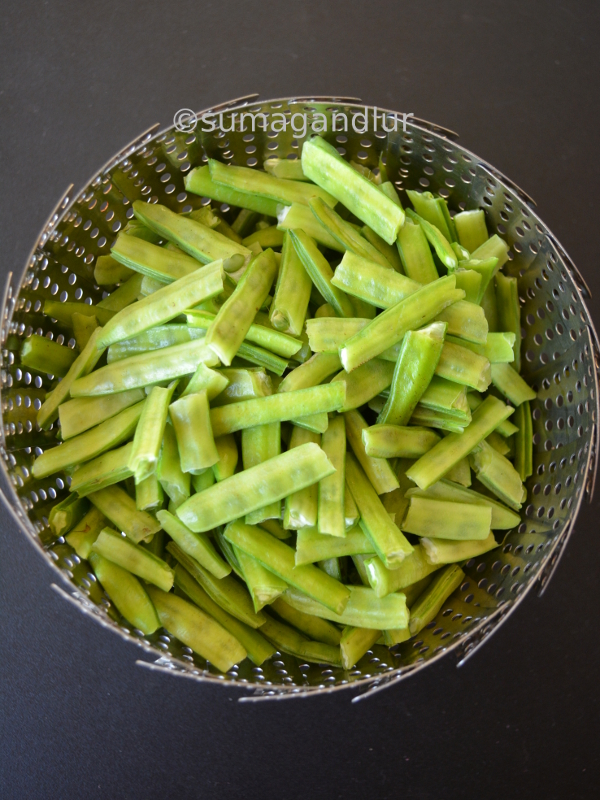
I am doing 'A - Z' recipes from Andhra cuisine this month, presenting dishes with regional names in an alphabetical order and it's time for the letter' M' today. The alphabet 'M' also stands for 'Matikkaaya' in Telugu and that is what the star of today's recipe is. There were some alphabets during this journey that needed no planning and this is one of those. I had decided early on that I would do this recipe without giving a second thought because this is a regular preparation in my husband's side of the family and not a well known version outside Rayalaseema. Cluster beans are called 'Matikkaaya' in the Rayalaseema area while they go by the name 'Goru Chikkudukaaya' in Andhra region. (While Andhra Pradesh is the name of the state, the coastal areas are also referred as Andhra region sometimes.) While pronouncing the word 'matikkaaya', the stress is on the 'k' sound and not on the 't' since 'matti' means dirt in Telugu. The word 'Karam' stands for the spiciness offered by the green chillies and 'Koora' means curry. And so 'Matikkaaya Karam Koora' literally means 'Spicy Cluster Beans Curry'.

The only Andhra version of cluster beans curries we knew about while growing up were the ones using coconut or the lentils. This karam koora using cluster beans is a Rayalaseema preparation and the recipe comes from my mother in law's kitchen. It was the only dish she used to prepare using cluster beans and is quite an unusual one. The beans are not chopped here but ground along with chillies, coconut and cilantro and then sauteed until done. The resulting koora is a spicy and delicious one.
'M' Ingredients from the Pantry:
Minugulu / Minumulu - Whole black gram
Minapappu - Skinned and Split black gram
Miriyalu - Peppercorn
Mogga - A spice / Maratha Moggu

Produce:
Maaredu - Bael fruit
Mamidi Kaaya - Green mango
Mamidi Pandu - Mango
Matikkayalu / Goru Chikkudu - Cluster Beans
Medi Pandu - Fig
Menthaku / Menthikoora - Fenugreek greens
Mokkajonna - Corn
Mokka Jonna Kankulu - Corn on the Cob
Molakalu - Sprouts
Mullangi - Radish
Munagaku - Drumstick plant leaves
Munagakaaya / Munakkaaya / Mulakkadalu - Drumsticks

Some 'M' dishes:
Maagaaya & Mukka Pachadi - Green Mango Pickles
Majjiga - Yogurt churned with small quantity of water / Buttermilk
Majjiga Pulusu - Spicy gravy prepared with sour buttermilk / Andhra style Kadhi
Manugupoolu & Murukulu - Spicy Snack / Chakli
Menthi majjiga - Spicy buttermilk
Menthula Pappu - Lentil preparation with fenugreek seeds (not the leaves)
Minapa Rotte / Minapattu - Breakfast dishes
Minapa Sunni - Sunnundalu, Urad dal laddus
Mirapakaya Bajji - Spicy snack
Miriyala Charu - Pepper rasam
Miriyala Kashayam - Home remedy / Herbal concoction to cure ailments
MLA Pesarattu - Pesarattu & Upma combo Breakfast
Mudda pappu - Plain cooked lentils with salt
(And also all curries, stews and dals prepared with the above vegetables.)
Ingredients for the Koora: (Yield 3 servings)
3 cups cluster beans' pieces
1/4 cup cilantro leaves
1/4 cup shredded fresh coconut
2 green chillies
1 tbsp. oil
1 tbsp. split chickpeas / chana dal
1 tsp. black gram / urad dal
1 tsp. mustard seeds
1/8 tsp. turmeric powder
2 pinches of asafoetida powder
Salt to taste

Method:
* Rinse and wash away any dirt present on the cluster beans.
Wipe them dry / transfer them to a colander so that beans can dry as much as possible.
* String the beans if needed and tear each bean into 2 or 3 pieces. (The step is optional but recommended to avoid the curry ending up with strings and getting struck between teeth while eating.)
* Add the cut beans, cilantro, coconut, and chillies into a food processor / blender and process just to a coarse mixture without adding any water. Avoid grinding the mixture to a paste.
* Heat oil, preferably in a non stick pan and add dals, mustard seeds in that order. When dals start turn reddish, add asafoetida, salt and turmeric and stir once with a spatula. Immediately add the ground bean mixture to the pan and mix well. Cover and cook on medium flame, turning intermittently, until the raw smell of the beans and chillies is gone.
* Turn off the stove and serve hot with rice or rotis.

So far on my 'A - Z' Andhra Cuisine,
A for Alasanda Vada
B for Bellam Garelu
C for Chiyali
D for Dondakaaya Kaarapu Kaaya
E for Endu Kobbari Podi
F for Fine Biscuits 
G for Gongura - Mamidikaya Pappu
H for Halwa Holigalu
I for Idli Karam Podi
J for Janthikalu
K for Kobbari Koora
L for Lauzu


Check out the Blogging Marathon page for the other Blogging Marathoners doing BM# 63.
Friday, April 1, 2016

A - Z Andhra Recipex ~ A for Alasanda Vadalu

 
The idea of posting A - Z recipes, based on Andhra Cuisine has been brewing in my mind for some years now though I could make it happen only now. I am going to post 26 dishes this month from the south Indian state of Andhra Pradesh, as part of the April Blogging Marathon, Journey through the Cuisines. The name of the dishes are going to be in the English alphabetical order with regional names and there is going to be a dish for each letter. Most of the dishes I have chosen are commonly prepared in Andhra Brahmin households and have been in our families for generations. And of course there are a couple of exceptions because of the difficult 'letters' whose sound equivalents are not found in the local dialect, Telugu.

Andhra Pradesh lies on the southeastern coast of India and up until recently was divided into three regions, Coastal Andhra, Rayalaseema and Telangana. Telangana region has formed it's own state now and is no longer a part of Andhra though both states are sharing the capital city of Hyderabad for the time being. Andhra is the leading producer of rice in the country and is dubbed as the rice bowl of India. And naturally all traditional meals are built around rice. Also the region is a leading producer of chillies in India and is known for it's spicy food and pickles. The spiciest food in the world I believe, not exaggerating. The cuisine includes both vegetarian and non-vegetarian dishes, the coastal regions being popular for sea food and meat dishes. Hyderabadi cuisine, predominantly non-vegetarian has evolved into a rich and diverse one, inspired by and during the Muslim reign.
 
The first thing I did when I decided to go with Andhra dishes was to make a list of ingredients and Andhra dishes that started with each alphabet as many as I can think of. And the below is that list for letter "A". I hope it is useful for those who are not familiar with the region's cuisine.

Fruits / Vegetables:
Arati pandu - Banana
Ananas pandu - Pineapple 
Aakakara - Teasle gourd, Kantola 
Aaku kooralu - Leafy greens
Aloo / Aloo gadda - Potato
Aanapakaaya - Bottle gourd, Lauki, Sorakaya 
Allam - Ginger
Anapakaya - Field beans, Avaraekaayi
Aratikaaya - Plantain
Arati bonde - Banana Stem
Arati puvvu - Banana Flower
Avise aaku - Flax plant greens
Ingredients:
Aavalu & Aavapindi - Mustard & Mustard powder
Alasandalu - Bobbarlu, Blackeyed Peas
Appadalu - Papad
Atukulu - Beaten rice flakes, Poha
Avise ginjalu - Flax Seeds 
(And the dishes like chutneys, curries, dals, that are cooked using above vegetables/ ingredients as the star ingredient will also start with the letter 'A'. The plantain leaf on which food is served on religious or special occasions is called arati aaku in Telugu.)

Pickles / Chutneys / Podis:
Aavakaaya - Spicy green mango pickle in mustard powder base
Aava pachadi - Yogurt - Mustard base chutney
Allam pachadi - Ginger chutney
Annamlo podi - Spicy powder made with a medley of lentils 
Dishes:
Aavadalu - Spicy, Andhra style dahi vada
Aava pettina koora  - Curry in mustard base
Aaviri Kudumulu - Steamed sweet or savory dumplings
Annam - Cooked rice
Appalu & Ariselu - Rice flour and jaggery based sweet dishes
Attu - Dosa / Pancake
Atukulu / Atukula upma - Cooked poha 
Appachi - Snack / Sweet in baby language


I am starting the series with Alasanda Vadalu, a popular street snack from the Rayalaseema region which also go by the name bobbarla vadalu in other areas. My mind kept going around 'Aava' / mustard based dishes but the instant I let know about the theme of this marathon, my Rayalaseema born and bred husband picked Alasanda vadalu. No surprises there considering that the deep fried black eyed peas' fritters is one of the most sought out and delicious street foods sold in the Rayalaseema region. My first introduction to them happened soon after my wedding when I stepped in my husband's hometown, Kadapa. A nephew of his bought a bagful of them for me to taste. The fritters were tasty enough though I ended up in bed for two days after catching a stomach bug and needless to say I never again dared to buy that stuff from the streets. I have zero immunity against the street food as my husband points out, making fun of me. I grew up in a household with a mother who would not allow us kids to buy any thing off the streets unless the seller appeared tidy and clean, which automatically meant rare occurrences and the blessing in disguise has been that I am not at all tempted by any street foods now. :) However here is a homemade version of those delicious and irresistible vadas from my kitchen.

Ingredients (makes about 18)
3/4 cup black eyed peas / alasandalu
2 to 4 green chilies *
1" ginger piece
A handful of cilantro leaves, finely chopped
Salt to taste
1 big onion, finely minced
About 2 cups oil to deep fry (I used canola oil.)

* The quantity of the chillies depends upon the spiciness preferred. I used 2 very spicy Serrano peppers.

Method:
* Wash and soak the black eyed peas in water for about 4 to 5 hours. Take care that they are immersed in water completely during the soaking period.
* Transfer the soaked peas to a colander and leave it aside for about 5 minutes so that the water gets drained completely. Otherwise the batter may end up watery.
* Add black eyed peas, ginger, chillies, cilantro and salt to a blender or a food processor and grind them to a slightly coarser mixture without adding any water. The mixture should be firm, holding together when shaped.


* Heat oil in a small frying pan / kadai.
* Take a small lime sized portion of the batter onto your left palm, slightly pat it and gently drop it into the hot oil. A hole can be poked at the center of the patty if preferred. Usually they are made with a hole in the center like medu vada but can be made just like patties as I did. Repeat the step with the remaining batter. Drop as many patties as the pan can hold without overcrowding. 
 
* Fry them on medium flame, turning them around once or twice in between until they are cooked through out and turn golden brown.
* Remove them with a slotted spoon and repeat the steps with the remaining batter. Serve warm.

Notes:
1. Add some chickpea flour to the ground mixture in case it is hard to shape it into patties.
2. The soaked black eyed peas can be drained and refrigerated for about two days. 
 
Check out the blogging marathon page for the other marathoners doing BM #63.


Saturday, September 12, 2015

Pachi Karam Dosa / Pacha Karam Dosa

 
Event: Blogging Marathon #56
Theme: Indian States
My choice: Andhra Pradesh

I am moving to my home state for the final day under this theme and I have saved the best for the last if you ask my husband. He is the reason why I chose to make dosas as part of this week's theme since he loves them to the core. Recently whenever I am doing blogging marathons, especially the mega marathons I am trying to incorporate dishes that are appealing to my husband and plan them when he is not traveling. He feels left out whenever he sees my blog posts and wonders aloud that why he didn't get to taste them or why those dishes were made when he was not around.  

When it comes to dosas, erra karam variety are his favorite without a doubt.  Dosas that are smeared with onion paste aka erra karam, generously sprinkled with roasted chickpea powder aka pappula podi and with ghee drizzled liberally. Erra karam dosas are a specialty of Rayalaseema region from Andhra pradesh. Though these dosas are a popular breakfast / evening snack option there, they are not a part of fancy restaurant menus. These dosas are usually sold from homes or in those 'wall in the hole' kind eateries, where if three sit inside on the only bench present there, a dozen would be standing outside on the street enjoying the yummy, spicy dosas. They are also sometimes referred to as komativalla dosalu (at least in Kadapa town) since mostly Vysyas used to sell them. 
 
Erra karam refers to the spicy onion paste that is red in color because of the red chillies used in the paste. I have already posted two detailed versions of erra karam dosas here and here and the one with a potato masala here. There is another less known twin version of this dosa called the pachi karam / pacha karam dosa referring to the green chillies paste used in the recipe. Obviously this paste would be green in color and adds a spicy flavor to the dosas. For the basic version, pachi karam can be smeared on dosas and sprinkled with roasted chickpea powder. A besan chutney, regular chutney and potato curry on the sides would be an additional bonus. 
This dosa preparation may come across as a laborious one, especially if you are not used to dosa making. However most of the dishes can be prepared ahead and the basic version needs only the pachi karam that can be prepared ahead and the pappula podi that can be prepared ahead and lasts for months. I am posting the pachi karam recipe today and I have provided links below for the rest of the items.

Ingredients needed:
Dosa batter
Pachi karam
Pappula podi
Besan chutney
Potato masala
Chutney
Ghee / Oil to make dosas (I used canola oil.)

Preparation:

1. Dosa batter:
Regular dosa batter is used to make these dosas. One can follow any favorite dosa recipe of their own. My dosa recipe can be found here.
2. Pappula podi / Roasted chickpeas powder: 
Check recipe here. Just roasted chickpeas can be ground along with salt and red chillies. If you don't prefer the spiciness, red chillies can be omitted here since there is erra karam too spread on the dosas. Garlic and /or shredded dried coconut can also be added if preferred.
3. Bombai chutney (Besan chutney):
I did not apply besan chutney for these dosas and instead served it as a side dish. If you are planning to make a besan chutney to serve on the side, a detailed recipe is here. If you are applying it as a paste, follow the recipe as mentioned but omit the tadka, tomatoes, green chillies and cilantro. Just saute one finely minced small onion and turmeric in 1 - 2 tsp oil until translucent and then add besan, salt and water accordingly. Cook until besan is done. The chutney should not be very thick (as in the picture below) if applying it on the dosas. Also remember that the chutney thickens as it cools and so make it thinner.
 
4. Potato masala:
Recipe can be found here and here.
 
5. Roasted Chickpeas Chutney
Recipe found here.

Pachi Karam / Pacha Karam:
 
Ingredients:
6 onions, roughly chopped (about 2 cups)
3 green chillies (I used 3 large, spicy variety. adjust the quantity if needed.)
1 to 2 tbsp. cilantro (Very optional. I added for color and flavor.)
Salt to taste
1 or 2 tbsp. oil
1 tsp mustard seeds (optional)

Method:
* Blend together the onions, chillies, salt and cilantro if using. Garlic can also be added if preferred. Onions can be ground fine or to an almost coarse consistency where you find teeny tiny pieces of onion. (We personally prefer finely ground onions.)
 
* Heat oil and add mustard seeds. When the seeds start to splutter, add the ground paste. Cover and saute it until the raw smell of the mixture leaves.

How to make dosas:
* Heat a tawa / griddle / non stick pan. To check whether the griddle is ready, sprinkle a few drops of water on the griddle. The water would sizzle and evaporate if the griddle is ready. 
* Pour a ladleful of batter on the griddle and spread it into a thin circle with the help of the backside of the ladle. Pour a tsp. of ghee / oil around the edges of the dosa.
* Cook on low - medium flame until the lower side turns golden brown. Spread 1 -2 tsp. of pachi karam over it and sprinkle some pappula podi.
 
* Fold the dosa and let it cook on both sides for a few seconds.(If desired a tsp, of besan chutney can be smeared lightly before the pachi karam is applied.)
 
* Remove the dosa with a spatula. Repeat the process with the remaining batter. 
* One can just eat the dosa as it is or serve with chutney / besan chutney. Or to make it more special serve with potato masala.

Check out the Blogging Marathon page for the other Blogging Marathoners doing BM# 56


Comments

Friday, September 6, 2013

E ~ Erra Karam Dosa (Version 2)

Event: Blogging marathon #32
Theme: Street food

Being a part of Rayalaseema thru matrimony, I couldn't stay away from a regional treat - the erra karam dosas. This is one dish that still remains associated to street food or small sized food joints there. Not being a part of big restaurants' menu or the franchise frenzy, the recipe still remains to its roots and hasn't been rehashed or revamped so far.
Erra karam dosas are named so because of the erra karam used in the recipe. One version is where these dosas are smeared with a layer of erra karam - a spicy onion chutney and are finished off with a sprinkling of roasted chickpea powder. They are then folded into half and are served with chutney and some more erra karam. I am posting another version common in the region where another chutney made with besan is smeared on the top of dosas before erra karam is applied. 
Check below my earlier posts to get a better idea.
Erra karam dosa  
Erra karam masala dosa.

Along with the dosa batter, we need the following items to prepare this dosa. Bombai chutney, erra karam, pappula podi and also some oil or ghee to make dosas.

 (Besan chutney applied to these dosas usually is very thin compared to the one in the above image.)


1. Dosa batter:
Regular dosa batter is what needed here and so one can follow their own favorite recipe if they have any. My dosa recipe can be found here.

2. Bombai chutney (Besan chutney):
Detailed recipe is here. Follow the recipe as mentioned but omit the tadka, tomatoes, green chillies and cilantro. Just saute one finely minced small onion and turmeric in 1 - 2 tsp oil until translucent and then add besan, salt and water accordingly. Cook until besan is done. The chutney should not be very thick. Also remember that the chutney thickens as it cools and so make it thin.

3. Erra karam:
The essence of the dish lies in this red spicy chutney. This can be prepared in advance and refrigerated. I have earlier provided the recipe here. How the erra karam is going to be depends on one's preference ranging from how the onion is ground to how much the mixture is sauteed in oil. 
Onions can be ground fine or to an almost coarse consistency where you find teeny tiny pieces of onion. I personally prefer to grind the onions fine since that is how my son likes it. Dried red chillies are usually added along with the onion but chili powder can replace them. A pod or two of garlic can be added though I give it a miss. Now let's come to the ground mixture. Some use the raw ground mixture directly, some saute it lightly and people like me saute it until the raw smell of the mixture leaves. My experience tells me that sauteing well is preferred by everyone.

4. Pappula podi / Roasted chickpeas powder: 
Check recipe here. Just roasted chickpeas can be ground along with salt and red chillies. If you don't prefer the spiciness, red chillies can be omitted here since there is erra karam too spread on the dosas. Garlic and /or shredded dried coconut can also be added if preferred.

5. Ghee / oil:  
Both ghee and oil version dosas are made where the ghee toasted ones are naturally expensive compared to the oil roasted dosas. Ghee / oil is used liberally but I don't go overboard regarding the fat. 

Preparation of erra karam dosas:
* Heat a tawa / griddle / shallow pan. To check whether the griddle is ready, sprinkle a few drops of water on the griddle. The water would sizzle and evaporate if the griddle is ready. 
* Pour a ladle full of batter on the griddle and spread it into a thin circle with the help of the backside of the ladle. Take ½ tsp of oil and spread around the edges of the circle / dosa. Cook on low - medium flame until the lower side turns lightly brown. Flip the dosa and again spread some oil around dosa and let it sit for 30 seconds so that it is brown on the other side too. 
* Now again flip it, take a spoon of bombai chutney and spread a thin layer on the dosa uniformly. Next spread a tsp of erra karam over it and sprinkle some pappula podi. Fold the dosa and let it cook on both sides for a few seconds.

* Remove the dosa with a spatula. Repeat the process with the remaining batter. You can just eat the dosas as it is or serve with chutney. Or to make it more special serve with potato masala.


Check the blogging marathon page for the other marathoners doing BM #32. And logo courtesy - Preeti


Comments