HOME        |        ABOUT        |        COPYRIGHT        |        CONTACT        |         RECIPE INDEX        |         INDIAN THAALIS        |         MILLET RECIPES        |        EVENTS' ROUNDUP        

Showing posts with label Ginger. Show all posts

Thursday, January 3, 2019

Ginger Biscuits

Wishing all my readers a happy, healthy and prosperous new year. May all your wishes come true this year and hope you get to create a collage of wonderful memories with your near and dear ones. 

I have read enough novels set in the Victorian period to know a thing or two about the popular tea tradition and tea rooms of Britain. However I always associated it with the afternoon tea sessions. A ritual which doubled as a light meal and was meant to ward off the hunger pangs between the lunch and dinner periods. A Duchess named Anna Maria, a lifelong friend of queen Victoria is credited with the creation of the afternoon tea ritual, during mid 1840s. 

There were only two meals served prior to 18th century - a breakfast and a dinner, the main meal of the day that happened around two or three in the afternoon. Somewhere during the 18th century, dinner was slowly moved to somewhere between six to eight in the evening. During this period, a very light midday meal called 'luncheon' started to get served in wealthy homes, to fill the gap between breakfast and these new fashionably late dinners. However these luncheons were lighter and the long afternoons with no refreshments kept everyone feeling hungry. Anna found that a light meal of tea (usually Darjeeling) and cakes or sandwiches was  perfect to beat the hunger pangs before dinner and soon started inviting her friends to join her during the teatime. This post-lunch tea ritual became such a hit that the practice spread in aristocratic circles.

Now, there is another little teatime tradition called 'elevenses' which also happens to be my theme of blogging marathon this week. Elevenses is a short break taken for light refreshments at eleven in the morning, a couple of hours before the midday meal. This is like a second breakfast that comes between a proper breakfast and before lunch. It was not as formal or fancy as the afternoon tea but light snacks which are usually sweet were served with a tea. 

I read somewhere that not the fancy kind but simple ones like these ginger biscuits were a norm for the elevenses. I found the perfect recipe here to suit my purpose and tried it. I was baking a small portion and so, rather than running to grocery store, I substituted with the things I had in my kitchen. Golden syrup was replaced by honey and maple syrup combo, margarine by butter and self rising flour by a combo of all purpose flour, salt and baking powder. Also I baked them a couple of minutes more and left them in the oven for a few minutes. The extra time in the oven makes them perfect 'dunkers' for tea or coffee.
I was taking care of hundred other things while baking this and kind of messed up with my liquid measurement and so, I might have added more flour than needed. I am guessing that's why my cookies were thicker and did not spread as thinner as the original one. However they taste really good in spite of all the substitutions. As I mentioned above, I made them a little on the harder side to use them to dunk in tea / coffee.

Ingredients: (Yield about 30 - 32)
110 g / 4 oz margarine
110 g / 4 oz caster sugar
110 g / 4 oz golden syrup
225 g / 8 oz self rising flour
2 tsp. ground ginger

Directions:
* Preheat the oven to 180 c / 350 deg F. Grease a baking sheet.
* Melt the margarine, sugar and golden syrup in a pan over medium heat. Remove the pan from heat as soon as the contents are melted and allow it cool slightly. Add the flour and ginger and mix to form a dough.
* Once the dough is cool enough to handle, roll the dough into about 30 small balls with floured hands. Place the balls onto the prepared baking sheet with space in between to allow them to expand while baking. Mark the top of each ball with a fork. 
* Bake them until the biscuits are golden brown, about 10 minutes. (Mine were not done at 10 minutes. However remember that they harden a little, while cooling.)
* Remove from the oven, let them cool down a bit and transfer onto a wire rack to cool completely. Store in an air tight container.

bmlogo

Comments

Wednesday, May 18, 2016

Ginger Lemon Detox Drink

I was surprised to notice that a lot of food ingredients that are allowed in a detox diet are commonly used in Indian kitchens regularly, especially the spices that aid in digestion and kick start the metabolism. This detox drink for instance, consists of two powerful detoxing ingredients, ginger and lemon which are commonly found in most kitchens. 
I made this drink on my husband's request without realizing at that moment that it is detoxifying. Ginger is anti inflammatory and effective in relieving digestive problems.Whereas lemon water is believed to be a natural diuretic which helps in detoxifying the body. And besides the citrus fruit is high in vitamin C content. Start your day healthy with a glass of this ginger lemon drink or refrigerate and drink through out the day.
 
Ingredients:
2.5 to 3 cups of water
2 inch piece of ginger
1/2 lemon

Method:
* Peel the ginger and either grate it or cut into small pieces.
* Bring together ginger and water to a boil. Or water can be boiled and poured over the ginger and allowed to sit for few minutes.  
* Squeeze the lemon juice or add the lemon slices to the ginger water. Let it sit for a couple of minutes if slices were added.
* Filter out the ginger pieces and lemon slices. 
* Enjoy the drink warm or cold. (My husband loved it with a pinch of salt and black pepper addition.)


This is going to be a part of Blogging marathon #64 under 'detox recipes' and check here to find out what other marathoners are cooking today.

Comments

Thursday, February 18, 2016

Adrakwali Chai / Indian Style Ginger Tea

It is not an exaggeration to say that the daily routine in every Indian household starts with boiling a pot of milk. Coffee / tea preparation is the first ritual in every home, every morning and they are prepared with a good dose of milk. Pasteurized milk is not a commonly available ingredient in India and so, the milk gets boiled properly before consumption. You see, everyone including any guests present expect their morning dose of coffee / tea while the kids are fed milk/ sugar-chocolate laden energy drinks. This all happens before serving the breakfast and so, there may be a round 2 coffee / tea session for adults after the breakfast, if time permits. And of course, there is the evening tea / coffee that is served around 4 or 5 pm along with light snacks.  
Coffee was once considered a south Indian drink while tea or chai as it is called in Hindi was associated with North Indians. Now both drinks are extensively consumed all over India and as as I mentioned above, both are milk based beverages. Indians expect a good quality tea / coffee and by default mostly use full fat milk, in portion for the preparation. Again tea preparation is subjective to one's taste preferences. The strength of the brew decides whether the tea is strong / kadak or light / feeki. One may stick to the basic version or may prefer to flavor it with spices / herbs. Tea can be made using milk alone, using milk and water in equal proportions or with more water ratio than milk. I usually go with milk and water in equal proportions whereas my husband uses more water and prefers fatfree milk. 
 
The basic tea preparation starts with boiling water. An extra amount of liquid need to be added than the final quantity of tea expected since some of the liquid gets evaporated during the tea making process. Black tea leaves / granules are then added to boiling water and allowed to simmer for few minutes before the addition of milk and sugar, the common sweetener used. The whole mixture is boiled some more time for the flavors to build up. The brew is then passed through a strainer and served piping hot. And of course plenty of variations can be created by adding herbs and spices while preparing the brew. Today's version is one such variation, that is based on fresh ginger root which is quite popular and a flavorful one. Besides, the ginger adds a healthy punch.

Ingredients for 1 serving:
3/4 cup water
1 tsp. peeled & grated / crushed fresh ginger
1.5 to 2 tsp. black tea granules (I used Brook Bond Red Label one.)
1/2 to 3/4 cup full fat milk
Sugar / Artificial sweetener to taste

Method:
* Add water and ginger to a sauce pan and bring it to a boil.
* Add tea leaves / granules and continue to boil for about 3 -4 minutes more.
* Next add milk and sugar and continue boiling the mixture until it starts to boil over.
* Pass it through a sieve and serve immediately.


Check here to see what other marathoners are cooking for BM #61.

Comments

Monday, July 12, 2010

Vankaya Kothimira Karam


There are many traditional eggplant recipes in Andhra cuisine that have wooed spice-loving palettes over the generations and continue to enchant the present. This following koora / subzi is one such classic example of the kind.  Bursting flavors of fresh cilantro and ginger and spiciness borrowed from green chillies add new levels of charm to the plain old eggplant/ brinjal koora.
Today I added the small, round, green colored eggplants (Thai variety) to prepare koora. These eggplants are called thella vankayalu (white eggplant) in our parts, because of their pale color compared to the dark, purple colored ones. Any other variety eggplants can be substituted.
Though the cilantro paste is used to stuff the eggplants, I have chosen to chop the eggplants.

Ingredients for 4 - 6 servings:
Thai Eggplants - about 18
Cilantro leaves - 1/2 cup firmly packed
Ginger -  a small piece
Thai green chillies - about 10 (more or less depending upon the spiciness)
Salt to taste
Tadka: 2 tsp oil, 1 tsp chanadal and 1 tsp mustard seeds


          Vankaya kothimira karam & payalaku-tomato pappu served with rice.

Method:
Chop off the green stalks and then cut the eggplants lengthwise into two halves. Then go again lengthwise into thin slices.
Heat oil in a sauté pan and add the chanadal and mustard seeds. When mustard seeds start to pop and the dal start to turn reddish, add the eggplant slices. Cook on low flame till the eggplants are done, keeping the lid covered. Keep stirring in between and take care not to turn the eggplants mushy.
Meanwhile, grind the cilantro, chilies and ginger into a coarse paste. Add this paste and the salt to the cooked eggplants and mix well. Taste and adjust their quantities if needed.
Let it cook for a few minutes or until the raw smell of the chillies disappear and then turn off the stove.

Post a Comment

Sunday, November 25, 2007

Sunnundalu - The Two Versions and Poha Pongal

For the past one month, I was going through a 'No interest in blogging' phase. And also my busy life kept me away from blogging and blog hopping. I would like to thank all of you who kept visiting my blog. Hopefully, I would be blogging again as usual and visiting my blogger friends.

To me personally, the word 'sunnundalu' has the strong power to invoke memories, the pleasant memories of my grand mother. Sunnundalu are dear to me because they always remind me of maternal grand mother and her wonderful cooking. Also, they are the only sweets with a healthy tag attached to them, at our house. My mom never made them at home and we always got our supply of minapa sunni from our grand mother. Even at an old age, she painstakingly used to grind the uraddal in an old fashioned stone grinder and pack bottles of it to send them along with her children and grand children who visited her. The only thing her daughters had to do was adding jaggery and ghee to the ground uraddal whenever they felt like eating sunnundalu. She passed away a decade ago and the last bottle of minapa sunni she sent to my mom is still with her. My mom is holding on to it as a form of connection with her mother.


Sunnundalu belong exclusively to Andhra, I think. They are a power house of protein since the main ingredient used is uraddal - the black gram of India. This nutritious ball of uraddal flour coupled with jaggery and ghee, is a delightful dessert to kids and adults alike.
I am posting two versions of sunnundalu here. The first one is my grand mother's ofcourse. She used to use the uraddal with the husk.


Version 1 :
Ingredients to make around two dozens of small laddos:
Uraddal with husk - 1 cup
Jaggery powdered - 1/2 cup (or more if you prefer)
Melted ghee - 5 Tbsp

Method: Fry the husked uraddal on low-medium flame till it turns golden brown. Let it cool. Powder the urad dal into a coarse powder. It should resemble very fine sand. You can store it in a bottle and use it later too. This coarsely ground urad dal remains fresh for atleast a year (or more). Traditionally, urad dal is powdered using a stone grinder. I used my coffee grinder to achieve the required consistency.
Combine the powdered jaggery to it and mix it thoroughly. Add ghee little by little till the mixture comes together and you are able to form the balls out of it. Add more ghee if required. Take small portion at a time and make a round ball out of it using your hand. Repeat the same with the remaining mixture.

Version 2 :
Ingredients:
Whole uraddal - 1&1/2 cups
Powdered sugar - 1/2 cup (or more if you prefer)
Melted Ghee - 5 Tbsp


Fry the uraddal on low-medium flame till it turns golden brown. Let it cool. Powder the urad dal into a fine, coarse powder. Combine the powdered sugar to it and mix it thoroughly. Add ghee little by little till the mixture comes together and you are able to form the balls out of it. Add more ghee if required. Take small portion at a time and make a round ball out of it using your hand.

This goes to
'Favorite dessert / sweet' event hosted by Hima of 'Snackorama'.

POHA PONGAL

My observation and experience has led me to believe that poha can be a good substitute for rice in most of the rice based, Indian dishes. Poha bisibele bhath, poha payasam, mosaravalakki (yogurt poha) are some of the examples where rice is replaced by poha with out altering the taste or texture of the dish. I was wondering lately whether replacing rice with poha works in pongal and I did experiment to find out. As usual, here too poha mingled humbly with nutritious moongdal, the fragrant, savory ginger and the spicy pepper for an aromatic, mouthwatering poha pongal.

Ingredients:
Poha - 1 cup
Moong dal - 1/2 cup
Ginger (grated /finely chopped) - 1 tbsp
Ghee - 4 tsp
Pepper corns - 1/2 tsp
Pepper powder - 1/2 tsp
Cumin seeds - 1 tsp
Few curry leaves (optional)
Turmeric powder - 1/4 tsp
Salt

Fry the moongdal on medium flame till it turns slightly red. Cook it along with the water and turmeric powder in a pressure cooker till you hear two whistles. Alternatively you can cook the moongdal in a pot adding sufficient water. Keep the dal stirring in between to avoid the moong sticking to the pot at the bottom and getting burnt.
  • Mean while, wash the poha twice with the water and drain all the water. Cover with poha with a lid and keep aside.
  • Do the tadka. Heat ghee in a small pan. Add ginger, cumin seeds, pepper corns, pepper powder, curry leaves in that order. When ginger pieces turn brown, turn off the stove.
  • Add this tadka mixture, poha and enough salt to the cooked moongdal and stir properly with a ladle. Again turn on the stove and let this mixture / pongal simmer on low flame for about 10 minutes so that it can absorb the flavors of the spices added and poha is cooked. Stir once again and turn off the stove.
  • Serve hot pongal with ginger gojju or chutney. Though it is optional, Pongal is usually served with a generous serving of ghee to make it more delicious.
  • This goes to 'Think Spice - Ginger', hosted by Sunita of 'Sunita's world'.

    Post a comment

    Wednesday, April 4, 2007

    Koththimira Annam ~ Cilantro Rice


    Cilantro / fresh coriander leaves with that lovely, magical fragrance play a dominant role in our Indian kitchens. They are used to garnish every possible dish. Most of the North Indian snacks would be a dull deal without the famous green chutney, prepared using fresh, green cilantro leaves. In Andhra, we have an equal counterpart to green chutney, koththimira karam which goes well with rice.(Koththimira, the Telugu word for the cilantro and karam means hot).
    I was familiar with all those things said above, but not in a rice dish, that too, as a primary ingredient. Recently, I heard about this cilantro rice dish and got the recipe from my husband's niece. I was hesitant because of the quantity of cilantro used in the dish, though I love the leaves and use it liberally in my kitchen. My SIL who had tasted it earlier convinced me that it's worth trying. She was not wrong. An easy, delicious dish which is going to be a crowd pleaser, for sure.

    Ingredients:
    Rice (preferably sona masuri) - 1 cup
    Bunches of cilantro (medium sized ones) - 2
    Cloves - 6
    Red Chillies - 6
    Ginger grated - 1 tsp
    Dry, grated coconut - 4 Tbsp
    Cinnamon pieces (approximately one inch) - 6
    Cashews (Optional)
    Salt - Accordingly
    Oil

    Method:
    Cook the rice.
    Remove and collect the leaves from cilantro stalks.
    Heat 2 Tbsp of oil in a pan and fry the cilantro leaves for a couple of minutes till they are wilted.
    Heat 1 or 2 tsp of oil and fry cashews till they turn golden brown. Remove them with a slotted spoon and add ginger to the same oil and fry till it starts to turn golden brown. Then add cloves, cinnamon and chillies to it and fry them for a few seconds. Turn off the stove and let them cool.
    Grind the fried cilantro leaves, coconut, cloves, cinnamon, chillies, ginger into a smooth paste.
    I had to use a little quantity of water for grinding. So, I heated a tbsp of oil in a pan and fried this ground mixture for a few minutes (less than 5 minutes). Turn off the stove. Add the cooked rice, salt and fried cashews to the above cilantro mixture and stir so that the rice is coated well with the mixture.
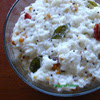
    Serve hot with some papads and yogurt.
    This is my entry to Indira's JFI - Greens and Nandita's WBB, hosted by Indira of Mahanandi.

    Wednesday, January 31, 2007

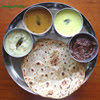
    Ginger Thali


    When I saw ginger being chosen for this month's JFI by Rosie, I thought of presenting a GINGER THALI. Thali is an Indian meal served on a big platter with several dishes arranged in small cups beautifully, increasing any body's appetite. Depending upon the region, the main dish would be rice or rotis / pooris. I am calling my meal as Ginger Thali because this is a simple meal (mainly South Indian minus dessert) prepared using ginger.
    Every dish (except rice) served on thali is prepared using atleast a small quantity of ginger. Don't assume that all dishes are gingery. Even if you have slight inclination towards ginger and Indian food, then these dishes are right for you. The gingery taste is subtle in most of the dishes with a few exceptions like ginger-tamarind chutney and ginger gojju.

    What is the menu then? Come and explore. Please click on the image to view the recipe.

    PongalGinger ParathasGinger GojjuMoongDal Ginger Vada
    Ginger Tamarind Chutney
    Dalia ChutneyGinger RasamYogurt Rice

    Hope you enjoy!!

    Post a comment

    Monday, January 29, 2007

    Ginger Parathas


    A couple of years ago, I saw a post about ginger parathas. I thought it was worth a try and noted it down. I am rather interested in collecting new recipes than trying them. So, actually I never attempted to prepare these parathas. The recipe was playing hide and seek whenever I opened my recipe book. Since, JFI - Ginger event is going on, I thought this is the right time to try them. I did and posting the recipe now. The original recipe can be found here. I followed basically the same recipe but omitted a few things to suit our taste.

    Ingredients:
    Whole wheat flour - 2 cups
    Ginger powder - 1/2 tsp
    Sesame seeds - 1 Tbsp
    Carom (ajwain) seeds - 1/4 tsp
    Fresh ginger grated - 2 tsp.
    Cilantro finely chopped - 1 Tbsp
    Yogurt - 2 Tbsp
    Oil - 2 Tbsp
    Salt - 1/4 tsp
    Oil to fry the parathas

    Making Parathas:
    Mix everything (except the last item in the ingredients list) and make a soft, pliable dough adding water as needed. Knead it and leave the dough to rest for half an hour. Then make lemon sized balls out of the dough and roll them out into thin circles. Heat a skillet and then shallow fry these parathas (thin circles rolled out of the dough) using oil, till both sides turn golden brown .
    Serve hot with a curry.

    Moongdal - Ginger Vada

    I used to have an elderly Gujarathi lady as a neighbor few years ago. Once when I visited her house, she made these dal vadas and served them with mint chutney. She had soaked moongdal earlier and so, she prepared them in a jiffy. Until then, I knew nothing about moongdal vadas. They tasted so delicious. Ofcourse, I tried them later and have been making them eversince. From yesterday, we are experiencing snowfalls on and off and we have snow predictions for a couple of days more. I prepared moongdal vadas today to beat the gloomy weather outside.

    Ingredients:
    Moong dal (Yellow) - 1 cup
    Ginger - Thumb size
    Salt
    Green chillies - 2 - 3
    Oil to fry

    Preparation:
    Soak moongdal in water for a couple of hours. Then grind smoothly with ginger, salt and chillies adding as little water as possible. (Otherwise your vadas would be shaped like those in the picture. If it is watery, add a little besan or riceflour to make it thicker)
    Heat oil in a wok. When the oil is hot enough, drop small balls of batter into it. Fry them on a low heat till they turn golden brown. Remove them and repeat the process with the remaining batter.
    Serve them hot with chutney.


    Post a comment

    Sunday, January 28, 2007

    Pongal and Roasted Chickpeas- Ginger Chutney

    January is the month when harvest festival Sankranthi is celebrated in Southern India. Their main staple food is rice and on the festive occasion, the food prepared reflects the new crops grown and harvested. One of the foods that always figure on that day is pongal. This is also one of the regular breakfast items in a South Indian wedding. I would call it divine food since this is one of the foods that is offered as "Naivedyam" (an offering to diety) and served as "Prasadam" to the devotees in Hindu temples worldwide including the world famous abode of Lord Balaji at Tirumala. This recipe is from my MIL who prepares one of the best pongals that I have ever tasted. I have followed her method and ingredients. My MIL never cooked in small quantities and hence the quantities used here are to suit my taste. She used to serve this with her ginger gojju and chutney. You can use a pressure cooker to keep this preparation simple and fast. If you don't own a pressure cooker, take a big sturdy pot with a thick bottom to cook pongal. You may need more water (than mentioned in the ingredients list), to cook in the pot. In my opinion, both methods will yield the same result. The quantity of the ghee used in the preparation of pongal makes all the difference. The more the ghee, the better the taste.  

    Ingredients: 
    1 cup rice
    1/2 cup moongdal 
    4 & 1/2 to 5 cups water
    1 tbsp. peeled and grated ginger
    1/2 tsp. pepper corns
    1/2 tsp ground pepper corns  
    1 tsp cumin seeds
    1/4 cup ghee
    1 /4 cup cashew nuts
    1.5 tsp salt
    A sprig of curry leaves 
    1/4 tsp turmeric powder (Optional)
      
    Method:
    * Dry roast moong dal on a medium flame till it starts to turn very light brown and you start to feel the aroma. 
    * Wash the rice thoroughly with water and drain. Add rice, moong dal, salt, turmeric powder, pepper corns and water to a pressure cooker and cook for 2 whistles. 
    * For the tadka part, heat ghee in a small pan. Add ginger, cumin seeds, pepper powder, cashews, curry leaves in that order. When ginger pieces turn brown, turn off the stove. Add this to the cooked rice - dal mixture and stir. Again turn on the stove and let this mixture / pongal simmer on low flame for 5 minutes so that it can absorb the flavors of the spices added. 
    Alternatively, the tadka mixture can be added to rice and moongdal before cooking. There is no need to simmer it at the end, if you cooked rice & dal with the tadka. Serve hot pongal with ginger gojju or chutney. Though it is optional, Pongal is usually served with a generous serving of ghee to make it more delicious. 
     Roasted chickpeas - Ginger Chutney:  
    Roasted chickpeas (Pappulu) chutney is the most common chutney prepared in South India. Indian stores sell these roasted chickpeas under the gujarati name dalia. It serves as a side dish for most of the breakfast foods like dosas, idlis, vadas, upmas, pongals etc. It is very easy to prepare and best served fresh. Usually the coconut chutney version has more coconut and a few tbsp. of roasted chickpeas. The other adult at home hates coconut and so I settled at this coconut-less version for our everyday needs. 

    Ingredients:  
    1 cup roasted chick peas (pappulu) 
    One inch piece of peeled ginger  
    3 to 4 green chillies
    Salt to taste
    A handful of cilantro leaves  
    For tadka: 
    2 tsp oil
    1 tsp. mustard seeds 
    1 tsp Chanadal (Bengal gram)
    A sprig of curry leaves    

    Method:
    Grind chickpeas, ginger, chillies,salt and cilantro using water into a smooth, thick paste in a blender and transfer it into a bowl.  
    Heat the oil in a small pan. Add chanadal, mustard seeds and curry leaves. When chandal turns red and mustard seeds start to splutter, remove from the stove and add to the chutney bowl. Stir and serve with breakfast.  

    Comment

    Saturday, January 27, 2007

    Ginger - Tamarind Chutney / Allam - Chintapandu Pachchadi

    My mom uses ginger rarely in her kitchen and preparation of Ginger - Tamarind chutney is one of those occassions. My parents are from Coastal Andhra and tamarind chutney is quite popular in that region. There, you sure are going to find a jar of ginger - tamarind chutney in most of the kitchens , any day, any time. This comes under 'Must haves' in my mom's kitchen. She never runs out of this chutney.
    As usual, this can be eaten with rice as all other Indian chutneys. If this would have been my sister's blog, she would have recommended this chutney with dosas and upmas. She would eat dosas only, with this chutney, even if you tempt her with hundred other side dishes. This comes in real handy when you have no time to prepare chutneys or during those power cuts which have become so frequent in India.

    Ingredients:
    Tamarind - 100 g / 3.5 oz
    One inch square ginger - 2 pieces
    Powdered jaggery - 1/4 cup
    Red chillies - 20
    Salt - 3/4 tsp
    Urad dal (Black gram) - 2 tbsp
    Mustard seeds - 1 tsp
    Methi (Fenugreek) seeds - A few ( half of 1/4 tsp)
    Asafoetida (Hing) - Little (half of 1/4 tsp)
    Oil - 1 tbsp


    In USA, tamarind (Indian brands) is usually sold in a 200 grams / 7 oz size bar. I have used half of it to make this chutney. Soak this in enough water for an hour or until it softens. Alternatively, you can place this in microwave for 2 minutes to quicken the process. When it is soaked, tamarind would become soft enough to squeeze. Extract a cup of thick tamarind pulp from it and keep aside.
    Peel the ginger. I used the same quantity of ginger shown in the picture.
    Meanwhile, heat oil in a small pan and add uraddal and mustard seeds. When urad dal starts to turn a little brown, add methi seeds, hing and redchillies. When urad dal and methiseeds turn red, switch off the stove. Let it cool. Grind this cooled mixture with ginger, tamarind pulp, jaggery and salt in a blender to a coarser mixture. Remove the chutney from the blender and store it in a glass / ceramic bowl.
    It usually stays fresh even for a month, refrigerated.

    This recipe is going to be a part of my contribution to the JFI - Ginger event.

    Post a Comment

    Friday, January 26, 2007

    Allam Gojju / Ginger Gojju

    For Rosie's JFI - Ginger event, I am planning to go overboard a little (assuming not overwhelming Rosie) and presenting a GINGER THALI. All Indians know what a thali is. It is an Indian meal, served on a big plate. Different dishes are served in small cups arranged in it. My Ginger Thali is a simple meal with food items (mainly South Indian) prepared with ginger. Don't assume that all dishes are gingery. You would not even notice that all the items have ginger unless someone tells you. Even if you have slight inclination towards ginger and Indian food, then these dishes are right for you. In South India, appetizers and desserts are not served unless it is a festive occasion. So, I am skipping those. I am sure my friends would come up with them in plenty. I already see Asha's mouth watering Rissoles.

    I am going to post ginger recipes from Ginger Thali for a couple of days. Today, I am coming up with the recipe for 'Allam Gojju' which you can eat with rice, pongal, rotis etc. (Ginger is called allam in Telugu, my native language).

    The spicy, sweet and the sour gojjus are a speciality of Karnataka, a southern state of India where I grew up. Gojju is usually prepared with a vegetable in a gravy. To a gojju, jaggery imparts the sweetness, the tamarind gives the sourness and spices of course give that kick associated with Indian food. A powder is usually used to thicken the gravy. Here I have used roasted chick pea (Dalia) - coconut powder. Every family sure will have their own favorite when it comes to the powders added to thicken the gravy. (If you don’t have any ingredients used to make this gravy thickening powder, you simply can add a tablespoon of rice flour. Before adding to the gravy, just take care to mix rice flour well with a little quantity of cold water without forming any lumps and then add it to the other ingredients in the wok).

    Here in this recipe, ginger has been used in place of the vegetable. I learnt this recipe from my MIL who in turn got this recipe from a cook at her nephew’s wedding. She cooks this primarily to go with pongali / pongal. It is good to go with rice, rotis and other Indian breakfast stuff. It takes hardly 10 minutes to prepare if you have all the ingredients ready. I have no words to describe this dish which has all the flavors infused in it. It is simply delicious. Try it once and this would be on your regular menu.


    Ingredients:
    Ginger grated and chopped into fine pieces – 2 Tbsp
    Tamarind – A small lemon size
    Jaggery, Powdered – 2 Tbsp
    Chillie powder – 1 & ¼ tsp
    Salt – 1 & ½ tsp
    Water – 1 & ½ cups
    Oil – 1 or 2 Tbsp
    Cumin Seeds (Jeera) – 1 tsp
    Mustard seeds – 1 tsp
    Chana dal – 1 tsp
    Asafoetida(Hing) – ¼ tsp
    Turmeric Powder - ¼ tsp
    Curry leaves – A few
    For gravy thickening powder:
    Roasted chickpeas /Dalia (Pappulu , Kadale pappu) - 2 Tbsp
    Dry coconut grated – 1
    Tbsp


    Preparation:
    Soak tamarind in water for half an hour. Alternatively, you can put the tamarind & water bowl in a microwave for 2 minutes to fasten the process of soaking. Squeeze two tablespoons of thick tamarind pulp from it.
    Grind dalia and coconut into a fine powder.
    Heat oil in a wok or a pan. When the oil is hot, add ginger and fry for 30 seconds. Then add chanadal and when both ginger and chanadal start getting brown, add cumin seeds, mustard seeds, hing, curry leaves and turmeric. When mustard seeds start to splutter, add tamarind pulp, jaggery, chillie powder, salt, dalia-coconut powder and water. When it starts to boil, lower the heat and leave it for a couple of minutes. Then, switch off the stove and allam gojju is ready to serve.

    Post a Comment