HOME        |        ABOUT        |        COPYRIGHT        |        CONTACT        |         RECIPE INDEX        |         INDIAN THAALIS        |         MILLET RECIPES        |        EVENTS' ROUNDUP        

Showing posts with label Green Mango. Show all posts

Friday, November 26, 2021

'Quinoa' Maavinakayi Chitranna / Mango - Coconut Quinoa


(This was originally posted on 5 /3/2011.)

Quinoa can be incorporated into Indian cuisine effortlessly. It can be used to replace rice in most of the dishes that need it and this post happens to be one such recipe. Mango chitranna / pulihora is a simple yet delicious dish from South India that uses rice and green mango. It is prepared especially during summer times when green mangoes are available in abundance. I have replaced rice with quinoa in this popular, tongue- tickling dish and here is the method.
And don't worry about the long list of ingredients mentioned. Most of them go in the tadka / tempering.

Below are some other quinoa based dishes that I have already posted.
Quinoa Bisebele
Quinoa Khichdi
Quinoa - Masoordal Soup
Quinoa Panchkuti Dal Khichdi
Quinoa Pilaf
Quinoa Pongal
Quinoa Sweet Pongal
Quinoa Upma

Ingredients: (Yield - 3 servings)
1 cup quinoa
1 - 2 tbsp. oil
1/4 cup. peanuts
1 tbsp. Bengal gram / chana dal
1 tbsp. skinned black gram / urad dal
1 tsp. mustard seeds
A sprig of curry leaves 
2 green chilies (I used Serrano peppers. If using other varieties, adjust the quantity according to the spiciness preferred.)
2 -3 dried red chilies, broken into small pieces
1/4 tsp. turmeric powder
A pinch of asafoetida powder
3/4 cup grated raw mango
1/2 cup shredded fresh coconut (thaw if using frozen)
Salt to taste
1/2 tsp mustard seeds powder +  1/4 tsp fenugreek seeds
/ methi powder (optional but recommended. The quantities can be increased if preferred. Lightly toast mustard and fenugreek seeds and powder them fine.)
Minced cilantro for garnish


Method:
* Wash quinoa in several exchanges of water. Add quinoa and 1 & 3/4 cups of water to a pressure cooker and cook until done. (2 - 3 whistles). Cool and fluff.
Alternatively, it can be cooked on stovetop. Bring the water to a rolling boil and then add quinoa. Cover and cook until done, about 20 minutes. When done, the seeds become translucent and the white germ would partially detach itself, appearing like a tail.
* Heat oil in a thick bottomed pan or a kadai. Add the peanuts, Bengal gram, skinned black gram and mustard seeds. When peanuts start to turn reddish, add green & red chilies and curry leaves. Sauté for a few seconds and then add the turmeric powder, asafoetida powder, mango and coconut and stir well. Turn off the stove.
* Next add the cooked quinoa, salt, mustard and fenugreek powders to the pan and mix well to combine.
* Garnish with cilantro and serve.

Friday, June 25, 2021

'Foxtail Millet' Green Mango Rice / Korrala Mamidi Pulihora / Navane Mavinakayi Chitranna

Rice is a chief crop of south India both in terms of production and consumption. Obviously there are plenty of main dishes made with rice in the region. Mavinikayi chitranna, a rice dish made with grated raw mango and seasonings happens to be a summer comfort food of Karnataka, a south Indian state. I tried to make the dish healthier and nutritious by replacing the rice in the recipe with a millet. Here are some other millet based rice dishes that I have posted.
 
I used foxtail millet but it can be replaced by other millets like barnyard millet or kodo millet. Cooking the millet into a mush spoils the consistency of the dish (especially if one is particular about it). Cooking the millet such that each grain stands apart is recommended while making these kind of dishes. I have cooked a large portion of the millet than the quantity mentioned below in the recipe and so, I haven't mentioned the exact quantity of water I used to cook the millet. I usually pressure cook millet for 2 whistles and use less than 2 cups of water for each cup of millet used. I leave the cooked millet aside for at least 10 minutes and spread it in a wide plate if especially trying to substitute it for rice in a dish. 
Thanks to my husband, I had a bag of frozen, grated mango which I would have never even thought of buying, 😉. I used that in the recipe and so the gratings are more noticeable than the shredded fresh green mango. If the mango used is not sour enough, drizzle some lemon / lime juice over the rice and stir to combine. This millet dish is dry compared to the rice version and so, serve it along with some yogurt on the side. Some chips / papad  or fried vadis would be a nice accompaniment.
Ingredients:
1/2 cup foxtail millet / 2 cups cooked foxtail millet
2 tbsp. oil
A handful of peanuts
1 tsp. split chickpeas / chana dal
1 tsp. skinned black gram / urad dal
1 tsp. mustard seeds
2 dried red chillies, broken into bits
1 spicy green chili, sliced lengthwise / chopped fine
1 sprig of curry leaves
1/8 tsp. turmeric powder
2 pinches of asafoetida powder
Salt to taste
1 cup peeled and grated green mango 
Lemon / lime juice to taste (optional)

Method:
* Check and remove if any tiny stone bits present in millet. Rinse and pressure cook the millet for 2 whistles adding water as needed. When the valve pressure is gone, remove and leave the millet container out on the counter for about 10 minutes. Then spread the cooked millet on a wide plate, breaking any lumps if present with a spatula. 
* Heat oil in a wide pan and add peanuts, split chick peas, black gram and mustard seeds in that order. When the peanuts turn golden brown, add green chillies, red chillies and curry leaves. Sauté for few seconds.
* Next add turmeric, asafoetida, grated mango and sauté for 3 to 4 minutes and then add the cooked millet and salt. Mix well, breaking any lumps if present. (Taste and add lemon / lime juice if the mango used was not sour enough.)
* Turn off the stove and serve the millet - green mango rice warm with fried papad or chips and some yogurt.
This post is an entry for Blogging Marathon and check the link to find out what other marathoners are cooking.

Sunday, April 11, 2021

Mamidikaaya Pappu / Andhra Style Green Mango Dal / à°®ాà°®ిà°¡ిà°•ాà°¯ పప్à°ªు

(This was originally published on 9/ 9/09.)

Pappu is a signature lentil based dish from the south Indian states of Andhra and Telangana. The preparation is a simple one using the basic ingredients from an Indian kitchen and usually brings out the flavors of the vegetable being used. However, it should be noted that all vegetables are not used to make a pappu. Some are absolute classics if a list of pappus is being made. Mamidikaya pappu (green mango dal), and the ones prepared using leafy greens like gongura and chukka koora are mouth watering and flavorful dals. Today's recipe is 
for mamidikaya pappu, which is one of our family favorites. Mango dal, the protein rich dish with the tart mangoes and a flavorful seasoning of asafoetida and curry leaves would make a pleasing meal when served with rice, drizzled with ghee.

Pick the tartest kind of green mango you can, for this dal. See that it is very firm to touch and green in color. The signature flavor of the dal is lost with out the sourness. The requirement of tamarind in this recipe depends upon the sourness of the mango being used. If the mangoes are really sour as back in India, tamarind may be omitted. I get sour mangoes but not that mouth puckering variety and so I happen to use tamarind. 

Ingredients needed:
1 cup pigeon peas / toor dal
1/8 tsp. turmeric powder
1 small firm, green mango - peeled, seeded and chopped into cubes (I had about a cup.)
About 2 tsp. salt or as needed
1/2 tsp. spicy chili powder or as needed

Thick tamarind puree (I used about 3 tbsp. See note below.)

Ingredients for seasoning / popu: 
2 tsp oil 
1 tsp. mustard seeds 
1 tsp. cumin seeds (optional)
A pinch of fenugreek seeds (optional)
2 pinches of asafoetida
Few curry leaves

Directions:
* Wash pigeon peas / toor dal with water twice and throw away the cloudy water. Pressure cook the dal adding 2 cups of water and turmeric powder for 3 whistles or until done. (The dal can be cooked in a thick bottomed pan on stove top in lieu of a pressure cooker. Soak dal for a couple of hours in that case to fasten the cooking process. Cook until the dal softens adding water as needed.)
* Cook mango cubes in another container in the cooker (while cooking dal) or cook separately in a sauce pan or in a microwave adding about 1/2 cup of water. (It is done because the tartness of mango interferes with the cooking of toor dal.)
* Mash the cooked dal with the back of a ladle and keep aside.
* Heat oil in a pan and add mustard and cumin seeds. When mustard seeds start to pop, add asafoetida and curry leaves. Then add the mashed dal, cooked mango cubes along with the water used to cook, salt, chili powder and tamarind if using. Mix all the ingredients well with the ladle. Add extra water if the dal appears thicker. Check the taste and adjust any seasonings if needed. Let the dal simmer for about 5 minutes for all the flavors to mingle and turn off the stove.

How to serve:
Serve this with a small mound of rice and a tsp of ghee. Serve along with a pickle, koora (a vegetable preparation), and yogurt for Andhra style lunch.

Notes:
Soak about 1/4 cup of tamarind in water for about an hour or microwave for about 3 minutes adding water. Squeeze thick tamarind puree using your fingers or passing through a sieve. Discard the seeds and fibre. Use the puree as needed and refrigerate the rest. The amount of tamarind puree used depends upon the tartness of mango being used. I used about 3 tbsp. of tamarind puree but the quantity may vary for the same amount of pigeon peas cooked depending upon the mango used. If using the ready made tamarind paste, the quantity mentioned above varies.

Wednesday, February 12, 2020

Bardoli Ki Khichdi


Khichdi, a medley of grain, lentils and vegetables is a common one pot meal prepared across Indian states. The regional variations keep this quick, humble meal interesting enough to keep it rotating in one's kitchen. Today's version supposedly comes from Bardoli, a suburb of Surat in Gujarat. The dish is a straight forward, no fuss kind prepared with the basic ingredients of an Indian kitchen. No special spices / spice powders are used here. 

Raw mango which is a summer staple of Indian kitchens is an interesting addition to this filling khichdi, which drew me to this recipe in the first place. I had a couple of raw mangoes in my refrigerator even in the middle of winter though they don't t match up to the varieties available back home in any manner. The khichdi also had onions in the recipe which I decided to leave out. The khichdi turned out to be how it should be - nutritious, wholesome and simple. Good to go with some papad / lentil wafers, a spicy pickle and drizzled with some ghee on the top.

Ingredients:
1/4 cup yellow lentils / toor dal
1 tbsp. ghee / oil
1 tsp. cumin seeds
2 green chillies, sliced
1/2 inch ginger, chopped
A pinch of asafoetida powder 
1/8 tsp. ground turmeric
1/2 cup rice
1 big sized potato, cut into cubes
1/2 cup raw mango, peeled and cubed
A handful of green peas
Salt to taste
Red chili powder to taste
Cilantro to garnish
Directions:
1. Soak lentils for about 2 hours and drain. (It cuts down the cooking time if the khichdi is going to be cooked in a pan or if the dal cannot be cooked for three whistles in a pressure cooker. Skip this step if lentils can be cooked in a pressure cooker in 2 or 3 whistles.)
2. Heat ghee in a thick bottomed pan on medium flame and add cumin seeds. When they start to brown, add chillies and ginger. Fry until ginger turns golden brown. Add asafoetida, turmeric, drained lentils and about 2 cups of water. 
3. When the lentils are half cooked, add rinsed and drained rice and potato cubes. Keep adding water if needed. Add raw mango cubes after about 10 minutes and continue to cook. After about 5 minutes, add peas and continue to cook. When the rice and lentils are completely cooked, add salt and chili powder. Check the consistency and add water if needed. Bring the mixture to a boil if water was added and if not, cook for about two minutes and turn off the stove. 
* Garnish with cilantro and serve warm.

Note:
Follow this method if using a pressure cooker. Heat ghee in the cooker directly and add cumin seeds. When they start to brown, add chillies and ginger. Fry until ginger turns golden brown. Add asafoetida, turmeric, drained lentils, rinsed and drained rice, potato, raw mango pieces, peas, salt, chili powder and about 2 cups of water. Close the cooker lid and pressure cook for two / three whistles.

Friday, January 25, 2019

Moongdal - Green Mango Rasam / Pesarapappu - Mamidikaya Chaaru

Chaaru / Rasam / Saaru whatever the regional name maybe, happens to be a staple dish in south Indian cooking and is a thin, spicy lentil broth served with rice. It is served in many homes for every lunch / dinner and considered a comfort dish by many. It aids in digestion and is light enough to serve even to the sick. The classic and the most common rasam uses the pigeon peas - tomato combo. Or lemon juice in lieu of tomato. There are different variations nowadays in the rasam preparations and I happened to see this one on a television cooking program. Rasam powder aka the spice powder used to prepare rasam is a pantry staple in south Indian homes and if you have rasam powder (either homemade or store bought - I would recommend MTR brand) handy, the preparation becomes a simple and easy one.

I prepare rasam / chaaru on a regular basis in my home though I don't have the basic rasam recipe posted here on my blog so far. I am quite good at rasam preparation while not being so in  photographing it. I admit it without any embarrassment that my 'rasam' photographs usually don't do justice to the dish itself.  I see many bloggers beautifully capturing rasam in their images. In my case, all the good stuff sinks to the bottom including the tempering and clear liquid topped with drops of grease remains to be captured and I usually give up. I wasn't happy with today's image too but the green mango rasam is so flavorful that I could not let go without posting it.

Ingredients:
1/4 cup moong dal / skinned, split green gram
1/8 tsp. ground turmeric
3/4 tsp. salt or as needed
1 and 1/2 cups water
1 tbsp. finely minced cilantro
Ingredients to toast and grind:
1/4 tsp. pepper corns
1/2 tsp cumin seeds
1.5 tsp. coriander seeds
or
1 tsp. homemade or store bought rasam powder
Ingredients for tempering:
1 tsp. ghee / oil
1/2 tsp. mustard seeds
1/2 tsp. cumin seeds
2 dried red chillies, broken into bits
2 green chillies, sliced lengthwise
6 - 8 curry leaves
A pinch of asafoetida powder
1/4 cup grated green mango 

Directions:
* Wash and rinse the moong dal in two exchanges of water and drain. Pressure cook moong dal adding 1/2 cup of water and ground turmeric for 3 whistles. (At this stage, one can also add mango pieces along with dal and cook instead of grating and frying later). When the valve pressure is gone, finely mash the dal and mangoes (if used) with the back of a ladle and keep aside.
* Meanwhile, toast pepper corns, cumin and coriander seeds without burning them. Let cool and grind fine. (Skip the step if you have rasam powder.)
* Heat oil / ghee in a pan / pot and add mustard seeds and cumin seeds. When mustard seeds starts to splutter add red chillies, green chillies and curry leaves and saute for a few seconds. Next add asafoetida powder and grated mango (in case if you haven't pressure cooked green mango in the first step.). Fry for few minutes on low flame until the mango appears cooked. Then add pureed moong dal, salt, ground spices (or rasam powder), minced cilantro and about 1.5 cups of water (or as needed to get the desired consistency.) Taste and adjust the seasonings if needed. Bring the mixture to a boil and turn off the stove.
* Serve piping hot rasam with rice and dollop of ghee or as a part of a south Indian meal.

Notes:
* I usually don't use green or red chillies in a rasam recipe since the red chillies and black pepper used in my rasam powder lend enough spicy kick. However I used MTR rasam powder while preparing this rasam and recommend the usage of red chillies and mildly spiced green chillies unless if the rasam powder being used is very spicy by itself. The sourness from the green mango cuts down the spicy level. 
* The mango can be cut into pieces and cooked (and then mashed) along with moong dal if desired instead of grating and frying later.
* Basically I use the same ingredients to prepare my own rasam powder but not in the same ratio. The recipe link to my rasam powder is given below.

Other Rasam recipes posted here.
Carrot Rasam
Drumstick Rasam
Pineapple Rasam
Rasam Powder / Charu podi

This goes to Blogging Marathon under 'Bookmarked Recipes' Theme.

bmlogo  

Comments

Wednesday, May 17, 2017

Raw Mango Rice / Maavinikaayi Chitranna

  
A rice dish would be a commonly prepared main dish when thinking in terms of a south Indian picnic. Until a few decades ago (or even now in many households), the spicy tamarind rice and the soothing yogurt rice combo would be blindly packed for lunches during any outdoor activities. The dishes would be prepared and relished without any second thought. The spicy tamarind based paste used for the tamarind rice can be prepared ahead and all that needs to be done on the picnic day is to mix it with cooked rice. It doesn't spoil at least for a couple of days even during the high summer temperatures, even when not refrigerated. While the yogurt rice is cooling and soothing, during the hot, sultry days.
And coming from that kind of background, I could not stop myself today from posting a rice dish as a part of this week's BM theme of 'picnic dishes'.  Besides, I thought of celebrating the sudden summer temperatures we are encountering this week after the 40s (around 4 deg C) we were freezing in last week. And what is a better way to celebrate the warm weather than a 'mango' that is almost synonymous to Indian summers? And the combo of rice and raw mango lead to this dish which is simpler than a pulihora preparation but nonetheless delicious in it's own way. This is prepared along the lines of 'kaayi saasive anna' from Karnataka and uses the extra step of grinding some ingredients and sauteing the paste.

Click on the recipe names below if interested to access the recipes of the rice dishes mentioned in the post.
Green Mango - Coconut rice
Tamarind rice / Pulihora
Yogurt rice / Daddhojanam
Kaayi Saasive Anna / Coconut - Mustard Rice
Green Mango Rice / Maamidikaaya Pulihora
Ingredients to grind:
1 cup firmly packed, peeled and grated raw mango
1/4 cup grated fresh coconut
3 red chillies + 1 green chillie
1/2 tsp. mustard seeds
1/2 tsp. to 1 tsp. jaggery powder

Other Ingredients:
3 tbsp. oil
2 tbsp. peanuts
1 tsp. split chickpeas / chana dal
1 tsp. black gram / urad dal
1 tsp. mustard seeds
Few curry leaves
1/8 tsp. turmeric powder
2 pinches of asafoetida powder
4 cups cooked rice
Salt to taste

Method:
* Spread the rice on a wide plate and allow it cool. Once cool, break any rice lumps if present.
* Keep a handful of grated mango aside and grind everything under 'ingredients to grind' to a slightly coarse paste, adding a little water.
* Heat oil in a saute pan and add peanuts, split chickpeas, black gram and mustard seeds. When the peanuts turn golden brown, add curry leaves, turmeric powder and asafoetida powder. Saute for about 10 seconds and add the ground paste. Saute the paste on medium flame, constantly stirring until the raw smell leaves, about 4 to 5 minutes. Next add the remaining mango gratings and salt and cook for a minute.
* Now the rice from the first step can be added to the pan and mixed or the cooked raw mango stuff from the above step can be added to the rice plate. Mix well so that the rice grains are coated well with the paste. Taste and adjust the seasonings if needed.
* Serve warm with lentil wafers or potato chips.

Notes:
1. Use south Indian style rice for this preparation, where the cooked rice grains could be seen individually. I used sona masuri rice and pressure cooked it with a rice and water ratio of 1:2. 
2. Let the rice cool before adding it to the pan since the hot rice will turn mushy when stirred.
3. If the raw mango is not sour enough to your taste, lime or lemon juice can be added to the dish at the final stage as needed. Or a tiny ball of tamarind can be added while grinding the paste.
 bmlogo
This goes to Blogging marathon #76, under the theme 'Picnic Recipes'. Check out the page to read what other marathoners are cooking.

Comments

Thursday, September 15, 2016

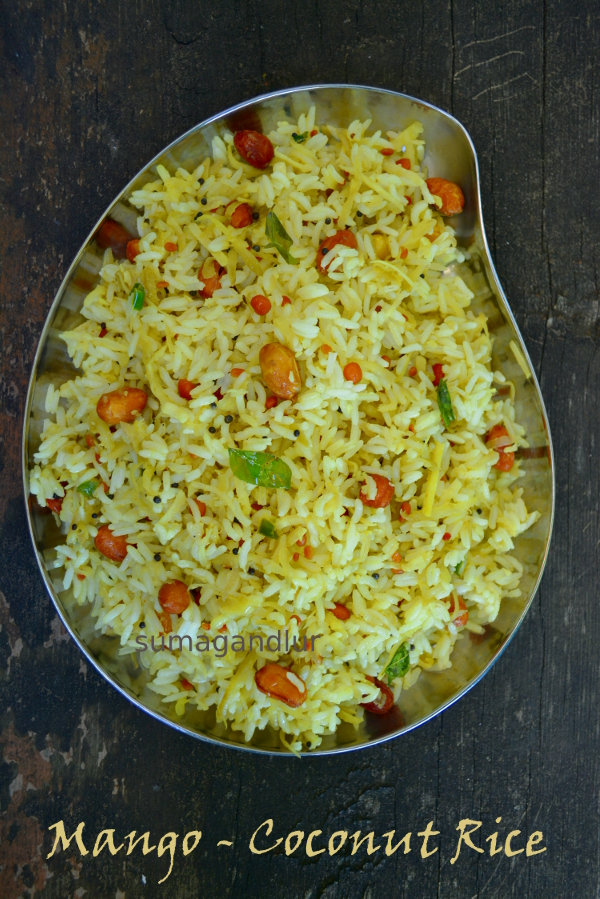
M for Mamidikaaya - Kobbari Pulihora / Green Mango - Coconut Rice


In spite of the heat and the inconvenience of power cuts, there are people like my mother who look forward to Indian summers which promise to bring an abundant supply of mangoes and jasmine flowers in the markets. Mango is an enticing fruit to many across the sub continent and both green and ripened ones are in high demand and supply for the few months they are available. The ripened mangoes are eaten as it is or used to whip up some delicious drinks and desserts while the green ones go into the preparation of variety of pickles/instant chutneys, stews or into a simple yet delicious rice dish like the one that is featured here today. 

A green mango pulihora is the main attraction of a Ugadi menu at my mother's place since it is the time when the green mangoes start appearing around the block each season. I have just followed my mother's recipe here, throwing in some fresh shredded coconut which adds a delicious flavor layer to the already tasty dish. If you are a coconut lover and tried this one, you would never probably going to skip the addition of coconut in this dish. There is a mango rice version where coconut and spices are ground and sauteed but I prefer to just add the plain coconut. This one makes a quick and easy to prepare rice dish for beginners that is fit to serve as a lunch box item or as a part of a festive meal.
Ingredients: (3 to 4 servings)
3 cups cooked rice *
3 to 4 tsp. oil
A handful of peanuts
1 tsp. split chickpeas / chana dal
1 tsp. black gram / urad dal
1 tsp. mustard seeds
2 dried red chillies, broken into bits
2 green chillies, sliced lengthwise / chopped fine
1 sprig of curry leaves
1/8 tsp. turmeric powder
2 pinches of asafoetida powder
Salt o taste
1 cup peeled and grated green mango
1/2 cup grated, fresh / frozen coconut (Thaw before if using frozen coconut.)
* Use south Indian style medium grain rice like sona masuri

Method:
* Spread the cooked rice on a wide plate, breaking any rice lumps if present with a spatula. Keep it aside for few minutes to cool.
* Heat oil in a wide pan and add peanuts, red chillies, split chick peas, black gram and mustard seeds in that order. When the peanuts turn golden brown, add green chillies, curry leaves and saute for few seconds.
* Next add turmeric, asafoetida, grated mango, coconut and salt. Saute for 3 to 4 minutes and then add the cooked rice. Mix well, breaking any rice lumps if present. Turn off the stove and serve the rice warm with fried papad or wadis or chips.

Recipes so far in A - Z Rice Dishes,
A for Achaari Chole Pulao
B for Bhuna Khichuri
C for Chintapandu Pulihora
D for Dindigul Thalapakatti Veg Biryani
E for Ellorai / Ellotharai  
F for Fodnicha Bhaat 
G for Gongura Pulihora 
H for Hare Moong ki Chaaswaali Khichdi 
I for Iyengar Style Kadambam 
J for Jodhpuri Vegetable Pulao 
K for Kaju - Karivepaku Annam 
L for Lilva Khichdi

Check out the Blogging Marathon page for the other Blogging Marathoners doing BM# 68.
An InLinkz Link-up

Thursday, April 28, 2016

A - Z Andhra Recipes ~ X for Xtra Spicy Hot Andhra Aavakaaya

I am presenting recipes in an alphabetical order this month, based on the theme of Andhra vegetarian dishes. Today is the turn of alphabet 'X' and I am at an impasse, considering that there are no ingredients or recipes that start with 'X' in the regional language, Telugu. If I am not wrong, there are probably only two dishes in India that start with 'X', both with foreign roots. One is xacuti from Goa, which is adapted from the Portuguese cuisine while the other one, is a Christmas cake or Xmas cake in abbreviated form that is popular in areas with large Christian population.

And so I had only choices of going with abbreviations like Xtra, Xplore and as such for today's post. Initially I thought of xploring Andhra thali meals (full course meals) served on different occasions but I could not do it on time for today's post. However I have a recipe for a dish that is cherished in the state, is quintessentially Andhra and does the justice for the adjectives I have used in the title.
 
As the title suggests, today's recipe is about the spicy, hot Aavakaaya, a special green mango pickle from the region. Andhra state is known for it's spicy food and especially the spicy pickles are the pride of it's cuisine. Most of the people in Andhra start their meal with a pickle / spicy chutney. The pickles are not used to just perk up a meal but they are the starting course of the meal. A spicy pickle is mixed with rice and ghee and  eaten as the first course, followed by a koora (usually a dry curry), pulusu / pappu / sambhar (lentil based stew), chaaru (rasam) and perugu/ majjiga (yogurt/ buttermilk) all eaten with rice. That is what a normal meal course would be in Andhra brahmin households.

Summer is meant to be the season of pickle making in the state, like the rest of the country. There are varieties of pickles that are made but the green mango based ones stand out among the lot. Aavakaaya of course takes the center stage and preparation of it is usually left to the elders or the seasoned cooks of the family. Aavakaaya preparation is highly regarded and falls under the 'complex recipes' zone since a large quantity of pickle used to be made from the scratch in olden days. However it is a staright forward recipe if made in small quantities.

The word 'aavakaaya' contains two parts, 'aava' and 'kaaya'. 'Kaaya' in general refers to any unripe fruit and in this case, it is the sour, green pickling mangoes. The word 'aava' is used in reference to the mustard powder base used in the recipe. 'Aavalu' in Telugu means mustard seeds while 'aava pindi' is the mustard powder.  Besides those two ingredients, a measured quantity of chili powder, salt, and sesame oil also go into this pickle preparation. Aavakaaya is not for the faint hearted. It is fiercely spicy and has a strong mustard flavor. And people who are not acquainted with it may not appreciate the strong flavors, the first time they get to taste it. Besides, people may get shocked looking at the quantities of ingredients used in the recipe. However that chili powder and the mustard powder provide the base for aavakaaya.

Brahmin households never add garlic to the aavakaaya while other communities prepare a garlic version too. One of the variations of aavakaaya is prepared in coastal areas which contains jaggery as well and is called bellam aavakaaya. And there are other aavakaaya preparations where green mango is replaced with other vegetables. Dosavakaaya is prepared using the plump, yellow cucumber while tomatoes are used to prepare tomato aavakaaya. However they can't be stored for longer periods like the aavakaaya.

Care should be taken during the preparation of aavakaaya in keeping the work surface, the utensils/jars used and the ingredients all dry. A trace of moisture or a water drop will ruin the entire hard work. The pickle gets ruined in no time and would be fit for trash. The pickle has a long shelf life and usually at least a big ceramic jar of it is prepared in families. Whenever one feels like serving it, all they need to do is scoop out a portion and serve. Just remember to use a dry spoon and close the lid back properly. My mother ties the pickle jar tops with a thin cotton cloth and then close them with lids to ensure it is properly sealed.
Usually a lot of care goes in picking the ingredients for the pickle preparation. Firm, unripe pickling mangoes without blemishes are picked for aavakaaya making. Cutting the mangoes into pieces is a chore if a large quantity of pickle is being made. In the recent decades, the sellers offer to cut the mangoes as well for a small fee. A hot and rich colored, dried red chili powder is chosen in the preparation and nowadays the stores sell the chili powder meant for aavakaaya. My mother was telling me that she has been using the chili powder from Hyderabad in the recent years for its color and it was a news to me. When we were young, she would get the Guntur variety chillies milled and use it in the pickle. As far as the mustard powder goes, my mother sundries the black mustard seeds and grinds finely at home. And the oil base used for aavakaaya is always the sesame oil / nuvvula nune. Salt is one other important ingredient in pickle making and should be used as needed perfectly. If not sure, pickle can be tasted and adjusted accordingly. Some of the pickles get spoiled when salt is less. And the addition of black chickpeas is optional but I recommend it. The marinated chickpeas soak up the flavor of aavakaaya and also add a nice texture while eating aavakaaya annam.

The following recipe is of course from my mother and coincidentally the last time I called her that was a few days ago, she had just finished making aavakaaya. The following are the measurements she had used and I didn't try to scale down the recipe though it can be done. And luckily, I received a small parcel of homemade aavakaaya this month, thanks to my husband's SIL and that's what is pictured here. They are visiting us next week but the aavakaaya came early and on time for my today's post.

Ingredients:
15 green pickling mangoes (the big sized ones)
4 cups hot variety red chili powder
4 cups mustard powder
3 cups salt
2 kg. sesame oil
Few tbsp. of black chickpeas (optional)
(If the mangoes are smaller in size, the quantities of other ingredients used need to be scaled down.)
 

Method:
* Wash and thoroughly dry the green mangoes. Make sure that your hands, the work surface, the ingredients used and the utensils used are all dry. (This is very important for the pickle's shelf life.)
* Chop the mangoes lengthwise into two, remove and discard the seeds. Chop the mangoes into 3/4 to 1 inch pieces.
* Add mango pieces, chili powder, salt, mustard powder, oil and if using black chickpeas to a big mixing bowl. Use a big spatula and mix thoroughly.
* Pour the mixture into a ceramic or glass jar and cover with the lid properly. Leave the jar in a dry place to sit. (Always store the pickle in a non reactive jar.)
* After two days, stir the whole mixture thoroughly one more time and close the lid again.
* Leave the pickle aside for a week after the preparation. It can then be consumed. Store the pickle jar in a dry place and always handle the pickle with dry hands and dry spoons.
* The mango pieces will have a crispy texture in the starting months where as they soften after a while. Aavakaaya looses it's vibrant red color and the fresh strong flavor after some time. It's natural and no need to worry. The pickle can be consumed for at least 2 years as long as it is properly stored. However people finish it off in a year as it is freshly prepared every year and fresh aavakaaya tastes better.

So far on my 'A - Z' Andhra Cuisine,
A for Alasanda Vada
B for Bellam Garelu
C for Chiyali
D for Dondakaaya Kaarapu Kaaya
E for Endu Kobbari Podi
F for Fine Biscuits 
G for Gongura - Mamidikaya Pappu
H for Halwa Holigalu
I for Idli Karam Podi
J for Janthikalu
K for Kobbari Koora
L for Lauzu
M for Matikkaaya Kaaram Koora
N for Nimmakaaya Kaaram
O for Ottotti
P for Perugu Vadalu  
Q for Qubani ka Meetha 
R for Ragi Sangati
S for Satyanarayana Vrata Prasadam
T for Theepi Dibba Rotte
U for Usirikaaya Pulihora 


Check out the Blogging Marathon page for the other Blogging Marathoners doing BM# 63.


Friday, April 8, 2016

A - Z Andhra Recipes ~ G for Gongura - Mamidikaya Pappu

My initial ideas about 'G' dishes revolved around garelu (husked black gram fritters and not the medu vada though some call it garelu as well), gongura (sorrel leaves) and godhum appalu (wheat flour - jaggery based traditional sweet). I had to rule out garelu in mid way since I had already three deep fried fritters in my finalized list of recipes. I had prepared both gongura pappu and appalu for my 'G' recipe. In fact, appalu was my choice until this morning but gongura dish won finally for the regional authenticity. Andhra appalu are done a little differently than the neighboring state versions but still I thought of going with gongura. Gongura is one of the most cherished leafy greens in Andhra and there was no way I would have a 'A - Z' list of Andhra dishes without including it. 

My recipe today comprises the two culinary aspects of Andhra - the 'pappu' preparation and the addition of green mango to leafy green dals. A pappu is a lentil / toor dal based preparation from Andhra, which is usually on a thicker side, compared to other south Indian dal preparations. Moong dal may replace lentils, sometimes. Any spice powders or sweeteners are not used in the preparation of pappu. A particular vegetable or leafy greens are added to lentils while making a pappu and the dish takes the name of that particular vegetable used in the preparation. Mamidikaaya pappu is the one using mamidikaaya or green mango, Palakoora pappu is the one using paalakoora or spinach and so on. The usage of green chillies / chili powder, tamarind, salt and a tempering that includes asafoetida and curry leaves balance the flavors in the dish.

Green mango is not an usual addition for gongura pappu preparation but is commonly added to other leafy green based dal preparations in the summer months. I added it since both gongura and mango available to me locally are not closer to the Indian versions in the flavor department and they are barely sour. I had to even add tamarind. This dish is like rolling two flavorful dishes in one - the popular regional dishes of gongura pappu and the green mango pappu. This is a sans onion - garlic preparation as I am used to but the green mango can be replaced with onion and above is the link for that recipe. Good variety gongura leaves do not need any souring agent and so go cautiously with the usage of green mango and / or tamarind in the dish.

Dal - A Hindi word that represents all dry and cooked versions of beans.
List of 'G' culinary terms in Telugu.

Fruits / Vegetables:
Gajanimma pandu - Sweet lime 
Gangi regi pandu - Jujebe fruit
Gadda kooralu - Root Vegetables
Genasu gadda - Sweet potato
Gongura - Sorrel leaves
Goruchikkudu kaaya - Cluster beans
Gummadi kaya - Ash gourd 

Ingredients:
Gadda perugu - Thick yogurt
Gasagasalu - Poppy seeds 
Godhumalu - Wheat kernels
Godhuma nooka - Broken wheat
Godhuma pindi - Wheat flour
Godhuma rava - Fine cracked wheat

Dishes:
Garelu & Gatti vadalu - Black gram fritters 
Gavvalu - Sweet dish
Godhuma appalu - Sweet dish
Godhuma kudumulu - Sweet dish 
Godhumannam - Cooked broken wheat
Godhuma rava upma - Cracked wheat upma
Gutti vankaya koora - Stuffed eggplant dish
Guntha ponganalu - Breakfast / Snack
Gongura pulusukoora - Sour and spicy, sauteed sorrel leaves
(Dals, curries and chutney made with above vegetables also fall under 'G' dishes.) 
 
Ingredients needed:
1 cup toordal / lentils / kandipappu
2 to 2.5 cups chopped gongura leaves (sorrel leaves)

1/2 cup green mango, peeled and cubed *
2 spicy green chilies, sliced lengthwise and/or chili powder as needed

Salt as needed 
Lemon sized tamarind ball * 
For tempering/popu: 
1 tsp oil
1/2 tsp. mustard seeds
1/2 tsp. cumin seeds
1/4 tsp. fenugreek seeds
A few pinches of asafoetida
Few curry leaves 

* The quantity of mango used depends upon the sourness of the gongura. And if the sourness lend by gongura and green mango are not enough for the dal, then add tamarind as well. Both the gongura and the green mango available to me locally are not sour and so, I end up adding tamarind as well.

Method:
* Wash lentils in two exchanges of water and drain. Pressure cook together the lentils, chopped gongura, turmeric, green chillies if using and 2 cups of water. Cook green mango cubes separately in a sauce pan on stove top or in a microwave adding little water. (I cook mango separately to avoid it turning mushy in the cooker. Besides, the sourness of mangoes interferes with the cooking of lentils.)
* Soak tamarind in water or nuke it in a microwave adding half a cup of water for about 2 - 3 minutes. Squeeze the tamarind using your fingers or passing through a sieve. Discard the seeds and fibre. Use the thick puree extracted as required and save the rest for later use. 
* Once the valve pressure is gone, remove the pressure cooker lid and mash the cooked lentils with the back of a ladle.
* Heat oil in a kadai / pan and add mustard and cumin seeds. When the mustard seeds start popping, add fenugreek seeds, asafoetida and curry leaves. Next add the cooked lentil mixture, mango cubes, salt, chili powder (if green chillies were not used before) and about 1/2 cup water. Stir the contents well with a ladle and check the sourness. Add the  tamarind extract if the pappu is not sour enough. Stir well once more and let it simmer for about five minutes for all the flavors to mingle.
* The tempering part can be done separately and added at the end as well.

* Serve hot with rice and a spoon of ghee as part of a Andhra style meal.

So far on A - Z Andhra Cuisine,
A for Alasanda Vada
B for Bellam Garelu
C for Chiyali
D for Dondakaaya Kaarapu Kaaya
E for Endu Kobbari Podi
F for Fine Biscuits

Saturday, January 24, 2015

Biscuit - Corn Chaat


This recipe is inspired from a 'Khana Khazana' episode, aired long ago. The idea of using a non fried base like these salty crackers makes this chaat more attractive and guilt free. The crackers add a nice, crispy texture to this chaat and this chaat variation make great one bite snacks. These can be assembled in a jiffy, if you have chutneys and sev ready beforehand or using store-bought stuff.

Ingredients:
15 round salty biscuits (I used Ritz crackers.)
1 boiled and mashed potato
1/4 blanched corn kernels
1 onion, finely chopped (Preferably red onion but I used white onion here.)
Salt to taste
Chaat masala as required
2 tsp. red garlic chutney (I didn't use any.)
3 to 4 tsp. green chutney (Keep it on thicker side.)
2 to 3 Tbsp. date -tamarind chutney
1/4 cup chopped raw mango
1/4 to 1/2 cup fine sev
1/4 tsp red chilli powder
Minced cilantro to garnish
 
Method:
* Mix mashed potato, corn, onion, salt and chaat masala. (I added red chili powder also in this step.)
* Arrange biscuits / crackers in a single layer on a serving platter. Place about a tbsp.of potato mixture and 1 tsp. of mango pieces over each biscuit / cracker. 
* Next, spoon a little quantity of three chutneys over the mixture. (The quantity of chutneys used depends upon one's preference.) Finally garnish with sev, red chili powder (if it was not used in the first step) and cilantro.
* Serve immediately. 

Click the links below for the recipes.
Date-Tamarind Chutney'
Sev (Omit carom seeds from the recipe.)

This goes to BM #48, under "Chaats" theme. Check here to see what my fellow marathoners are cooking during Blogging Marath on #48.

Comments