HOME        |        ABOUT        |        COPYRIGHT        |        CONTACT        |         RECIPE INDEX        |         INDIAN THAALIS        |         MILLET RECIPES        |        EVENTS' ROUNDUP        

Showing posts with label Lentils. Show all posts

Wednesday, November 10, 2021

A - Z Idli series ~ Y for Yellow Moong Idlis

Readers who follow my blog might have noticed that I am posting recipes as part of 'A - Z' Idli series these past few months. I am concluding the series this week and am going to post a recap of the whole series on Friday. Alphabet of the penultimate day happens to be 'Y'. Today's idlis are made only using yellow colored moong dal which are skinned mung beans (green ones). Moong dal is rich in protein like any other lentil and is easily digestible. These idlis are obviously healthy and protein rich, besides being diabetic friendly as well. These are gluten free and the recipe can be easily veganized by skipping yogurt. These idlis when served with a chutney and sambar make a wholesome meal.

The dal idlis I posted earlier in the series used both moong dal and black gram. These idlis need just moong dal as I mentioned above and do not need either rice or skinned black gram as the standard version idlis do. This idli preparation involves soaking but doesn't need fermentation of the batter, making these idlis a quick fix variety. Moong dal soak quickly and it takes about a couple of hours soaking. The dal can be soaked overnight to cut time, ground in the morning and idlis would be ready in less than an hour. I added carrots and peas to the batter for extra nutrition. Yogurt was added to lend a bit of tanginess to idlis. I added Eno's fruit salt to instantly ferment the batter as this idli batter was being used without any fermentation. 
Ingredients: (Yield - 8 idlis)
3/4 cup moong dal (Skinned mung beans / yellow colored one)
1.5 tsp. salt or to taste
2 tbsp. yogurt
1 tbsp. oil
1 tbsp. cashew pieces
1 tsp. mustard seeds
1 tsp. Bengal gram / chana dal
1 tsp. cumin seeds
1/2 tsp. grated ginger
1 small green chili, finely minced
1 sprig of curry leaves
2 tbsp. yogurt
3 tbsp. grated carrot
1 to 2 tbsp. frozen / fresh peas
1 tbsp. finely minced cilantro
2 tbsp. water (optional)
1/2 Eno's packet
Directions:
1. Rinse moong dal with water twice and drain. Soak moong dal in enough water for about 2 hours and drain the water completely.
2. Grind together the soaked moong dal, salt and yogurt in a blender to a smooth consistency. Add a little quantity of water if needed to grind the batter. Transfer the ground batter to a bowl.
3. Heat oil in  a pan and add cashews. Toast them until golden brown, by turning them once. Transfer them into a small bowl with a slotted spoon.
* Add Bengal gram, mustard and cumin seeds to the same oil. When the lentils start to turn reddish brown, add ginger, green chilis and curry leaves. Sauté for about a minute and turn off the stove. 
* Transfer the above sautéed tempering, cashews, grated carrot, peas and minced cilantro to the bowl.
4. Mix well and cover the bowl. Keep it aside for about 30 minutes.
Stir the mixture well after the resting period. Add water if the mixture appears too thick at this point. 
* Grease the idli moulds with oil / ghee. 
* Heat about 2 cups of water in a idli cooker base or a idli cooker or a steamer on medium heat.
5. Add Eno's fruit salt to the batter just before making idlis.
6. Sprinkle a tbsp. of water over the fruit salt and mix well. 
7. Ladle the batter into the idli moulds. Place the idli stand in the prepared cooker / steamer and close the lid. Don't use the valve for the lid if using a pressure cooker.
* Steam the idlis on low heat setting for about 20 minutes or until done. (The idlis should not stick when touched with moist fingers or a toothpick / knife inserted in the center should come out clean.) Check the water level in the steamer base and add extra if needed.
8. Wait for about 10 minutes and then remove the idlis by running a spoon around the edges.
* Drizzle melted ghee over the idlis and serve them with a chutney / sambhar.
* Refrigerate the left over idlis and use in a day or two. Or they can be cooled down immediately after preparation and frozen to use later. Nuke them covered in a microwave, and enjoy hot, piping idlis when needed. 

Sunday, September 19, 2021

Seemavankaya Pappu / Andhra Style Lentils with Chayote

 
'Pappu' is a lentil aka dal dish from the south Indian state of Andhra Pradesh. The dish is on a thicker side compared to sambhar, a signature lentil dish from south India and also doesn't need sambhar powder. Green mango, greens, cuke, okra, tomato, and some of the gourds are the commonly used vegetables to prepare this style of dal. Chayote also works well in a pappu recipe though it is not used traditionally. The lentils can be pressure cooked adding the vegetable of your choice, green chili and even the tamarind, making it a quick and easy preparation. The seasoning of mustard seeds, curry leaves and asafoetida makes the dal flavorful. The delicious dal is served with rice, drizzling with ghee.
Ingredients needed for pappu:
1 cup pigeon peas / toor dal
1/8 tsp. turmeric powder
1 small chayote - peeled, seeded and chopped into cubes (I had about a cup.)
1 spicy green chili, slit lengthwise
Salt to taste (I added about 1 & 3/4 tsp. salt.)
1/2 tsp. spicy chili powder or as needed

Thick tamarind puree (I used somewhere about 3 - 4 tbsp. See note below.)
Ingredients for seasoning / popu: 
2 tsp oil 
1 tsp. mustard seeds 
1 tsp. cumin seeds (optional)
A pinch of fenugreek seeds (optional)
2 pinches of asafoetida
Few curry leaves

Directions:
* Wash pigeon peas / toor dal with water twice and throw away the cloudy water. Pressure cook the dal adding chayote cubes, green chili, turmeric powder and 
2 cups of water for 3 whistles or until done. (I cooked chayote separately. The dal can be cooked in a thick bottomed pan on stove top in lieu of a pressure cooker. Soak dal for a couple of hours in that case to fasten the cooking process. Cook until the dal softens adding water as needed.)
* When the valve pressure is gone, remove the lid. Slightly mash the cooked dal with the back of a ladle and keep aside.
* Heat oil in a pan and add mustard and cumin seeds. When mustard seeds start to pop, add asafoetida and curry leaves. Then add the mashed dal, salt, chili powder and tamarind. Mix all the ingredients well with the ladle. Add extra water if the dal appears thicker. Check the taste and adjust any seasonings if needed. Bring the dal to a boil and lower the heat setting. Let the dal simmer for 3 to  4 minutes for all the flavors to mingle and turn off the stove.
How to serve:
Serve this with a small mound of rice and a tsp of ghee. Serve along with a pickle, koora (a vegetable preparation), and yogurt for Andhra style lunch.

Notes:
1. Soak about 1/4 cup of tamarind in water for about an hour or microwave for about 3 minutes adding water. Squeeze thick tamarind puree using your fingers or passing through a sieve. Discard the seeds and fibre. Use the puree as needed and refrigerate the rest. The amount of tamarind puree used depends upon how much tartness is preferred in the dal. It must balance the salt and chili powder used in the recipe. If using ready made tamarind paste, the quantity mentioned above varies.
2. Chili powder can be entirely omitted from the recipe and green chillies can be used accordingly. Or only green chilies can be used in the recipe.

This post is an entry for Blogging Marathon under the theme 'Regional Side dishes'. Check the link to find out what other marathoners are cooking.

Tuesday, November 17, 2020

Potlakaaya Pindi Miriyam / Andhra Style, Spicy Snake Gourd Dal

Pindi miriyam is a traditional dish from the south Indian state of Andhra Pradesh. It is a lentil based preparation flavored with the addition of a freshly ground spice paste. The paste includes 'miriyam' or black pepper as well which gives a spicy kick to the dish. The dish has a thicker consistency compared to the regular sambhar dish. There is another version called paala pindi miriyam that do not use any lentils but prepared with milk and the spice paste and that recipe is found here.

This had become almost like a forgotten dish though it was a favorite dal of mine while growing up. This is my maternal grandmother's recipe which I got from my aunt as my mother has almost stopped preparing this in the recent years and had forgotten the recipe. It seems that it was one of my grandfather's favorite dishes and so, my grandmother used it prepare it now and then. My mother on the other hand hated the dish and would be in tears whenever she saw the dish. It is hard to visualize the scene as I have never seen my mom disliking any food prepared at home. And guess what, this is one of the dishes she used to prepare regularly while I was growing up and had become one of my favorites over the years. 
We usually use snake gourd in this recipe but any vegetables on hand can be used. My mother used to add coconut in this recipe while my grandmother's recipe does not include it. I prepare it nowadays without adding coconut but I highly recommend it as coconut enhances the flavor of pindi miriyam. I have started making this dish recently and thought of posting today this comfort meal of mine.

Ingredients for dal:
3/4 cup yellow lentils / toordal
1 heaped cup of chopped snake gourd pieces
1/8 tsp. ground turmeric
Salt to taste
1 lime sized tamarind ball
Ingredients for the spicy paste:
1/2 tsp oil (I didn't use any.)
1 heaped tsp. rice 
1 heaped split chickpeas / chana dal
1 tsp. black gram / urad dal
1 heaped tsp. coriander seeds
1/2 tsp. peppercorns 
A pinch of fenugreek seeds 
3 / 4 dried red chilies
2 pinches of asafoetida (I added it in tadka instead.)
1/4 cup fresh / frozen shredded coconut 
Ingredients for tadka:
1 tsp. oil
1/2 tsp. mustard seeds
1/2 tsp. cumin seeds
Few curry leaves
Directions:
* Rinse yellow lentils / toor dal with water and drain. Pressure cook the lentils adding snake gourd pieces, turmeric and 1 and 3/4 cups of water, for three whistles. If the lentils takes longer to cook than three whistles, cook the snake gourd separately as the pieces may turn mushy if cooked longer. Lightly mash the cooked dal with a back of a ladle.
* Soak the tamarind in water for about an hour to soften it or cook the tamarind with water in a microwave for two minutes. Squeeze the tamarind paste and keep it ready.
* Meanwhile, toast the ingredients mentioned under the list. Add oil to a small pan and add rice, split chickpeas, and black gram. Saute until dals start changing color and add coriander seeds, peppercorns, fenugreek seeds, and red chilies. Saute on low flame until coriander seeds and  fenugreek starts changing color. Add asafoetida and turn off the stove. 
* When the toasted ingredients cool down to room temperature, grind them along with coconut to a thick paste, adding water as needed.
* Add a tsp. oil in a kadai / pan and add mustard and cumin seeds. When mustard seeds start to splutter, add curry leaves. (I added asafoetida here.) Immediately add the cooked dal with the snake gourd pieces, the ground paste and salt to the pan. Add tamarind water to your taste. 
* Mix the contents in the pan with a ladle, taste and adjust the seasonings if needed. Add extra water if it appears too thick. (Pindimiriyam's consistency is on a thicker side compared to sambhar and so add water accordingly.) 
* Bring the mixture to a boil, lower the heat and cook for a couple of minutes more. Turn off the stove and serve warm with rice / roti.


Thursday, March 19, 2020

Dahiwaali Toovar Dal

After the black gram and the split chick peas based dals, here is a dal prepared using toor dal / yellow lentils. Toor dal or pigeon peas is used in my kitchen almost on a daily basis and is a pantry staple like many households of India. In fact, for the south Indian folks who eat a rice platter served with a vegetable preparation, lentil based side dish and yogurt for their lunch and dinners, these lentils are the most commonly used ones. Today's dal however doesn't come from a south Indian kitchen and I happened to try this version from Tarla Dalal. This dal is a simple one with an unusual addition of yogurt to it. A good addition to everyday kind of dals to rotate.

Ingredients:
1/2 cup pigeon peas / toovar dal
1/8 tsp. turmeric powder
1/2 cup low fat yogurt
1/2 tsp. chickpea flour / besan
1 tbsp. oil
1 tsp. cumin seeds
1 onion, finely chopped
Salt to taste
Chili powder to taste
1 tsp. cumin powder
1 tsp. coriander powder
2 tbsp. minced cilantro to garnish

Directions:
* Rinse and pressure cook pigeon peas adding a cup of water and turmeric for three whistles or until the lentils are softly cooked. When the valve pressure is gone, remove the lid and mash the lentils well.
* Whisk together yogurt and chickpea flour together in a bowl and keep aside.
* Heat oil in a non stick pan and add cumin seeds. When they start to brown, add onion. Fry until the onion turns light brown. Lower the heat and add mashed dal, salt, chili powder, cumin powder, coriander powder and the yogurt mixture. Stir well and add about 1/4 cup of water. Cook the mixture for about 5 minutes. Turn off the stove.
* Garnish with cilantro and serve warm with rice / rotis.

Wednesday, February 12, 2020

Bardoli Ki Khichdi


Khichdi, a medley of grain, lentils and vegetables is a common one pot meal prepared across Indian states. The regional variations keep this quick, humble meal interesting enough to keep it rotating in one's kitchen. Today's version supposedly comes from Bardoli, a suburb of Surat in Gujarat. The dish is a straight forward, no fuss kind prepared with the basic ingredients of an Indian kitchen. No special spices / spice powders are used here. 

Raw mango which is a summer staple of Indian kitchens is an interesting addition to this filling khichdi, which drew me to this recipe in the first place. I had a couple of raw mangoes in my refrigerator even in the middle of winter though they don't t match up to the varieties available back home in any manner. The khichdi also had onions in the recipe which I decided to leave out. The khichdi turned out to be how it should be - nutritious, wholesome and simple. Good to go with some papad / lentil wafers, a spicy pickle and drizzled with some ghee on the top.

Ingredients:
1/4 cup yellow lentils / toor dal
1 tbsp. ghee / oil
1 tsp. cumin seeds
2 green chillies, sliced
1/2 inch ginger, chopped
A pinch of asafoetida powder 
1/8 tsp. ground turmeric
1/2 cup rice
1 big sized potato, cut into cubes
1/2 cup raw mango, peeled and cubed
A handful of green peas
Salt to taste
Red chili powder to taste
Cilantro to garnish
Directions:
1. Soak lentils for about 2 hours and drain. (It cuts down the cooking time if the khichdi is going to be cooked in a pan or if the dal cannot be cooked for three whistles in a pressure cooker. Skip this step if lentils can be cooked in a pressure cooker in 2 or 3 whistles.)
2. Heat ghee in a thick bottomed pan on medium flame and add cumin seeds. When they start to brown, add chillies and ginger. Fry until ginger turns golden brown. Add asafoetida, turmeric, drained lentils and about 2 cups of water. 
3. When the lentils are half cooked, add rinsed and drained rice and potato cubes. Keep adding water if needed. Add raw mango cubes after about 10 minutes and continue to cook. After about 5 minutes, add peas and continue to cook. When the rice and lentils are completely cooked, add salt and chili powder. Check the consistency and add water if needed. Bring the mixture to a boil if water was added and if not, cook for about two minutes and turn off the stove. 
* Garnish with cilantro and serve warm.

Note:
Follow this method if using a pressure cooker. Heat ghee in the cooker directly and add cumin seeds. When they start to brown, add chillies and ginger. Fry until ginger turns golden brown. Add asafoetida, turmeric, drained lentils, rinsed and drained rice, potato, raw mango pieces, peas, salt, chili powder and about 2 cups of water. Close the cooker lid and pressure cook for two / three whistles.

Saturday, January 26, 2019

Shaak Wali Dal

I had cooked other dishes for this week but somehow ended up posting regional dals prepared with moong. Today's comforting and simple flavored dal called 'Shaak wali dal' comes from Gujarat. A lentil dish where you can sneak in all those 'not so favorite' kind of veggies and no fussy eater would figure out. And so this 'mixed vegetables' based dal is especially for those picky eaters or when one needs to finish off those last bits and odds from the refrigerator. Here dal and vegetables are cooked together and mashed to invisible bits to mask any vegetables used and tempered with ghee and spices. Any vegetable other than bitter gourd for the obvious reasons can be used. Onion, potato, tomato, carrots, peas, cauliflower, pumpkin, chayote, bottle gourd, zucchini are some of the vegetables that can go into this dal. Greens / Beets would be a nutritional addition if you don't mind the green/ red looking dal.  I used potato, carrot, peas and tomato and made it on a thicker side by not adding any extra water other than needed for pressure cooking. Also I added more toor dal than moong in my dal.

Recipe source: Here
Ingredients:
1/2 cup moong dal / skinned and split green gram
1/4 cup toor dal / split pigeon peas
3 cups of diced vegetables 
1/2 tsp. turmeric powder
1 tsp. cumin powder
1 tsp. coriander powder
1 tsp. chili powder
Salt to taste
For tempering:
2 tsp. ghee / oil
1 tsp. cumin seeds
2 red chillies
a Pinch of asafoetida
1 sprig of curry leaves
Lemon wedges to serve

Directions:
* Wash and rinse the dals in two exchanges of water. Pressure cook dals adding vegetables, turmeric powder and 1.5 cups of water for 4 whistles.
(Soak dals for about 30 minutes in case not using a pressure cooker for any reason. Cook dals and vegetables together in a sauce pan on medium flame adding water as needed until the dals are cooked well. Keep stirring in between.)
* When the valve pressure is gone, mash the dal and vegetables well with the back of a ladle or potato masher or a churner, until the mixture becomes homogeneous. Add the spices and 1/2 cup (or more) of water and bring it to a boil.
* Heat ghee / oil in a small pan and add cumin seeds and red chillies. When the red chillies start to brown add curry leaves and asafoetida. Turn off the stove and add the tempering over the dal and give it a stir. (Garlic can be used as well for tempering.)
* Garnish with chopped coriander leaves if preferred.
* Serve with rice or rotis, with lemon wedges on the side. 

This goes to Blogging Marathon under 'Bookmarked Recipes' Theme.

bmlogo 


Comments

Thursday, January 24, 2019

Kerala Cuisine ~ Parippu Curry

A dal served with rice / roti is equivalent to a comfort meal to an average Indian. That 'dal' happens to be a legume preparation served in millions of Indian homes everyday and the kind of legume used varies regionally. Today's dal comes from the southern state of Kerala, and is prepared using moong dal and/or toordal. This parippu curry happens to be a simple dal flavored with coconut and mild spices. It is an essential part of sadya meal (Vegetarian festive meal). The use of onions in the recipe is optional and skip them if serving on festive occasions. 

Ingredients:
1/2 cup moong dal
1/8 tsp. turmeric powder
2 tsp. ghee / coconut oil
1/2 tsp. mustard seeds
2 dried red chillies, broken into bits
Few curry leaves
1 big onion, sliced or chopped (optional)
1/4 cup coconut
1/2 tsp. cumin seeds
2 green chillies
Salt to taste

Directions:
1. Rinse the dal with two exchanges of water and drain. Pressure cook moong dal adding turmeric and a cup of water for 3 whistles. When the valve pressure is gone, mash the dal well with the back of a ladle.
2. Meanwhile, heat ghee / oil in a pan and add mustard seeds. When they start to splutter, add red chillies, curry leaves and onion if using. Fry the onions until they turn golden brown and translucent.
3. Grind coconut, cumin seeds and chillies to a smooth paste adding water as needed. 
4. Add the ground paste from step 3 to the cooked dal. Add salt and about 1/2 cup of water or extra if needed and bring the mixture to a boil. Turn off the stove.
5. Pour the sauteed onion mixture from step 2 over the cooked dal and serve warm with rice and a dollop of ghee. 

This goes to Blogging Marathon under 'Bookmarked Recipes' Theme.
bmlogo

Comments

Tuesday, June 12, 2018

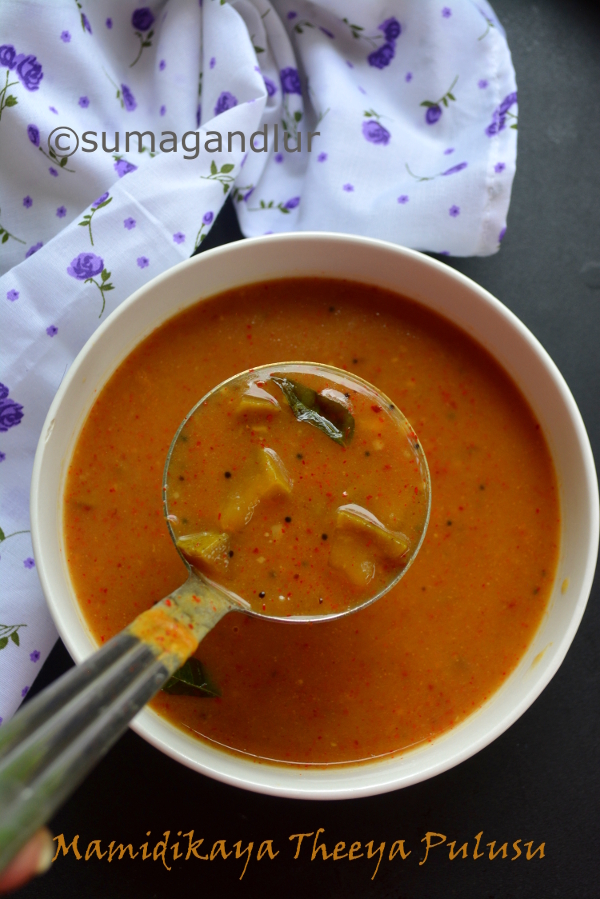
Mudda Pappu & Mamidikaaya Theeya Pulusu


There are plenty of combo dishes in Indian cuisine where two dishes gel well and are always served together. Like today's pair of lentils and gravy that comes straight from my kitchen or any Andhra kitchen for that matter. 

Muddha pappu is basically cooked lentils with just a seasoning of salt. It literally means lentils cooked to a thick consistency. It is also called otti pappu or chappa pappu which means that the dish is plain / bland.  A similar preparation of plain lentils can be found through out the regions in India. However this pappu holds a significant place in Andhra cuisine. Kids in their growing years start their solid food with a little mashed rice, mudda pappu with ghee spooned over. Toddlers and adults have a similar affinity to this dish. My high school going daughter loves this pappu so much that she eats it at least 3 or 4 times per week. Even our extended family members know her love for this and save some plain dal for her during our visits. 


Muddha pappu served with hot steamed rice and ghee with aavakaaya on side is the ultimate combo food for a person form Andhra. The other popular pairings that go with this dal rice are majjiga pulusu (Andhra style kadhi), perugu pachadi (Andhra style spicy raita), charu aka lentil based rasam. This mudda pappu is also served when otti pulusu or theeya pulusu is prepared. Otti pulusu or theeya pulusa is a gravy prepared similar to Andhra style dal called pulusu sans lentils. These dishes are never eaten alone with rice in our homes. Usually rice is mixed with mudda pappu and mixed with a tsp. of ghee and dipped in any of these side dishes and eaten. 


I prepared otti pulusu today and mudda pappu to go along with it as part of our meal today. Usually otti pulusu is made thinner and no lentils are used. A tsp. of ric eflour is added to slightly thicken the gravy. The dish is a balance of flavors - hot, sour and sweetness and need a little practice to be able to come up with a gravy where all  flavors gel well.

Ingredients for mudda pappu:
1 cup lentils / toor dal / arhar dal
2 cups water
1/8 tsp. ground turmeric 
Salt to taste

Method:
* Wash toor dal in two exchanges of water and drain. Pressure cook the dal along with water and turmeric for three whistles. 
* When the valve pressure is gone, mash the cooked dal with the back of a ladle slightly. 
* Add salt to the cooked dal and mix well to combine.
Ingredients: (Yield 3 servings)
1 cup peeled and cubed green mango pieces
1 tsp. oil
1 tsp. mustard seeds
A sprig of curry leaves
2 pinches of asafoetida
1/8 tsp. turmeric powder
2 tsp. chickpea flour / senaga pindi *
1&1/2 cups water
1/2 tsp. chili powder
Salt to taste
2 tbsp. tamarind juice
1 to 2 tbsp sugar / jaggery (I used 3 gm / 3/4 tsp. Splenda)
( * or a paste made with 2 tsp. rice flour and water can be used.)

Method: 
* Soak about a big lemon sized tamarind in water until it softens or nuke the tamarind and water in a microwave for 3 minutes. Squeeze the pulp and extract thick juice.
* Cook the mango pieces with little water in a microwave, without turning them mushy.
* Add chickpea flour / rice flour and a few tbsp. of water to a small cup and make a smooth paste. (Rice flour or chickpea flour is used to thicken the stew here since lentils are not used.)
* Heat 1 tsp. oil in a sauté pan and add mustard seeds. When mustard seeds start to pop, add curry leaves, asafoetida and turmeric. (If mango pieces were not cooked in the microwave before, they can be added along with the water now and cooked until done.)
* Next add the cooked mango pieces along with the water used to cook them, tamarind juice, jaggery, chili powder, salt, chickpea flour (or rice flour paste) and about 1&1/2 cups of water to the pan. 
* Mix everything with a ladle and check the consistency. It thickens while cooking and the final pulusu should be of pourable consistency like sambhar. Add extra water if necessary and bring the mixture to a boil. Taste and adjust the seasonings, if needed. There must be a balance between the dominant flavors of the dish but the dish is slightly sweeter.
* Lower the heat and simmer for a couple of minutes more. 
* Serve with rice, dal and ghee, as part of a Andhra meal.

bmlogo
This goes to Blogging marathon # 89, under the 'Combo dishes' theme. Check out the page here to read what other marathoners are cooking.

Comments

Thursday, August 4, 2016

Tomato Pappu ~ Andhra Style Tomato Dal


 A pressure cooker in an Indian kitchen is as indispensable as any other pot or pan is in other kitchens. No surprise there considering that rice and lentils are cooked on a daily basis in majority of the Indian homes and a pressure cooker cuts down the cooking times drastically. Today's lentil preparation from the south Indian state of Andhra is a classic example of cooking using the said appliance, which can be prepared in about 10 - 15 minutes, with about 2 minutes prep time included. This simple and tasty pappu would make a great side dish for rice / Indian style flat breads. This is how my mother makes all her pappus though I happen to add the tamarind juice at the end since there will be bits of tamarind in the dal, when cooked this way and one needs to pick them out while eating. 

Ingredients:
1 cup toor dal / lentils
2 tomatoes
3 - 4 green chillies (I used 3 spicy, Serrano peppers.)
1/8 tsp. turmeric powder
1 tbsp. sized ball of tamarind
1.5 tsp. salt
2 tsp. oil
1 tsp. mustard seeds
1 tsp. cumin seeds
Few curry leaves
2 -3 pinches of asafoetida powder


Method:
* Wash the toordal in two exchanges of water and drain. 
* Chop tomato into cubes and slice the chillies lengthwise. 
* Add toordal, 2 cups of water, turmeric, green chillies and tomato to a small sized pressure cooker directly or to a container that fits in a pressure cooker. Add tamarind and 2-3 tbsp. of water in a small cup and place it on the over the lentil mixture in the cooker or the container. (The idea is not to mix the lentils and tamarind together while cooking since the tamarind interferes with the cooking of lentils. The lentils may not cook properly.)
* Pressure cook them and when the valve pressure is gone, remove the cooker lid. Add salt and the cooked tamarind to the cooked lentil-tomato mixture and mash lightly to the desired consistency using the back of a ladle.
* Heat oil in a small pan and cumin and mustard seeds. When mustard seeds start to pop, add asafoetida and curry leaves to the pan and turn off the stove. Add this tadka to the above lentil preparation and mix once with a ladle to combine. Some minced cilantro can be added as garnish, if preferred.
* Serve warm with rice / rotis.
This is going to be a part of Blogging marathon #67 under 'Pick one appliance and Cook 3' (My choice being pressure cooker). Check here to find out what other marathoners are cooking today.
 
 Comments

Wednesday, November 11, 2015

Palakoora Podi Koora ~ Sauteed Spinach with Lentils

 
A typical south Indian meal even in it's simplest form and without any prior planing would be a well balanced one if one sticks to the basics. Rice served along with a lentil preparation, a vegetable dish and yogurt. Today's meal is such one - rice served with radish & lentil preparation aka mullangi sambhar and a spinach based side dish along with yogurt. I am sticking with the spinach dish for today's post as part of the blogging marathon. 

Dry sautes based on greens is a traditional and common preparation in the southern states of India. And the version I am posting today is a typical one from Andhra brahmin households and hence the absence of onion or garlic in the recipe. Or for that matter, there is no coconut either since coconut is not used that extensively in Andhra cooking as the rest of it's neighboring states do. This healthy saute is kept on a drier side and the addition of cooked lentils up the nutrition value. I have used spinach but thotakoora / amaranth greens is the most commonly used greens while preparing the dish or a combination of spinach, amaranth greens and methi / fenugreek greens can be used as well. And the word 'podi' in the title doesn't represent any spice powder used in the recipe but is a reference to the 'dry' version of the preparation.

Ingredients: (Yield 3 servings)
2 bunches of spinach / 8 cups of chopped spinach (palakoora)
1 tbsp. oil
1 tsp. mustard seeds
1 tsp. chana dal / split chickpeas
4 dried red chillies, each broken into 3 - 4 bits
1/8 tsp. turmeric powder
Salt to taste
1/4 cup cooked toor dal / lentils 

Method:
* Cook about 2 tbsp. toor dal until done but still holding the shape.
* Wash the spinach leaves and tender stalks thoroughly to get rid off the dirt if any present and spread them on a kitchen towel to air dry. Or pat them dry with a towel and then chop the leaves and stalks fine.
* Heat the oil in a pan and add mustard seeds, chana dal and chillies. When the dal starts to turn reddish, add turmeric powder and the chopped greens. Cook until the raw smell of the greens leave and any water released during the cooking evaporates. 
* Add cooked lentils and salt. Mix well and cook for about a  minute before turning off the stove.
* Serve warm with some hot, steamed rice.  
 
This goes to Blogging marathon #58 under the theme 'Dry Sautees'. Check the link to see what other marathoners are cooking.

Comments